1 hour ago
Flash floods triggered by a glacial collapse have ravaged the Nepal-Tibet border region, with rescues under way for missing residents and Indians. A new barrier lake and shattered roads are worsening risks and complicating relief across the affected districts.

Stock photo used for illustration

Kathmandu,UPDATED: Aug 27, 2026 23:16 IST
The death toll from the Nepal-Tibet flash floods rose to 392 on Thursday as rescue teams continued searches for hundreds of missing people, including 290 Indian nationals, officials said. Of the dead, 389 were in Nepal and three in neighbouring Tibet. Authorities on the two sides of the border said 1,468 people were missing, including 910 in Nepal and 558 in Tibet.
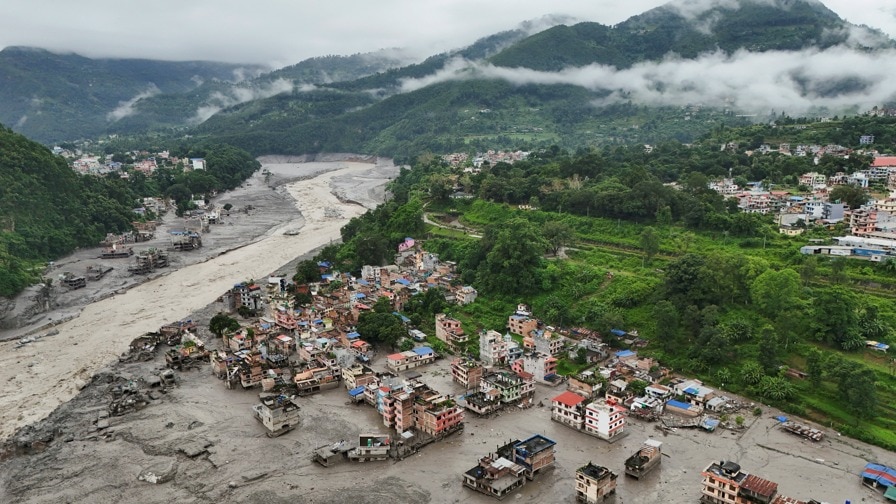
The disaster was triggered by an ice-rock avalanche caused by a glacial collapse near the Nepal-Tibet border on Wednesday, sending water, mud and debris through central Nepal. Towns and villages were devastated, with homes, vehicles, roads and bridges washed away and hydropower infrastructure damaged. The threat of further flooding remained after a new barrier lake formed near the source of the Bhote Koshi river system.
A Nepal Police statement said 796 people, including 50 foreigners, had so far been rescued from affected areas by helicopters, while another 796 had been evacuated by land. It did not specify the nationalities of the foreigners. Nepalese security personnel have evacuated more than 800 people from affected districts, while helicopters, drones and ground teams continue to search isolated settlements, riverbanks and downstream areas clogged by mud and debris.
The Ministry of External Affairs said 290 Indian nationals remained uncontactable and New Delhi was making "urgent efforts" to ascertain their whereabouts and coordinate their rescue. The ministry said 84 Indian nationals had been rescued, including 63 workers employed at the under-construction Trishuli-I hydroelectric project and 21 people from Tamil Nadu. It also said around 200 Indian nationals on the Tibet side had sought assistance for evacuation. External Affairs Minister S Jaishankar said, after a high-level meeting attended virtually by India's envoys in Kathmandu and Beijing, that urgent efforts were under way to ascertain the status and well-being of Indians in the flood-hit areas. He said the ministry was coordinating with the Nepalese side, other ministries, state governments, tour operators and relevant authorities.
India also stepped up relief assistance to Nepal. After sending 10 tonnes of humanitarian assistance and disaster relief material on Wednesday, it sent another 37.5 tonnes of relief material, medicines and food packets on Thursday in a military transport aircraft, taking the total dispatched to 47.5 tonnes.
Chinese authorities said about 2 million cubic metres of water had accumulated in the new barrier lake by Thursday morning, and another 3 million cubic metres could flow into it over the next three days. The lake has formed near the confluence of the Chhochen Khola and Purepu Tsangpo rivers, which originate in Tibet and flow into Nepal as part of the Bhote Koshi river system. Nepal's Department of Hydrology and Meteorology said it had received this information from Chinese authorities and warned of a continuing flood risk in the Bhote Koshi and Trishuli river areas, urging people to stay away from riverbanks and remain in safe places. Travellers, security personnel and search-and-rescue teams were also asked to stay alert. Chinese authorities are monitoring the lake and carrying out flood simulations and risk assessments, while a Chinese rescue team with communications and detection equipment has reached Gyirong to assess the upstream blockage.
Authorities in Nepal said the floods first hit the Rasuwa district after the ice-rock avalanche and debris flow near the Nepal-Tibet border. Water, mud, rocks and debris tore through settlements including Timure and Rasuwagadhi before moving downstream through the Bhote Koshi and Trishuli river system. A preliminary assessment by Nepalese authorities and a revised analysis by the US Geological Survey said the disaster was caused by a glacial collapse and debris flow, not by an earthquake. The USGS said the event that was initially reported as a 4.4-magnitude earthquake was in fact generated by the glacial collapse and debris flow. Nepal's disaster management authority said the debris-laden flood occurred in the Lhende River after an ice-rock landslide near the Nepal-China border, about 20 km northeast of Rasuwagadhi, before entering the Trishuli river after passing through Timure.
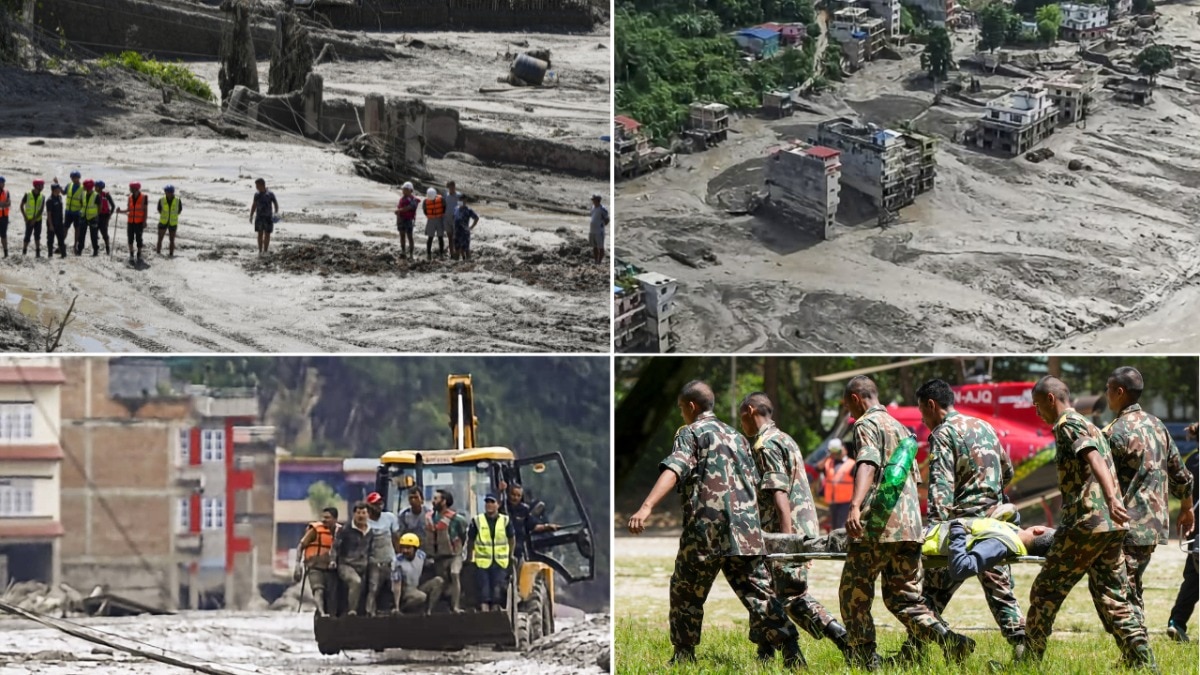
Images and videos from the affected areas showed buildings swept away or left standing amid thick mud and debris, vehicles buried or carried off, roads torn up and bridges washed away. Large stretches of riverbank settlements in Rasuwa and Nuwakot districts were covered in mud, rocks and wreckage. Nepal's Department of Roads said the entire 42-km road section between Betrawati in Nuwakot and Rasuwagadhi was damaged at multiple points, while several concrete bridges were washed away. The Disaster Risk Reduction and Management Authority said 35 motorable bridges, 45 suspension bridges and about 40 km of black-topped roads were damaged, badly affecting movement across the affected districts. The Trishuli and Devighat hydropower projects, along with other power infrastructure, were also damaged. Efforts were under way to reopen the Galchhi-Baireni road in Dhading, which was blocked after the floods in Rasuwa.
The scale of destruction has made rescue work harder, with damaged roads, washed-away bridges, deep deposits of mud and debris, and the continuing risk of more flooding keeping some areas out of reach. Security personnel and local authorities have been searching riverbanks and downstream areas for survivors and recovering bodies carried by the Bhote Koshi and Trishuli rivers. Authorities said they were still assessing the full extent of the damage.
Balendra Shah visited Bidur Municipality in Nuwakot on Thursday to inspect flood-hit areas. In Tibet, Chinese Premier Li Qiang visited Gyirong Township to oversee rescue and relief operations. Chinese state media said the People's Liberation Army's Western Theatre Command had also sent a directing group to coordinate military rescue operations. Nepal Foreign Minister Shisir Khanal spoke by phone on Thursday with senior officials in the US, the UK and several other countries, whose governments expressed solidarity and offered to help Nepal's search and rescue work, his office said.
Nepal Police said 137 bodies had been recovered from Chitwan, the highest number among the affected districts. Bodies have also been recovered from Rasuwa, Nuwakot, Dhading, Gorkha, Tanahun and Nawalparasi districts. Officials said at least 44 Nepali Army personnel, 28 Nepal Police personnel and 13 Armed Police Force personnel were among those still unaccounted for. Around 160 people working at hydropower projects and customs offices have also been reported missing.
The search has also extended to hospitals, where hundreds of relatives have gathered to look for family members and friends missing since Wednesday. At Tribhuvan University Teaching Hospital in Kathmandu, authorities put up lists of people brought there so families could check if relatives had been rescued or were receiving treatment. Photographs of those who died were displayed and desks were set up to record details of missing people. Similar scenes were reported at Bharatpur Hospital in Chitwan, where families searched for relatives as authorities struggled with the rising number of bodies and the mortuary was reportedly running out of space.
Officials also rescued 27 foreign tourists stranded in Rasuwa on Thursday, including 11 Indians, four South Koreans, two Italians and two US citizens. The Nepal Tourism Board said the nationalities of the remaining eight had not been confirmed. They were airlifted to Kathmandu by the Nepal Army. Most of the Indian tourists affected were travelling towards Kailash Mansarovar in Tibet or Gosainkunda in Nepal's Bagmati Province.
With the death toll climbing, more than 1,400 people still missing across Nepal and Tibet, and some areas still cut off, the disaster has become one of Nepal's worst in recent years. Rescue operations continued on Thursday as authorities in both countries dealt with heavy destruction, the danger from the new barrier lake and the urgent effort to trace the missing, including Indian nationals.
With PTI Inputs
- Ends
Published By:
India Today Web Desk
Published On:
Aug 27, 2026 23:16 IST