1 hour ago
Nepal's former environment minister said delayed information-sharing with China worsened the flood crisis after a Tibet glacier collapse. The disaster has exposed cross-border warning gaps as rescuers search for thousands missing, including Indian tourists.
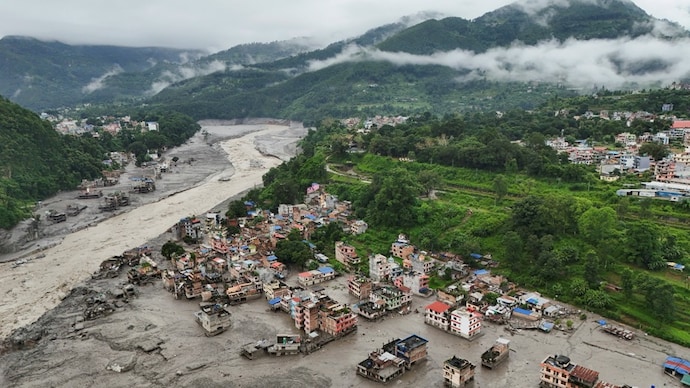
Nepal and Chinese authorities have now agreed to share information more promptly. (Photo: Reuters)

Newdelhi,UPDATED: Aug 27, 2026 21:01 IST
Nepal's former Forest and Environment Minister Madhav Prasad Chaulagain on Thursday said the lack of timely information-sharing between Nepal and China before the devastating floods was "quite concerning", as the disaster has already killed hundreds and left thousands missing, including nearly 300 Indian tourists.
A glacier collapse in Tibet triggered catastrophic flash floods in border areas of China and Nepal on Wednesday morning. Nepal has reported 270 deaths, while the overall toll, including Tibet, is reported to be more than 500. Chaulagain said the number of missing people could still rise sharply as many travellers and pilgrims may not be covered by official records.
Chaulagain said Nepal had faced a similar but smaller glacier-collapse incident in 2025, after which the need for prompt early-warning information-sharing between the two countries had been recognised. "It has become a quite concerning state because it was early in the morning. So we observed that there is some lack of timely information exchange between the two countries," he told PTI over the phone.
He said Nepal and Chinese authorities have now agreed to share information more promptly. "Apparently, yesterday, the Meteorological Department and Chinese authorities realised this, and from now onwards they have agreed to share timely information," he said. "From China side... there is some lack of information sharing," he added, saying the Chinese side had also suffered extensive damage and "probably that side also was not fully prepared". "Otherwise, they might have provided the information, because the border-crossing points and the nearby downstream areas were also badly affected," he said.
On the cause of the disaster, Chaulagain said it was now clear that the floods were not triggered by the earthquake, as reported earlier, but by a river blockage caused by landslide and ice fall, which then burst. "As far as we know, it's not because of the earthquake thing, but it's because of the river blocked by the landslide and ice fall," he said.
He said there was still no clear explanation for what triggered the landslide, though climate change, rising temperatures and glacier melt were among the possible factors. "So far, we have received a generic kind of explanation only, like now we know this climate change things, temperature rising, glacier melting," he said. He added that Nepal needed greater access to information and satellite imagery from the Tibetan side to understand what had happened. "We are hoping that we'll get more clarity in the days to come," he said.
Chaulagain said the affected zone was not only a Nepal-China border crossing but also a route used by pilgrims travelling to Kailash Mansarovar and other religious sites. "There are many people crossing from the Indian border. So they also visit that site," he said, adding that many trekkers and domestic pilgrims travel without formal records. "This gives a picture that the death toll would rise unbelievably," he said.
On coordination with India, he said New Delhi was the first neighbouring country to respond quickly, with the Indian embassy starting coordination and joint search efforts. He said authorities were gathering more information from the ground to establish how many tourists were in the affected areas and trace them. He also said the Nepal government had declared a state of emergency in the affected area and was using all available resources for rescue and recovery.
Chaulagain said Nepal had disaster-management mechanisms and early-warning systems for smaller and medium-scale disasters, including monitoring of high-risk glacial lakes and mobile alerts, but this event was beyond what authorities could have anticipated. "This scale of disaster is beyond anyone's, like, comparison... Nobody was prepared," he said.
He said Nepal was especially vulnerable to climate-linked disasters despite contributing relatively little to global greenhouse gas emissions. "We are mountain countries, and we have not done any wrong against our environment... But we are facing the challenge," he said. "Because of the global warming thing, the mountains are suffering, mountain people are suffering, and this is a very sad story that we have witnessed here," he added.
Chaulagain also said the floods had caused major damage to infrastructure, sweeping away around 40 kilometres of road and nearly 18 bridges. Authorities were working to rebuild links and create emergency routes to reconnect affected communities. He said India had already sent a flight carrying relief material, while China had offered funds for relief work. The World Bank, the US and volunteer groups were also providing support. "We actually need that in the time like this," he said.
- Ends
Published By:
India Today Web Desk
Published On:
Aug 27, 2026 21:01 IST