1 hour ago
The death toll from the devastating Nepal-Tibet flash floods climbed to 392 on Thursday, while 1,468 people remained missing on both sides of the border and a newly formed barrier lake threatened to unleash another surge downstream. India was racing to trace 290 uncontactable nationals as rescue teams battled destroyed roads, washed-away bridges and mountains of mud and debris.
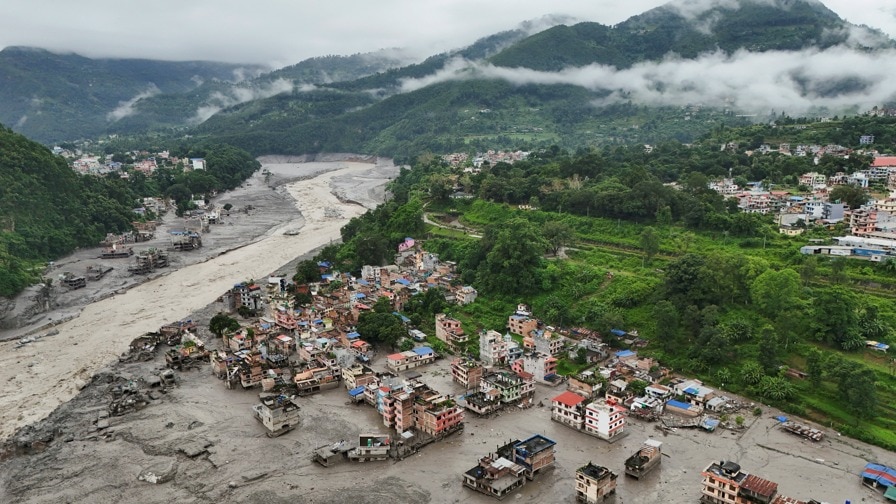
Triggered by an ice-rock avalanche following a glacial collapse near the Nepal-Tibet border, the floods unleashed a torrent of water, mud and debris through central Nepal, tearing through towns and villages and sweeping away homes, vehicles, roads and bridges. Entire settlements in Rasuwa and Nuwakot were left buried under thick layers of mud and wreckage, while hydropower projects were also damaged as the flood surged downstream through the Bhote Koshi river system.
The scale of destruction has left several villages cut off, with washed-away roads and bridges making it difficult for rescue teams to reach people stranded in remote areas. Homes, markets, farms and government buildings have disappeared beneath mud and debris, with survivors describing scenes of devastation and saying entire neighbourhoods were wiped out within minutes.
As rescuers search riverbanks and isolated settlements for survivors and recover bodies carried downstream, the threat is far from over. A newly formed barrier lake near the source of the Bhote Koshi river system has raised fears that a breach could unleash another surge, potentially worsening the disaster and complicating rescue operations already underway.
392 DEAD, 1,468 MISSING AS RESCUE TEAMS RACE AGAINST TIME
Of the 392 people killed in the disaster, 389 died in Nepal and three in neighbouring Tibet.
Nepal Police said 796 people, including 50 foreigners, had been rescued from the affected areas by helicopters, while another 796 had been evacuated by land. The police did not specify the nationalities of the foreigners.
Nepal authorities reported 910 people missing, while officials in Tibet said another 558 people remained unaccounted for, taking the total number of missing people on the two sides of the border to 1,468.
Nepalese security personnel have evacuated more than 800 people from affected districts, while helicopters, drones and ground teams continue to search isolated settlements, riverbanks and downstream areas.
Nepal Police said 137 bodies had been recovered from Chitwan, the highest number among the affected districts. Bodies were also recovered from Rasuwa, Nuwakot, Dhading, Gorkha, Tanahun and Nawalparasi.
At least 44 Nepali Army personnel, 28 Nepal Police personnel and 13 Armed Police Force personnel are among those whose whereabouts remain unknown. Around 160 people working at hydropower projects and customs offices have also been reported missing.
The disaster has severely disrupted the search, with damaged roads, collapsed bridges, deep deposits of mud and debris and the continuing risk of further flooding cutting off several areas.
290 INDIANS UNTRACEABLE, INDIA STEPS UP RESCUE
The catastrophe has triggered a major rescue effort by India, with the Ministry of External Affairs saying 290 Indian nationals in Nepal remain uncontactable.
New Delhi is making "urgent efforts" to ascertain their whereabouts and coordinate their rescue, with the missing Indians including hydropower workers and tourist groups from different states.
External Affairs Minister S Jaishankar, after a high-level meeting attended virtually by India's envoys in Kathmandu and Beijing, said urgent efforts were underway to ascertain the status and well-being of Indians caught in the flood-hit areas.
He said the ministry was coordinating with the Nepalese side, other ministries, state governments, tour operators and relevant authorities.
Prime Minister Narendra Modi also spoke to Nepal Prime Minister Balendra Shah and assured him of India's full humanitarian assistance.
India has so far rescued 84 nationals. This includes 63 workers from the Trishuli-I run-of-river hydroelectric project and 21 people from Tamil Nadu.
Around 200 Indian nationals on the Tibet side have sought assistance for evacuation, with some already moving towards Nepal.
The MEA has also established a 24-hour control room to assist with tracing and evacuation efforts.
27 FOREIGN TOURISTS, INCLUDING 11 INDIANS, RESCUED
Nepalese authorities rescued 27 foreign tourists stranded in Rasuwa on Thursday, including 11 Indians.
The group also included four South Koreans, two Italians and two US citizens. The nationalities of the remaining eight had not been confirmed by the Nepal Tourism Board.
The tourists were airlifted to Kathmandu by the Nepal Army.
Most Indian tourists affected by the disaster were travelling towards Kailash Mansarovar in Tibet or Gosainkunda in Nepal's Bagmati Province.
Delhi-Kathmandu bus services have also been suspended as a precautionary measure because the flash floods have disrupted road transport.
The Delhi Transport Corporation has suspended the August 28 Delhi-Kathmandu journey and the return journey from Kathmandu to Delhi on August 28. The August 29 Delhi-Kathmandu Nepal bus service has also been suspended for now.
63 INDIAN WORKERS RESCUED FROM TRISHULI-I
Sixty-three Indian nationals working at the Trishuli-I power project site have been rescued following the flash floods.
The Nepal Army also rescued around 350 workers and staff trapped inside a tunnel at the Trishuli hydropower project. Several Indian workers were among those working at the project.
47.5 TONNES OF RELIEF SENT TO NEPAL
India has stepped up humanitarian assistance to Nepal as rescue operations continue.
After sending 10 tonnes of Humanitarian Assistance and Disaster Relief material on Wednesday, India dispatched another 37.5 tonnes on Thursday in a military transport aircraft, taking the total sent to 47.5 tonnes.
The supplies include temporary shelters, blankets, hygiene kits, solar lamps, medicines and food packets.
India has said it stands "shoulder-to-shoulder" with Nepal as the neighbouring country deals with the scale of the disaster.
NEW BARRIER LAKE RAISES FEAR OF ANOTHER FLOOD
Even as rescue teams search for survivors, authorities are facing a fresh threat from a newly formed barrier lake near the source of the Bhote Koshi river system.
Chinese authorities estimated that around 2 million cubic metres of water had accumulated in the lake by Thursday morning. Another 3 million cubic metres could potentially flow into it over the next three days, raising fears that the natural barrier could breach.
The lake has formed near the confluence of the Chhochen Khola and Purepu Tsangpo rivers, which originate in Tibet and flow into Nepal as part of the Bhote Koshi river system.
Nepal's Department of Hydrology and Meteorology said it had received information from Chinese authorities about the lake and warned of a continuing risk of flooding in the Bhote Koshi and Trishuli river areas.
It urged people to stay away from riverbanks and remain in safe places. Travellers, security personnel and search-and-rescue teams were also advised to remain alert.
Chinese authorities are monitoring the lake and conducting flood simulations and risk assessments. A Chinese rescue team carrying communications and detection equipment has reached Gyirong to assess the upstream blockage.
Officials fear a breach could trigger a secondary disaster and further complicate rescue operations.
GLACIAL COLLAPSE, NOT EARTHQUAKE, TRIGGERED DISASTER
The flash floods began after an ice-rock avalanche triggered by a glacial collapse near the Nepal-Tibet border sent a torrent of water, mud and debris downstream through central Nepal.
The preliminary assessment by Nepalese authorities, backed by a revised analysis by the US Geological Survey, identified a glacial collapse and debris flow rather than an earthquake as the trigger.
The ice-rock avalanche struck the Lhende River and temporarily blocked its flow. When the natural barrier gave way, a massive surge was unleashed downstream into the Bhote Koshi and Trishuli river system.
Nepal's disaster management authority said a debris-laden flood occurred in the Lhende River following an ice-rock landslide near the Nepal-China border, about 20 km northeast of Rasuwagadhi border city. The flood subsequently entered the Trishuli river after passing through Timure.
The US Geological Survey said its analysis of long-period seismic waves showed that the event initially reported as a 4.4-magnitude earthquake was generated by a glacial collapse and debris flow, rather than an earthquake.
A separate 3.2-magnitude earthquake also jolted parts of Nepal on Thursday.
ROADS, BRIDGES AND POWER PROJECTS RIPPED APART
The destruction has spread across critical infrastructure in several districts.
Nepal's Department of Roads said the entire 42-km road section between Betrawati in Nuwakot and Rasuwagadhi was damaged at multiple points, while several concrete bridges were washed away.
The Disaster Risk Reduction and Management Authority said the floods damaged 35 motorable bridges, 45 suspension bridges and around 40 km of black-topped roads.
Hydropower infrastructure has also suffered major damage. The Trishuli and Devighat hydropower projects, along with other power infrastructure, were affected.
Efforts are underway to reopen the Galchhi-Baireni road in Dhading, which was blocked after the floods in Rasuwa. The route is a key link between Kathmandu and other parts of Nepal and an important transit corridor for heavy and light traffic.
The first devastation was reported in Rasuwa district, about 160 km from Kathmandu, after the ice-rock avalanche and debris flow near the Nepal-Tibet border.
A torrent of water, mud, rocks and debris tore through settlements including Timure and Rasuwagadhi before surging downstream through the Bhote Koshi and Trishuli river system.
FAMILIES SEARCH HOSPITALS FOR LOVED ONES
Across flood-hit Nepal, families are moving between hospitals and rescue centres, searching for relatives who disappeared after Wednesday's disaster.
At Tribhuvan University Teaching Hospital in Kathmandu, authorities posted lists of people brought to the facility so families could check whether relatives had been rescued or were receiving treatment.
Photographs of those who died were also displayed, while desks were set up to record details of people whose whereabouts remained unknown.
Similar scenes unfolded at Bharatpur Hospital in Chitwan, where families searched for relatives as authorities struggled with the growing number of bodies. The mortuary was reportedly running out of space.
Giri Lal, 38, is among the survivors facing the devastating loss of his family. The floods swept away his wife, two sons and two daughters in Timure. Lal survived and is undergoing treatment at a state-run hospital in Kathmandu.
At Bharatpur Hospital, Lipa Sapkota was searching for her brother, Sabi, who has been missing since Wednesday morning while returning to Nepal from Tibet.
"We have been showing their pictures to people and asking if anyone has seen them," Sapkota said.
"There were some dead bodies, but they were not easy to identify because of their condition," she told the Setopati.com news portal.
In Trishuli, anxious families gathered at Sainik Maidan to provide information about missing relatives.
"My father is there. He worked at a hydropower project in the affected area. He is missing. He was on duty that morning, and we have not been able to contact him since," a local resident told PTI Videos.
One survivor from Rasuwa described the devastation simply: "Nothing is left there. I have lost everything."
The survivor said both his father and mother were missing.
An elderly woman from Trishuli described the disaster as unprecedented.
"I have never witnessed such a tragedy before. We were terrified and fled to higher ground after leaving our homes. We had never seen a flash flood of this magnitude before," she told PTI Videos.
Another resident said homes, government offices, markets and farms had been swept away.
"The area that was swept away by the flash floods was full of homes. We still have no information about the death toll or loss of life. There were government offices, markets, residences and farms. It is all gone, all of it," the resident said.
One eyewitness said he first realised something was seriously wrong while eating breakfast.
"I was at home this morning. While I was eating breakfast at around 8:40 am, news came that a flood had hit Timure. I heard people saying, 'Timure is completely gone, nothing is left,'" he told the Nepal News web portal.
"It felt like an earthquake was happening. It was impossible to figure out what was taking place. Right before our eyes, the market and the settlement were devastated," he said.
SEARCH OPERATIONS CONTINUE AMID DESTRUCTION
The search for the missing has stretched across riverbanks, downstream settlements, hospitals and hydropower sites.
"Fifteen employees from our Customs Department are missing. There is nothing we can do from Kathmandu, so we have come here with our colleagues to file missing persons' reports," Shivraj Bohra, a branch officer with the Department of Customs, told PTI Videos.
Police are collecting phone numbers, location details and other information supplied by families to trace those unaccounted for.
"For people whose location cannot be traced, we collect the phone numbers, location details and other information provided to us and use it to search for them. Helicopters are also being used in the search," police officer AK Chhetri told PTI Videos.
Chhetri said around 200 missing cases had been resolved by noon, including people who were found alive and those who were found dead.
The Nepal Army and other security agencies continue search-and-rescue operations in Rasuwa, Dhading, Nuwakot and Chitwan.
Nepal Prime Minister Balendra Shah visited Bidur Municipality in Nuwakot on Thursday to inspect areas affected by the flash floods.
Chinese Premier Li Qiang visited flood-hit Gyirong Township on Thursday to oversee rescue and relief operations. Chinese state media reported that the People's Liberation Army's Western Theatre Command had also sent a directing group to the affected area to coordinate military rescue operations.
Nepal Foreign Minister Shisir Khanal also held telephone conversations with top officials in the US, UK and several other countries. They expressed solidarity with Nepal and committed to helping the government with search-and-rescue operations.
The full extent of the destruction is still being assessed, but the scale of the disaster is already clear: entire settlements have disappeared, critical transport links have been severed, hydropower infrastructure has been damaged and hundreds of families are still waiting for news of loved ones.
- Ends
Published By:
Sonali Verma
Published On:
Aug 28, 2026 00:01 IST