1 hour ago
The narrow waterway, which carries roughly 20% of the world's crude oil and liquefied natural gas (LNG), has become a major indicator of whether stability is returning to the Gulf after weeks of conflict. Although vessels have started moving through the strait again, data suggests confidence has yet to fully recover.
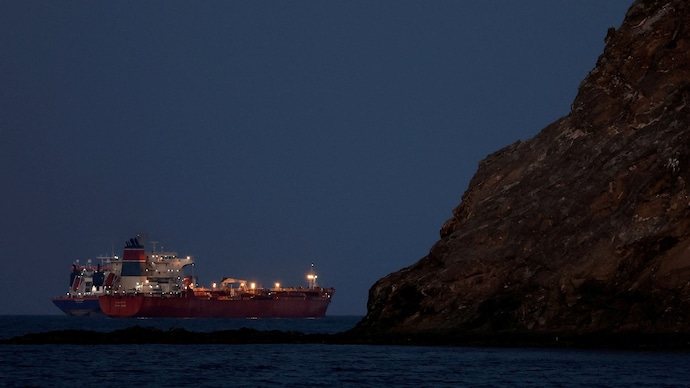
A tanker sits anchored as the traffic is down in the Strait of Hormuz. (File Photo: Reuters)
Commercial shipping is gradually returning to the Strait of Hormuz following the US-Iran ceasefire, but one of the world's busiest energy corridors is still operating well below normal levels as security concerns continue to keep many shipping companies on edge.
The narrow waterway, which carries roughly 20% of the world's crude oil and liquefied natural gas (LNG), has become a major indicator of whether stability is returning to the Gulf after weeks of conflict. Although vessels have started moving through the strait again, data suggests confidence has yet to fully recover.
According to MarineTraffic vessel-tracking data, only 34 commercial ships transited the Strait of Hormuz on Wednesday. While that marks an improvement from the disruption seen during the conflict, it remains far below the pre-war average of around 100 ships a day.
The slow rebound shows, despite the guns falling silent, the world's most important oil chokepoint has not yet returned to business as usual.
TRAFFIC IS RISING, BUT CAUTION REMAINS
The Strait of Hormuz links the Persian Gulf to the Gulf of Oman and the Arabian Sea, making it the primary export route for oil producers across the Middle East. Even a brief disruption to shipping through the corridor can send ripples across global energy markets.
Commercial traffic almost ground to a halt during the US-Iran conflict as security risks mounted. Several shipping companies diverted vessels to alternative routes, while others temporarily suspended operations altogether.
The reopening of the waterway became one of the most significant commitments under the US-Iran Memorandum of Understanding (MoU) signed on June 17. The agreement called for commercial navigation through the strait to resume immediately as part of broader efforts to reduce tensions.
The MoU states that commercial traffic through the Strait of Hormuz would "immediately start," making vessel movement one of the clearest measures of whether the ceasefire is holding.
Even so, industry experts say shipping companies, insurers and energy traders remain cautious about restoring normal operations.
WHY SHIPS ARE STILL HESITANT
Security remains the biggest obstacle to a full recovery.
According to a CNN report, the Joint Maritime Information Center has warned that the Strait of Hormuz continues to pose serious maritime risks. Several areas are still believed to contain naval mines, while mine-clearing operations remain underway. As a result, commercial vessels have been advised to navigate the route with additional caution.
The geography of the strait also adds to the challenge.
At its narrowest point, the waterway is only about 24 miles wide. Iran lies on one side and Oman on the other, leaving ships with little room to manoeuvre. Because of these constraints, any military escalation in the region tends to affect the Strait of Hormuz almost immediately.
Industry analysts say a sustained increase in daily vessel movements will be closely watched as a sign that operators believe the security environment has improved enough to resume normal schedules.
Iran has also ramped up crude exports following the easing of sanctions. Under the June 17 agreement, the United States is expected to completely lift the naval blockade on Iranian ports by July 19.
Tehran has pledged to help restore shipping through the Strait of Hormuz to pre-conflict levels during that period. Since sanctions were eased, Iran has exported about 50 million barrels of crude oil, although several neighbouring Gulf producers are still struggling to return exports to normal.
FRESH WARNING FROM IRAN
Despite the gradual recovery in maritime traffic, tensions around the strategic waterway remain high.
Iran's Khatam al-Anbiya joint military command has warned that all oil tankers transiting the Strait of Hormuz must follow routes approved by Iranian authorities or risk military action.
According to a statement carried by Iranian state television, "Any failure to comply, deviation from the designated route, or disregard for the navigation protocols of the Islamic Republic of Iran in the Strait of Hormuz will be met with an immediate and forceful response from the armed forces, endangering the security of the violating vessels."
The military command also criticised the continued presence of US aircraft over the waterway, saying it "causes insecurity in this waterway and threatens regional security."
It further warned that "Any attempt by the United States to interfere in security matters or any disruptive action in the Strait of Hormuz will be considered a threat to Iran's national sovereignty and will be met with a rapid and decisive reaction."
The warning came a day after US and Iranian diplomats held indirect 'technical' talks in Qatar, where the future of the Strait of Hormuz remained one of the central issues in negotiations.
The statement also followed remarks by the US military's Central Command after a meeting with Middle Eastern officials in Bahrain, where participants reaffirmed their commitment to maintaining the free flow of commerce through the Strait of Hormuz.
Even though commercial shipping has resumed, several unresolved questions continue to hang over the waterway.
One of the biggest concerns is who will ultimately control shipping arrangements in the Strait of Hormuz. While the current agreement suspends transit fees for 60 days, Iran has indicated it could introduce tariffs on vessels using the route once that period expires.
- Ends
With inputs from agencies
Published By:
Satyam Singh
Published On:
Jul 2, 2026 18:22 IST