2 hours ago
The UN's cultural arm, Unesco, has warned Pakistan over its "conservation work" in the Vedic-era archeological complex of Taxila. Unesco said that Pakistan's use of cement in the "conservation" of the ancient sites is a violation of restoration norms and could result in the site being delisted from its list of World Heritage Sites.
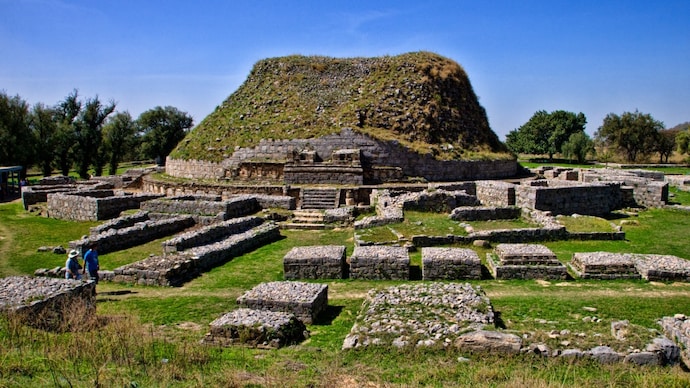
The Dharmarajika Stupa or the Great Stupa of Taxila, was built over the relics of the Buddha by Ashoka, the Emperor of Magadha, in the 3rd century BCE. (Image: Sasha Isachenko/Wiki)
The intervention of Pakistan in the ancient archaeological complex of Taxila has come under scrutiny after Unesco, the cultural arm of the United Nations, warned Islamabad over "conservation work" at the Vedic-era site, which is one of South Asia's most significant mahavihara complexes.
Pakistan's Department of Archaeology and Museums used cement and modern masonry in the name of conservation work, which violated Unesco's internationally accepted principles for preserving archaeological monuments.
According to Pakistan-based newspaper Dawn, Unesco has warned Islamabad that recent interventions at parts of the World Heritage Site have compromised its authenticity and integrity, and unless corrective measures are taken, Taxila could be placed on the organisation's List of World Heritage in Danger.
Today known as Taxila, the ancient city of Takshashila has been extensively promoted by Pakistan through tourism campaigns, museum projects and heritage initiatives, amid Islamabad's bid to appropriate the Indus Valley Civilisation and its pre-Islamic history.
Taxila was once home to one of the Indian subcontinent's earliest centres of learning and housed a Buddhist mahavihara. The site also preserves archaeological remains from the Achaemenid, Mauryan, Indo-Greek and Kushan periods, reflecting its rich Vedic, Buddhist and Greco-Buddhist heritage.
WHY IS UNESCO OBJECTING TO PAKISTAN'S RECONSTRUCTION IN TAXILA?
The controversy revolves around restoration work carried out at Sirkap and Mohra Moradu, two important monuments within the Taxila archaeological complex. Citing officials in Pakistan's Ministry of Heritage and Culture, Dawn reported that Unesco raised serious objections during a recent meeting with senior government officials.
According to Dawn, the UN agency described the works as "unnecessary interventions" that undermine the site's historical authenticity and warned that it would not hesitate to take strict action if the changes were not reversed.
The newspaper further reported that Unesco reminded Pakistani officials that it had previously removed a World Heritage Site in Germany from the prestigious list, signalling that Taxila could face similar consequences if conservation norms continued to be violated.
The issue first came to Unesco's attention in March after a visitor reportedly shared photographs and details of the restoration work with Pakistan's Permanent Delegate to Unesco in Paris.
According to news agency PTI, the visitor alleged that the original archaeological walls had been replaced with new masonry or had their height increased during conservation work. Unesco noted that these interventions could compromise the authenticity and integrity of the World Heritage Site.
Dawn also reported that it had reviewed the photographs of the archaeological sites in question. The newspaper said that there was fresh masonry replacing sections of ancient walls. The report also claimed that while the original stonework consisted of irregularly shaped ancient stones, the newer additions were made using polished, uniformly sized modern materials.
Government officials quoted by the Karachi-based newspaper argued that using cement and modern masonry in the name of conservation violated Unesco's internationally accepted principles for preserving archaeological monuments.
WHY IS UNESCO'S TAG FOR TAXILA IMPORTANT FOR PAKISTAN?
Following the complaints regarding reconstruction in Taxila, Unesco conducted a joint technical visit to the Taxila Museum and surrounding archaeological sites on June 12 along with Pakistan's Department of Archaeology and Museums (DOAM) and the Ministry of Heritage and Culture.
During the inspection, the Punjab archaeology department of Pakistan made a presentation defending its conservation work.
The controversy carries wider implications for Pakistan's ambitions, in which it's using its pre-Islamic heritage to bluff the world on the Indus Waters Treaty.
Officials cited by Dawn warned that the dispute could weaken Islamabad's efforts to secure Unesco recognition for 24 additional heritage sites, an exercise that has been underway since 1997.
Pakistan is currently seeking World Heritage status for sites such as the Buddhist site of Rani Ghat (in Khyber Pakhtunwa's Buner) and the Scytho-Parthian and Buddhist site, Bhanbhore (in Sindh's Thatta), and the Taxila dispute could negatively affect those proposals during deliberations of the Unesco World Heritage Committee.
'TAXILA RECONSTRUCTION CLAIMS NOT TRUE,' SAYS PAK PUNJAB ARCHEOLOGY DEPT DG
Pakistan's Punjab archaeology department, however, has strongly rejected the criticism.
Its Director General, Malik Zaheer Abbas, told Dawn that the claims regarding the ongoing work as "reconstruction" were inaccurate. Abbas maintained that the interventions were conservation measures aimed at stabilising vulnerable archaeological remains, preventing further deterioration and preserving the site's authenticity in line with internationally accepted conservation principles.
Abbas added that there was "no question" of reversing reconstruction because the work involved conservation rather than rebuilding.
Taxila occupies a unique place in the history of the Indian subcontinent. Located about 35 kilometres northwest of Islamabad in Pakistan's Punjab province, the ancient city formed part of the historic kingdom of Gandhara, which is mentioned in the Indian epics Ramayana, Mahabharata and several other Sanskrit texts.
Flourishing between the 6th century BCE and the 5th century CE, Taxila remained one of the world's earliest centres of higher learning and is traditionally associated with scholars such as Chanakya (Kautilya) and physician Charaka. Taxila came under the Mauryan Empire after its founder Chandragupta Maurya conquered the Punjab region around 316 BCE.
The archaeological complex at Taxila contains the material remains of the Achaemenid, Mauryan, Indo-Greek, Kushan and Gupta empires and kingdoms, making it one of the most important cultural landscapes in South Asia.
Recognising its outstanding universal value, Unesco inscribed Taxila on the World Heritage List in 1980. The current dispute, therefore, is not merely about restoration techniques but concerns the preservation of a site that represents a shared civilisational legacy of the Indian subcontinent stretching back to the Vedic age.
- Ends
Published By:
Avinash Kateel
Published On:
Jul 2, 2026 20:06 IST