2 hours ago
Just two days into the Iran war, the US faced a massive setback when six soldiers were killed in a drone strike at their base in Kuwait. The US said an Iranian drone slipped through. Now, the surviving members said the base was an easy target.
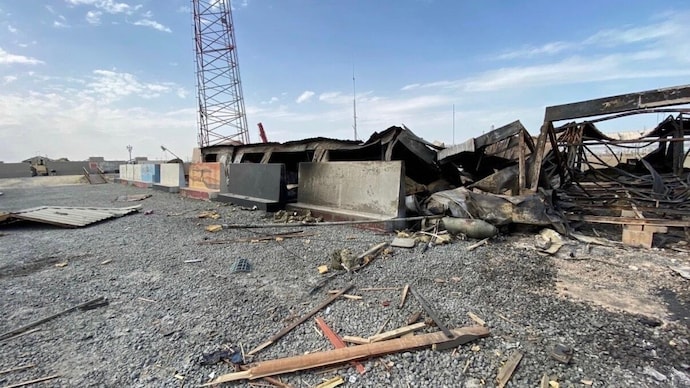
The photo shows damage from the Iranian drone attack that killed six US soldiers in Kuwait (CBS News)

New Delhi,UPDATED: Apr 11, 2026 11:25 IST
Just two days after the US and Israel launched strikes on Iran, America faced a massive setback when six soldiers were killed in a drone attack at their base in Kuwait. It was a direct hit - the deadliest attack on US forces since 2021. And the 60-odd troops were left dangerously exposed. A month on, survivors of the attack contradicted the official version of events narrated by US Defence Secretary Pete Hegseth. In reality, they were defenceless and unprepared, the survivors told CBS News.
Since the Iranian attack on the Shuaiba port in Kuwait, which also left 20 others injured, much of what transpired has remained shrouded in secrecy. Days later, Hegseth said a "squirter" drone slipped through the defences of the "fortified base" in Kuwait, causing widespread damage. However, the Army survivors called it an old military base that offered no protection from aerial attacks.
"Painting a picture that 'one squeaked through' is a falsehood. The unit was unprepared to provide any defence for itself. It was not a fortified position," one of the injured soldiers told CBS News.
Despite being sitting ducks, the troops swiftly responded to the crisis, preventing more casualties. "Those soldiers put themselves in harm's way... I am immensely proud of them," he said.
'KUWAIT BASE WAS A KNOWN TARGET'
What happened on that fateful day? How did the situation unfold? Stay with us as we delve into the story of the '60 bahadur'.
The soldiers were part of the 103rd Sustainment Command. A week before the US attacked Iran, the Trump administration relocated most soldiers stationed in Kuwait to bases in Jordan and Saudi Arabia. These bases were farther from the Iranian missile range.
In fact, the soldiers were told they would come back within 30 days. They were asked to leave most of their personal belongings behind. It suggests the confidence the US had in decimating Iran within 3-4 weeks. However, Iran proved to be more resilient. The war dragged on for 40 days before the US and Iran reached a two-week ceasefire deal.
While most troops were relocated to bases away from Iran, around 60 personnel from the 103rd sustainment command were sent to Port of Shuaiba, a smaller military outpost south of Kuwait.
Their job was to manage the operational and informational flow of munitions, equipment and personnel across the Middle East.
"We moved closer to Iran, to an unsafe area that was a known target... I don't think there was a good reason ever articulated," another soldier told CBS News.
The tactical operations centre was constructed before the era of drone warfare. The base had basic defences - steel-reinforced concrete barriers designed to stop rockets or mortars - but offered no protection from attacks from above.
"It's just kind of a classic, older military base... From a bunker standpoint, that's about as weak as one gets," one soldier recalled. "Some small barriers... a bunch of little tin buildings to set up makeshift offices," he further said.
One soldier said the US had intel that the base was on Iran's list of potential targets.
'LIKE WHAT YOU SEE IN THE MOVIES'
Indeed, it was. On March 2, sirens blared as incoming missiles were detected. The crew took over in a cement bunker. A ballistic missile flew overhead. Minutes later, an all-clear alert sounded. The soldiers heaved a sigh of relief and returned to their offices.
However, 30 minutes later, the ground beneath them shook. There was dust everywhere. "It's something like what you see in the movies. Your ears are ringing. Everything's fuzzy. Your vision is blurry. You're dizzy," one soldier said.
It was one of Iran's Shahed drones that detonated directly at the centre of the US base. The aftermath was chaotic, with one soldier describing seeing blood everywhere.
"Head wounds, heavy bleeding, lots of perforated eardrums... folks are bleeding from their abdomen, bleeding from arms, bleeding from legs," he said.
The drone strike left six US personnel dead. Visuals showed dark smoke billowing into the sky hours after the incident. The walls of the base were blackened, blown outwards by the blast's impact. Some parts were peeling away from the building.
"I would put it in the none category," a soldier said, describing the degree of fortification of the base.
- Ends
Published By:
Abhishek De
Published On:
Apr 11, 2026 11:25 IST
Tune In