1 month ago
Tehran on Wednesday marked the anniversary of the 1979 Iranian Revolution that ushered in the Ayatollah regime. However, the celebrations this year came amid the shadow of an armed conflict with the US. That fear is making Iran use dirt to fortify its nuclear facilities in Isfahan.
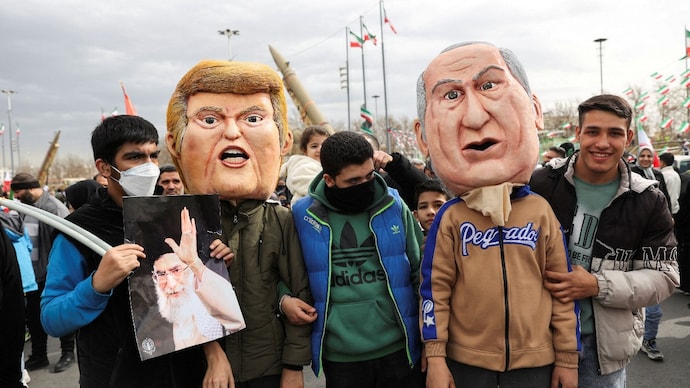
People in masks of US President Donald Trump and Israeli PM Benjamin Netanyahu in Tehran during the 47th anniversary celebrations of the Islamic Revolution. (Image: Reuters))
Iran on Wednesday marked the 47th anniversary of the 1979 Islamic Revolution that brought the regime of the Ayatollahs to power. There were state-backed celebrations, parades and defiant rhetoric. At the same time, Tehran was making new defensive preparations, using soil and dirt, in anticipation of a major US strike, reported The Jerusalem Post, citing satellite images.
News agency Associated Press reported thousands of supporters of the Islamic Republic taking to the streets armed with pictures of Supreme Leader Ayatollah Ali Khamenei and chanting anti-US and anti-Israeli slogans.
These celebrations, however, are occurring under the shadow of heightened regional tensions. The Jerusalem Post reported Iranian forces fortifying the Isfahan Nuclear Complex by piling dirt on the facility's entrances to dampen the impact of explosive attacks.
At the same time, AP reported US President Donald Trump suggesting that another US Navy aircraft carrier group could be deployed to the Middle East in addition to the USS Abraham Lincoln group already in the area.
HOW IRAN IS FORTIFYING NUCLEAR FACILITIES AGAINST POTENTIAL US STRIKE
Even as Iran celebrated its revolutionary legacy, analysts reviewing recent satellite imagery say the country appears to be reinforcing key nuclear infrastructure in anticipation of potential strikes.
According to The Jerusalem Post, high-resolution images of the Isfahan nuclear complex show tunnel entrances being covered with soil and defensive engineering work around the facility. The Institute of Science and Security told the Post that backfilling tunnel entrances could help dampen the impact of airstrikes and complicate ground operations aimed at seizing or destroying Iran's stocks of highly enriched uranium.
Jonathan Hackett, a former US Marine Corps intelligence specialist, told The Jerusalem Post, "The late January and early February 2026 activity around the Isfahan nuclear complex is likely part of a larger push to create defensive layers to the Islamic Republic’s nuclear and ballistic missile facilities in anticipation of a possible US strike,"
He added that this coincided with new deployments by Iran’s Islamic Revolutionary Guard Corps (IRGC) to secure ballistic missile facilities across the country.
Hackett added that the deployments align with Iran’s long-standing "Mosaic Doctrine," a defence strategy designed to disperse and harden military assets so they can survive initial strikes and retaliate against regional targets if attacked.
Lynette Nusbacher, a former British Army intelligence officer, told The Jerusalem Post that the visible construction work might also be a strategic message during ongoing negotiations. "Iran is protecting these facilities in ways that are observable from satellites," she said, noting that such preparations could be reversed more easily than rebuilding destroyed infrastructure after a major bombing campaign.
Security analyst Efrat Sopher, speaking to The Jerusalem Post, suggested these actions indicated Tehran expecting possible "kinetic engagement," though she questioned whether the current fortification work would offer sufficient protection against aerial bombing.
HOW TEHRAN CELEBRATED ANNIVERSARY OF 1979 IRAN REVOLUTION
Even as defensive preparations against a US strike continue in full swing, Iran celebrated the 47th anniversary of the 1979 Islamic Revolution that brought the Ayatollah regime to power.
AP reported that the commemoration represented a split-screen view of life in Iran, with state television showing hundreds of thousands of people across the country attending pro-government rallies, which included the burning of American flags and cries of "Death to America!"
AP also reported that the night before, as government-sponsored fireworks lit the dark sky, witnesses heard shouts from people’s homes in the Iranian capital, Tehran, calling for "Death to the dictator!"
Meanwhile, President Masoud Pezeshkian took the stage at Azadi Square in Tehran and insisted that Iran is willing to negotiate over its nuclear program as fledgling nuclear talks with America hang in the balance.
In his speech at the anniversary ceremony, AP reported Pezeshkian as insisting that his nation was "not seeking nuclear weapons. ... and are ready for any kind of verification." However, the United Nations’ nuclear watchdog — the Atomic Energy Agency — has been unable for months to inspect and verify Iran’s nuclear stockpile.
"The high wall of mistrust that the United States and Europe have created through their past statements and actions does not allow these talks to reach a conclusion," Pezeshkian said. Yet moments later, he added: "At the same time, we are engaging with full determination in dialogue aimed at peace and stability in the region alongside our neighbouring countries."
IRAN SENDS OFFICIAL FOR US TALKS TO QATAR
As the commemoration took place, AP reported that the senior Iranian security official, Ali Larijani left Oman for Qatar, a country that hosts a major US military installation and has served as a key mediator in past negotiations between Tehran and Washington DC. Its state-run Qatar News Agency reported that ruling emir Sheikh Tamim bin Hamad Al Thani spoke with US President Donald Trump about "the current situation in the region and international efforts aimed at de-escalation and strengthening regional security and peace." This comes as Iran's top diplomat, Foreign Minister Abbas Araqchi said on Friday that nuclear talks with the US mediated by Oman were off to a "good start" and set to continue.
However, while speaking to the state-run Russian state media RT, Araghchi also stated that Tehran still does "not have full trust for the Americans." He added, "Last time we negotiated, last June, we were in the middle of negotiation then they decided to attack us and that was a very very bad experience for us," while also saying it could be possible "to come to a better deal than Obama."
Meanwhile, AP reported that in addition to the USS Abraham Lincoln carrier strike group already deployed to the region, Trump had suggested deploying another such strike group. Trump told the US news outlet Axios that, "We have an armada that is heading there, and another one might be going."
Taken together, the parallel scenes of mass rallies, diplomatic manoeuvres and visible military preparations show that the region is caught between negotiation and confrontation. Even as Tehran celebrates its revolutionary legacy, the Islamic Republic is simultaneously preparing for future conflict while trying to come to a mutually agreeable solution via talks with US officials in Qatar.
- Ends
Published By:
Shounak Sanyal
Published On:
Feb 11, 2026
Tune In