 4 hours ago
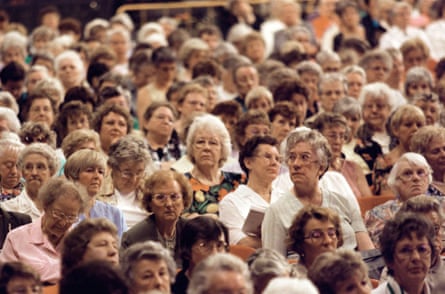
Tony Blair’s key advisers agonised over the writing of his notoriously ill-judged speech to the Women’s Institute (WI) which saw the then prime minister heckled and slow hand-clapped before 10,000 members at Wembley Arena, newly released documents reveal.
Despite the WI explicitly warning they were “wary of anything that smacked of capital P politics”, Blair’s aides were critical of his first draft and bombarded him with additions to inject more policy.
Fresh from paternity leave after the birth of his son Leo, Blair believed the annual WI conference in 2000 allowed for a more personal and reflective speech and an opportunity to blend tradition and modernity to appeal to middle England.
But his communications chief, Alastair Campbell, wrote of the first draft: “There is not much sense of a recharged, refocused Blair firing on all fronts, and in parts, a danger of coming over as rather Majoresque.”
Particular lines that irked Campbell included Blair saying he applauded the Tate Modern “even though I don’t always understand it” and describing any suggestion of doing away with the old-fashioned “pomp and pageantry of the queen’s speech in parliament” as an “unnecessary act of destruction of an ancient and loved ceremony”.
Campbell wrote: “The queen’s speech/Tate Modern stuff comes across as rather desperate and you sound in parts like a commentator rather than a political leader.” There was a “risk of it seeming patronising”, he added, urging Blair to address topics such as drugs, Sure Start, university access and small business startups. The speech was “too complacent and too comfortable” and a “seeming effort to distance yourself from what is you”.
The strategy and polling adviser Philip Gould felt it “leaves the wrong taste’”, tried to be “conversational but instead feels condescending” and lacked “energy, verve, dynamism and change”, according to files released to the Archives at Kew, west London.
Blair’s special adviser Peter Hyman thought it “hands the Tories a huge propaganda victory”. “Arguably it might suit the audience, but I do not think it satisfies the political moment that we must seize”, he wrote, adding that it could be interpreted as a “‘back to basics’ speech (Blair becomes Major)”.
“I do not think the ‘old-fashioned values’ message will ‘settle down” Middle England or anyone else,” Hyman wrote.
In another memo Hyman said it could be interpreted as: “TB sheds cool image for appeal to fuddy duddy Britain (Don’t understand the Tate, love royal ceremonies.) Looks like we want the Telegraph vote not just the meritocratic Murdoch vote.”

The political adviser Sally Morgan was “deeply uncomfortable with the concept of ‘old-fashioned values’” which she believed would be “very alien to most of our under-40 voters (if not older as well). We may be speaking to Middle England, but they are not all late middle-aged or elderly”. She advised Blair not to say “‘women tied to the kitchen’ as many of your audience stay at home”.
As re-drafts were circulated, Anji Hunter, Blair’s special assistant, lamented the eventual excision of royal matters, pointing out that the queen was “an exemplar of WI values and indeed ours – of community, responsibility”.
A week before Blair was due to give his address, Julian Braithwaite from the No 10 press office had met the WI leadership to see what they were expecting. “They were wary of anything that smacked of capital P politics, and are clearly sensitive to being patronised,” he reported back.
The result, after several rewrites, was met with heckles, jeers and slow-hand clapping by its unappreciative WI audience, with many comparing it to a party political broadcast, and the media dubbing the eventual speech as “an extraordinary error of political judgment”.
Looking back years later for a BBC documentary, Blair recalled: “I gave them a lecture, they gave me a raspberry.”