2 hours ago
The IRGC's true power lies beyond the battlefield; it operates as a business juggernaut, running a parallel economic network spanning foreign contracts, illicit trade, and shadow finance, using this vast financial web to sustain the Axis of Resistance and entrench its influence across Iran's economy and regional order.
Since its inception in 1979, following what the world knows as the Islamic Revolution in Iran, the Islamic Revolutionary Guard Corps has emerged as a powerful military force. Today, as global attention remains fixed on Iran, the IRGC has established itself as the most prominent and influential force shaping the country’s direction, both domestically and across the region.
However, beneath this military prominence lies a far more consequential dimension, an economic structure that sustains the regime amid sanctions and internal pressures. The IRGC no longer merely “guards” the Islamic Republic; it operates across political, economic, and security spheres, exerting deep and enduring influence over the system itself.
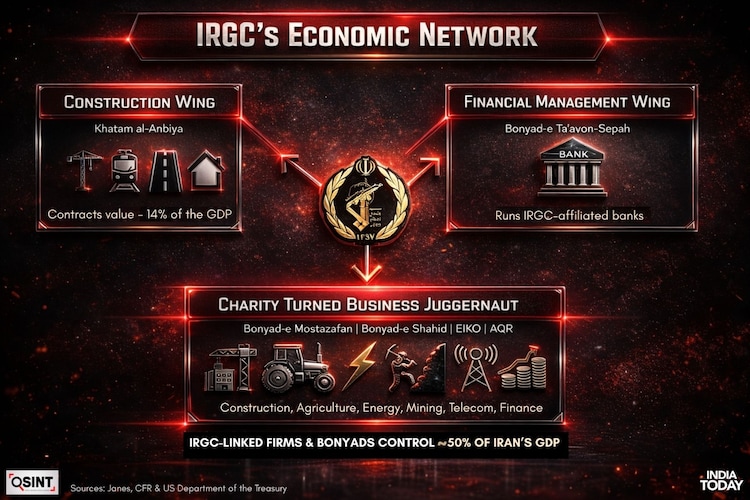
A report by the Clingendael Institute estimates that the IRGC and its broader “military–bonyad complex” account for over 50% of Iran’s GDP, while several reports quoting the Washington Institute for Near East Policy put the long-term value of Khatam al Anbiya’s contracts at about $50 billion, roughly 14% GDP.
India Today’s Open Source Intelligence (OSINT) team analyses media reports, research documents, and government publications from multiple countries to examine how the IRGC has transformed itself into a parallel governing structure that combines military strength, economic power, and political influence.
Designated as a terrorist organisation by over 13 countries globally, including the United States, the European Union, Saudi Arabia, Canada, Australia, and others, much of the IRGC’s rise has taken place under the shadow of now slain Supreme Leader Ali Khamenei. In his absence, the IRGC appears to wield influence far beyond what is typically expected of a military institution.
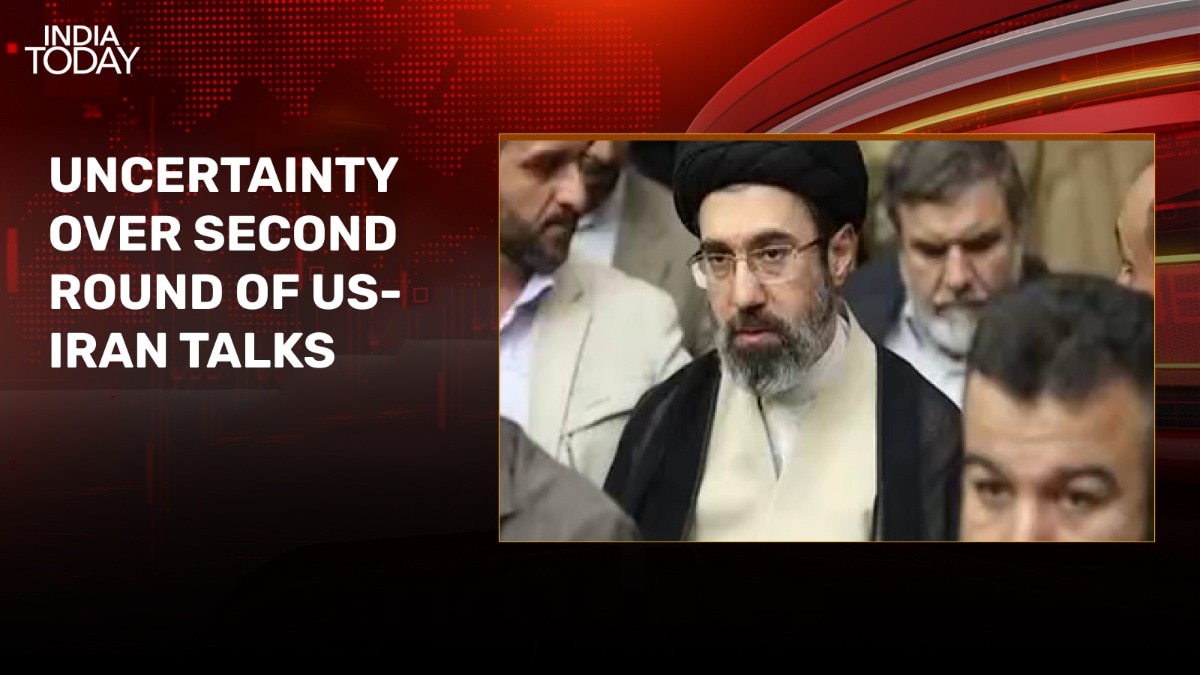
This can further be deduced from a report by Axios. Amid uncertainties around the second round of talks between the US and Iran, the report suggests that “Iranians were stalling amid apparent pressure from the Revolutionary Guards on the negotiators to hold a firmer line: no talks without an end to the US blockade...The Iranian team waited for a green light from the Supreme Leader. It came on Monday night”.
IRGC: the economic “powerhouse”
A report by Clingendael Institute, a Dutch think tank, highlights that the IRGC and the broader “military-bonyad complex” that links revolutionary religious foundations with military institutions such as the Mostazafan Foundation, and Iran’s military apparatus, has been assessed to account for over 50% of the country’s GDP.
This system emerged after the establishment of the Islamic Republic and the Iran-Iraq War. Some institutions were newly created, while others, such as the Imam Reza Shrine Foundation, were taken over and absorbed into broader revolutionary objectives. They remain unaccountable, with leadership appointed directly by the Supreme Leader, ensuring ideological alignment, autonomy, cohesion, and loyalty.
As Kayhan Valadbaygi, in his paper for Clingendael Institute, argues that by the mid-1980s, within a few years of the Islamic Revolution, “the Mostazafan Foundation, one of the Bonyads alone had assembled a vast empire: 203 mining and manufacturing enterprises, 472 commercial farms, 101 construction firms, 238 trading and service companies, and nearly 2,800 real estate holdings.”
Originally meant to advance religious and revolutionary goals, these institutions evolved over time, where “wealth accumulation became an end in itself,” serving elite interests such as self-enrichment, political control, regime survival, and social engineering.
Khatam al-Anbiya construction headquarters (KAA)
It lies at the centre of this economic structure of the IRGC, established in 1989 to drive post-war (Iran-Iraq) reconstruction, which has since evolved into a vast conglomerate handling infrastructure projects from railways and roads to housing, alongside overseas operations spanning the Middle East, Europe, Africa, South Asia, Russia and former Soviet republics.
Several reports quoting the Washington Institute for Near East Policy suggest that the long-term value of KAA’s contracts is estimated at about 50 billion dollars, roughly 14 per cent of Iran’s GDP.
An October 2014 note of the United Nations Security Council alleges that “KAA undertakes a significant amount of work on Passive Defence Organisation projects. In particular, KAA subsidiaries were heavily involved in the construction of the uranium enrichment site at Qom/Fordow.”
Bonyads - the charity groups which work beyond the domain
Bonyads, or parastatal foundations, are often presented as charitable institutions. However, according to US agencies, these organisations operate across a wide range of commercial and revenue-generating activities. Through their vast economic holdings and limited oversight, they form a major pillar of the IRGC’s non-budgetary domestic funding network.
For instance, Bonyad e Taavon Sepah, also known as the IRGC Cooperative Foundation, serves as the Guard’s primary investment and financial arm. It manages key institutions such as Ansar Bank and Mehr Bank, which provide financial services to IRGC personnel and the Basij. These entities have all been subjected to sanctions by the US Department of the Treasury.
The US agency claims that banks operating under Bonyad e Taavon Sepah receive benefits from the Iranian government, while not being required to have their budgets publicly approved. They account for a significant share of Iran’s non-petroleum economy, enabling the foundation to extend preferential financial services to IRGC personnel.
Other major bonyads, such as Bonyad e Mostazafan and Bonyad e Shahid, while not formally part of the IRGC, operate within its sphere of influence and form part of the same economic ecosystem. These foundations control assets across real estate, mining, telecommunications, manufacturing, and agriculture. They receive state support and remain largely unaccountable, reinforcing the broader financial network linked to the Guards.
The US Department of the Treasury describes Bonyad e Mostazafan as a vast conglomerate with hundreds of holdings spanning key sectors. Though officially presented as a charitable organisation for the poor, it states that these assets were expropriated and are used by the office of the Supreme Leader. The department has imposed sanctions on several of its entities, including Sina Energy Development Company, Behran Oil, Kaveh Pars Mining Industries Development Company, and Sina Financial and Investment Holding Company.
Entities such as the Execution of Imam Khomeini’s Order (EIKO) and Astan Quds Razavi (AQR) operate under the authority of the Supreme Leader. However, following the killing of Ali Khamenei and the continued absence of Mojtaba Khamenei from public view, the IRGC is widely believed to be exerting significant influence over these institutions.
Additionally, a Reuters report states that the IRGC have tightened their grip on the country’s oil industry, controlling up to half of the exports that generate most of Tehran’s revenue and fund its proxies across the Middle East.
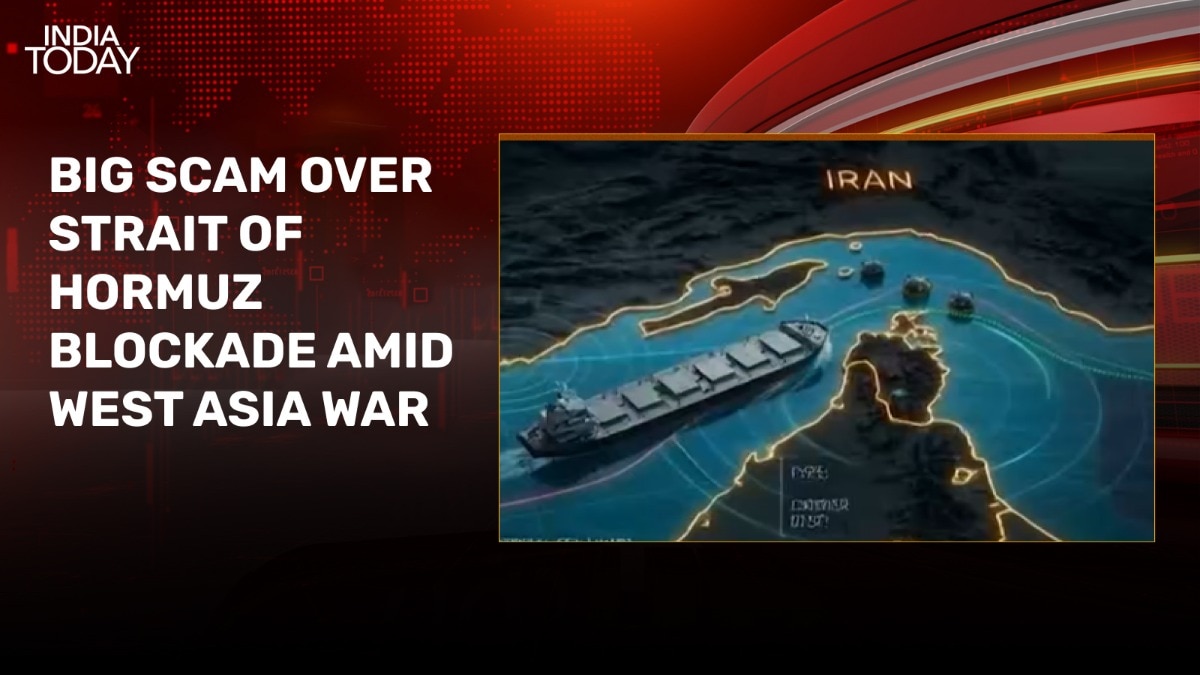
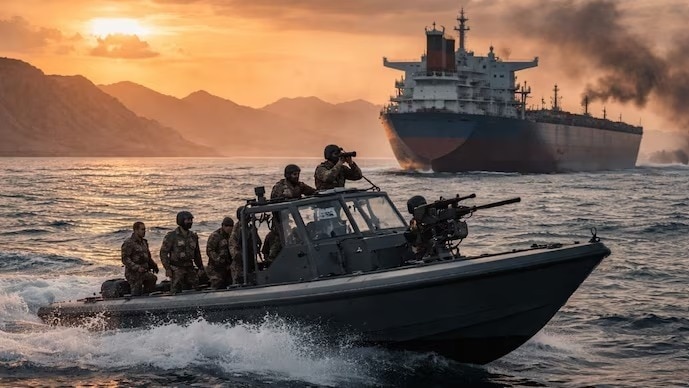
Corroborating this, the IRGC is believed to manage a large fleet of shadow vessels, complementing its exclusive naval presence in the Persian Gulf and the Strait of Hormuz. Tasked with operational control in these waters, the force oversees what has been described as “now a perilous corridor” that handles nearly 20 per cent of the world’s crude shipments.
Foreign sources of the IRGC income
An analysis by the intelligence platform Janes notes that since the late 1990s, Khatam al Anbiya and affiliated bonyads have executed projects across multiple regions, including the Middle East, Europe, Africa, South Asia and Russia, including a 30 million dollar UAE road contract.
Though the figures remain unverified, IRGC is also reported to operate smuggling networks involving fuel, tobacco, and other goods, with estimates suggesting profit margins of 200 to 300 per cent and revenues of up to 12 billion dollars annually.
US Treasury notices indicate these operations are facilitated through regional networks in Iraq and Trkiye, generating hundreds of millions of dollars and forming a “shadow banking” system that obscures transactions and enables access to global markets.
The IRGC is further involved in supplying commodities and weapons to allied groups, including those in Syria, Hamas, Iraqi militias, Ansar Allah, and Hezbollah.
It has also increasingly turned to cryptocurrencies to bypass sanctions, supported by domestic regulatory frameworks.
A major revenue stream comes from illicit oil and gas sales through a “dark fleet,” using ship-to-ship transfers, intermediaries, and rebranding to mask origin and secure high profit margins.
Military strength
Not a conventional military, as many would assume, the IRGC’s own constitution defines its role as protecting the Islamic Revolution and the system that emerged from it, including the Islamic Republic and the ruling regime. Article 2 explicitly states that the corps is tasked with combating “factors and trends that aim to sabotage and overthrow the Islamic Republic of Iran, or act against the Islamic Revolution.”
Operating directly under the Supreme Leader, the IRGC also commands significant state resources. Iran’s 2025 budget indicates an allocation of over 6 billion dollars to the IRGC, nearly twice that of the country’s conventional armed forces, underscoring both its priority and expanding institutional weight.
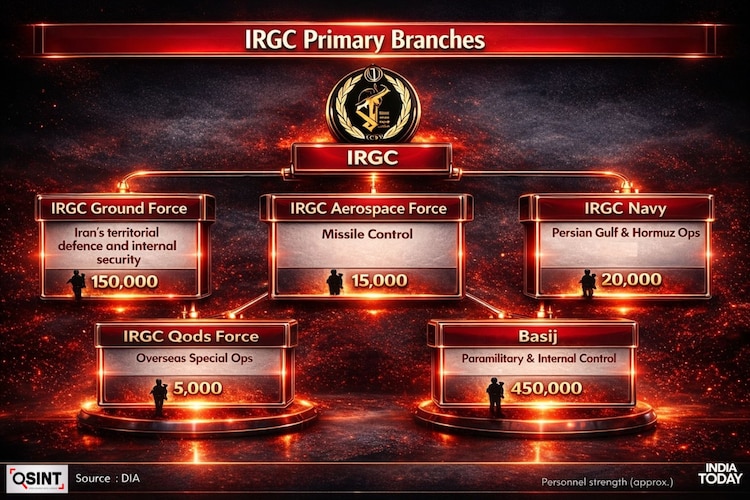
At its core, the IRGC operates through a five-branch structure that blends conventional force with asymmetric reach and internal control.
The Ground Force, with around 150,000 personnel, anchors territorial defence and domestic security, while the Aerospace Force, roughly 15,000 strong, commands Iran’s missile capabilities. In the waters of the Persian Gulf and the Strait of Hormuz, the IRGC Navy fields about 20,000 personnel, specialising in strategic maritime operations.
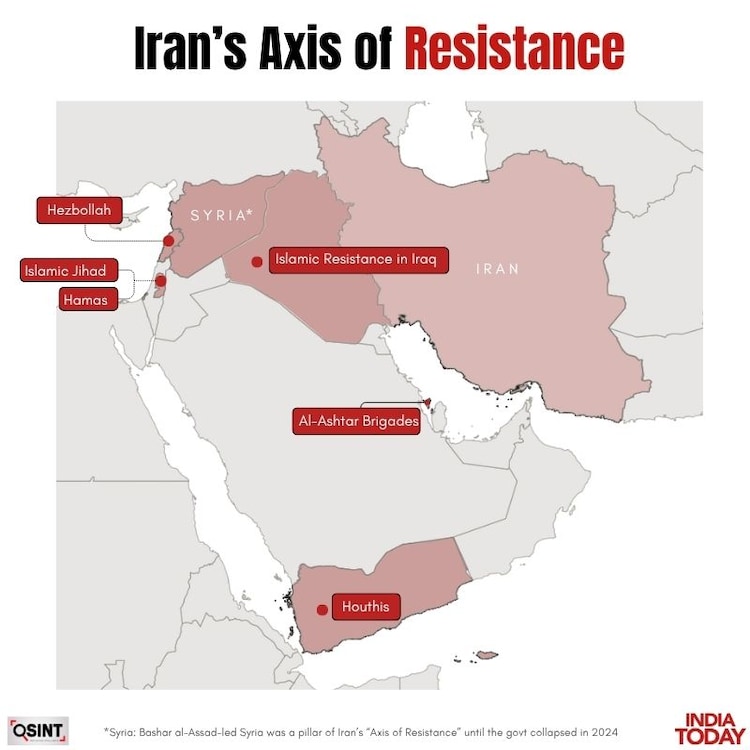
Beyond borders, the Qods Force, an elite IRGC unit of over 5,000 personnel, anchors Iran’s “Axis of Resistance,” managing a network of allied militias across the region. It supports and coordinates groups such as Hezbollah in Lebanon, Hamas and Palestinian Islamic Jihad in the Palestinian territories, the Houthis in Yemen, and key Shiite militias in Iraq, including Kataib Hezbollah, Asaib Ahl al Haq, and the Badr Organisation. However, a CFR report suggests that after the collapse of Bashar al-Assad’s regime in Iraq in December 2024, Iran’s role there has shrunk significantly.
Through this network spanning Lebanon, Syria, Iraq, Bahrain, and Yemen, the Qods Force extends Iran’s influence far beyond its borders, linking multiple fronts into a coordinated and strategically aligned structure.
But the real scale of internal control is reflected in the Basij, a vast paramilitary network of approximately 450,000, embedding the IRGC’s presence deep within society and reinforcing its grip on the state from within. They are the ones tasked with containing protests via oppression and moral policing within Iranian territory.
- Ends
Published By:
bidisha saha
Published On:
Apr 21, 2026 14:02 IST
Tune In