 1 hour ago
The resolution at the 193-member UN General Assembly received 130 votes in favour, 25 abstentions and 17 votes against, including those of the US and Israel.
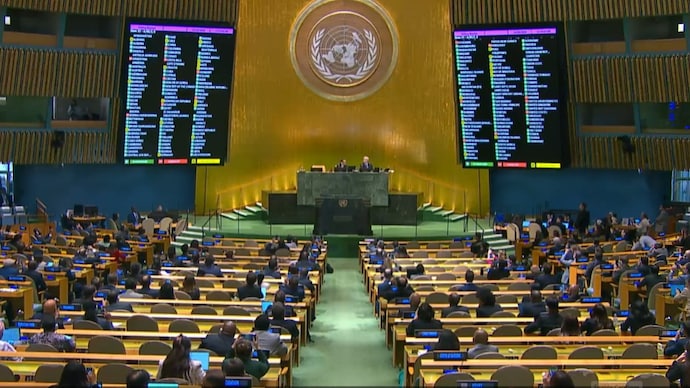
The General Assembly has adopted resolutions urging an end to the embargo every year for more than three decades. (Photo: X/@UN_News_Centre)
India has backed a United Nations call to end the United States' economic, commercial and financial embargo on Cuba, joining 129 other countries in opposing the restrictions even as Washington secured a shift in support for the resolution. The vote on Wednesday exposed a growing divide at the UN, with several countries that had previously supported the motion choosing to abstain, while 17 voted against it.
The resolution at the 193-member UN General Assembly received 130 votes in favour, 25 abstentions and 17 votes against, including those of the US and Israel. Bosnia and Herzegovina, Czechia, Lithuania, Slovenia, Morocco, Ukraine and the United Arab Emirates were also among the countries opposing it.
The result marked a significant change from last year, when 165 countries voted in favour, seven opposed the resolution and 12 abstained. Germany and Italy were among the Western countries that abstained this year after supporting the call to end the embargo in previous years.
Although the annual vote carries considerable diplomatic weight, it does not have the power to overturn the restrictions. Only the US Congress can lift the embargo, which has remained a major source of friction between Washington and Havana.
US WELCOMES SHIFT IN UN VOTE
Washington has stepped up efforts to persuade countries to reconsider their support for the resolution. The US gained the backing of more than 23 additional countries compared with last year, with its envoy to the UN describing the shift as a diplomatic success.
"I'm satisfied that so many countries now, including major economies like Korea, like Germany, and others have shifted their position," US envoy Mike Waltz told reporters after the vote.
"Diplomacy takes time, but now that we've had a tripling of countries that have shifted, we expect that to only to continue to grow," he said.
The United States has voted against resolutions calling for an end to the embargo since 1992, apart from 2016, when the administration of former President Barack Obama abstained as Washington and Havana moved towards closer relations.
The General Assembly has adopted resolutions urging an end to the embargo every year for more than three decades, with 2020 the sole exception during the Covid-19 pandemic. While the resolutions are non-binding, they have repeatedly demonstrated the extent of international opposition to the US policy.
DIPLOMATIC ROW ERUPTS AT THE UN
The vote came amid mounting tensions between American and Cuban representatives at the United Nations. Exchanges between diplomats grew increasingly heated in the days leading up to the resolution, culminating in shouting and shoving on the floor of the General Assembly on Tuesday.
On Wednesday, Waltz accused a Cuban diplomat of "assaulting an American diplomat" during the confrontation and said Richard Tur de la Concepcion, a first secretary at Cuba's UN mission, would be expelled from the United States.
"That Cuban first secretary will be on a plane out of the country back to Havana today," Waltz told reporters at the UN.
CUBA ACCUSES US OF ‘COLLECTIVE PUNISHMENT’
Cuban Foreign Minister Bruno Rodriguez hit back after the vote, accusing Washington of trying to deepen the island's economic hardship through its restrictions.
The "US government is once again isolated in its attempt to continue strangling the Cuban people and subjecting them to an act of collective punishment and genocide," Rodriguez said on X.
"Neither its most insane pretexts nor its pressures nor media circus will prevail over the force of facts and truth," he added.
The embargo has long been a central point of contention between the two countries. Cuba says the sanctions have worsened its economic crisis, which has been marked by shortages of basic goods, runaway inflation and deteriorating infrastructure.
The island has also struggled with severe electricity shortages. Last month, its power grid suffered a total collapse, plunging the country into darkness and leaving millions without electricity.
TRUMP STEPS UP PRESSURE ON HAVANA
US President Donald Trump has adopted a tougher stance towards Cuba, adding to the pressure on its government. His administration's approach follows Washington's January military operation to remove Venezuelan President Nicolas Maduro, a close ally of Havana.
Addressing the UN last month, Trump described Cuba as a failed state and said freedom would be coming to the island nation.
Havana has continued to argue that US sanctions are a major driver of its economic difficulties and has called for the embargo to be lifted.
The latest vote is unlikely to bring an immediate change in American policy, as the General Assembly cannot compel Washington to end the restrictions.
- Ends