 1 hour ago
Death toll from train crash rises to 31
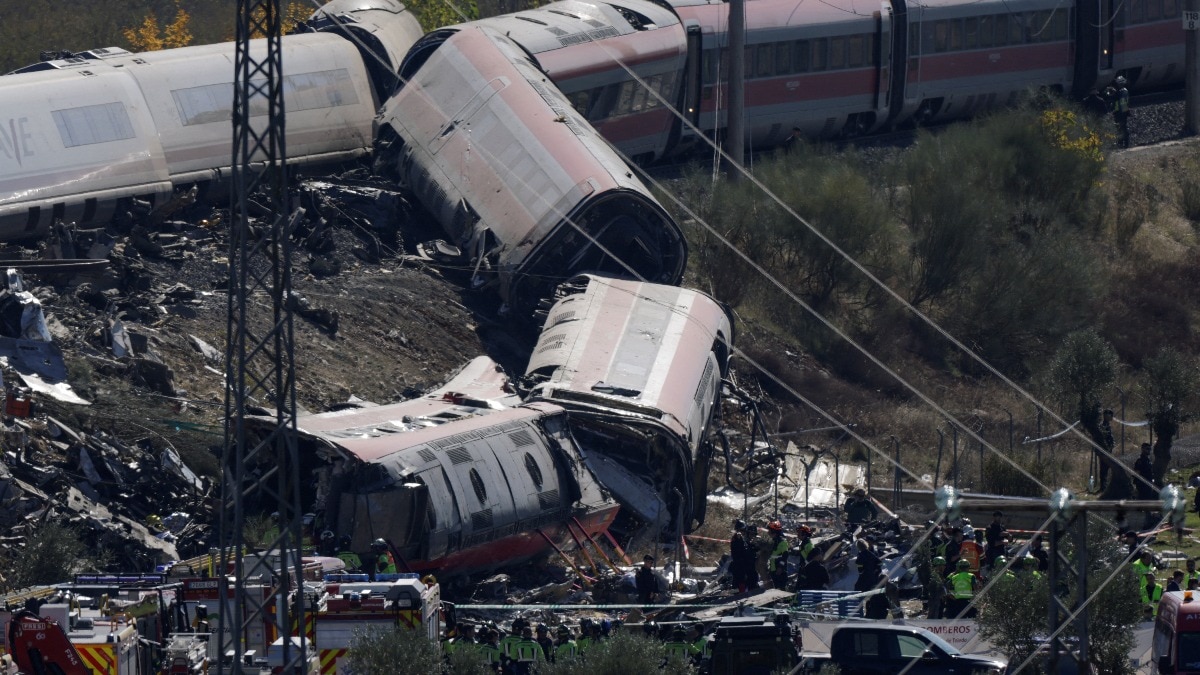
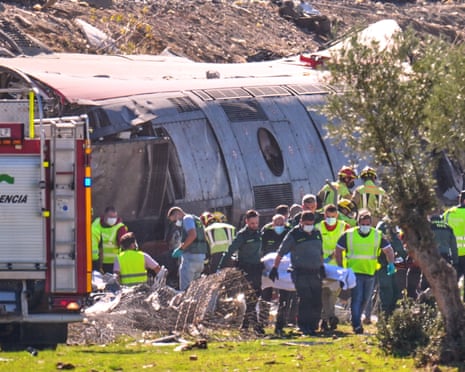
The death toll from today’s train collision has risen to 31, according to the latest information from local government in Castile-La Mancha.
Key events 51s ago Signalling system likely to come under close scrutiny - snap analysis 37m ago Death toll from train crash rises to 31 40m ago All Spanish Cup football games cancelled as mark of respect 43m ago EU 'ready to support' Spanish investigation into train crash 1h ago At least 30 dead, 80 injured, with concerns death toll could rise further - what we know 1h ago Aerial footage from the crash scene - video 1h ago At least 30 dead, 80 injured, but numbers likely to rise, local president says 2h ago Death toll may rise further, local government spokesperson warns 2h ago At least 30 dead in Spanish train crash, local government confirms 2h ago Spanish royals express concern for and support to all affected by train crash 2h ago 'Europe mourns in you,' EU's von der Leyen responds to train collision in Spain 2h ago At least 30 dead after two train collide in Spain - what do we know 2h ago Spain's transport minister working to 'obtain all possible information' 3h ago Spanish PM, opposition leader 'shocked' by train crash in Toledo 3h ago Spanish health minister fears 'major tragedy' after train collision in Toledo 3h ago Toledo crash brings back memories of deadly crash in Adamuz 3h ago Death toll likely to rise, local government spokesperson warns 3h ago At least 10 feared dead after collision in Toledo province
Signalling system likely to come under close scrutiny - snap analysis

Gwyn Topham
Transport correspondent
The signalling system used on the high-speed line between Madrid and Seville will come under scrutiny as investigators seek to understand Spain’s latest horrific rail crash.
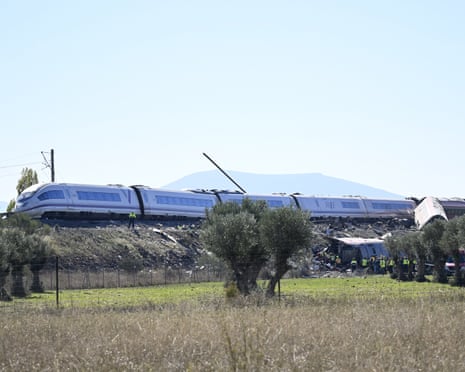
The rear-end collision between two trains, whose death toll already looks likely to exceed the disaster in Adamuz on the same line in January, should, theoretically, be a remoter risk than other types of accident.
The LZB signalling system should automatically stop a train if the line ahead is occupied, even if the driver failed to apply the brakes.
The technology, used previously in Germany before being installed on the Spanish high-speed line, translates as “linear train control” and uses continuous electronic communication between the track and train to control speeds.
That should make it safer than, for example, the stretch of the Midland main line in the UK where a rear-end collision occurred earlier this year – the first fatal crash of its type between two passenger trains in Britain for more than 40 years.
In that part of the railway, there was no technology to automatically stop the second train, whose driver failed to apply the brakes when passing a red light that warned of danger ahead.
Spain has had another high-speed disaster, in Galicia in 2013, under a system where the driver was able to ignore speed warnings.
This should not have been possible under this system – a different scenario for investigators than the faulty rails identified in the head-on Adamuz crash.
According to early, unconfirmed reports from Spain (12:30), the first train, an Iryo service, may have stopped after flagging a failure in the LZB system.
Spain, like all European operators of high-speed lines, is transitioning its various signalling systems to a standard ERTMS service.

Jakub Krupa
We are expecting to hear from Spain’s transport minister Óscar Puente at the top of the hour, at 2pm local time (1pm UK).
Spain’s former labour minister Fátima Báñez was reportedly on one of the trains caught up in this morning’s crash.
Speaking just now on RTVE, Antonio Sanz, the Andalusia government’s emergency minister, confirmed she is believed to have been on board and has not yet been reached since the incident.
Death toll from train crash rises to 31
The death toll from today’s train collision has risen to 31, according to the latest information from local government in Castile-La Mancha.
All Spanish Cup football games cancelled as mark of respect
All games of the first round of Spanish Copa del Rey football competition planned for today have been postponed as a mark of respect following the train crash in Urda, Spanish football federation said in a statement.
“The great Spanish football family remains united in grief over this tragedy, offering its support to the authorities to help the victims of this devastating accident,” the RFEF said in a statement.
A revised schedule will be published in due course.
EU 'ready to support' Spanish investigation into train crash
The European Commission has offered to help with the investigation into today’s train crash in Urda.
EU chief spokesperson Paula Pinho said:
“Our thoughts and our feelings are with the victims, their families and friends, and all those affected, and the Commission, together with the European Union Agency for Railways, is closely following the situation, and we stand ready to support the Spanish authorities in any way that may be needed.”
But she noted it was “too early, absolutely too early, to draw any conclusions” as the emergency response continues.
Von der Leyen has not yet spoken with Spain’s PM Pedro Sánchez this morning, the spokesperson said, who also pointed reporters to her message of solidarity on social media (11:32).
Today’s crash is already the fourth worst train accident in Spain recorded since the seventies – and the death toll is still expected to rise.
In 1972, 86 people died and 112 were injured in a head-on clash between two passenger trains in El Cuervo (Sevilla).
In 2013, 80 people died and more than 140 were injured in Angrois, Santiago de Compostela (A Coruña) after a high-speed train detailed outside the station.
And earlier this year, 46 people died and 152 were injured after two trains collided in Adamuz (Córdoba).
At least 30 dead, 80 injured, with concerns death toll could rise further - what we know
Jakub Krupa
At least 30 people have died and 80 have been injured after two high-speed trains collided in Spain’s Toledo province, with fears the death toll could still rise higher (12:22).
The number of people affected is still expected to rise (10:46, 12:04), local authorities said, with growing concerns about a “major tragedy” (11:03).
The affected trains are understood to be Iryo 7076 with 146 passengers plus one baby on board, and AVE 2080 with 397 passengers on board, making it 544 people in total on board of both train (11:00).
Early inquiries point to a possible signalling failure that contributed to the crash, Spanish media reported (12:32).
The incident comes less than a year after a similar crash in Adamuz, the province of Córdoba, which killed 46 and injured 152 in January this year (11:00).
Spain’s high-speed railway network ranks as the largest in Europe and the second biggest in the world after China, carrying 25 million passengers in 2024.
Spain’s prime minister Pedro Sánchez said he was “shocked” by the accident (11:05), with transport minister Óscar Puente working at the emergency control centre to “obtain all possible information about what happened” (11:16).
The Spanish king Felipe VI expressed his sorrow and solidarity with all affected (11:38, 12:07).
Meanwhile, El Mundo is reporting that the Iryo train flagged a failure in its LZB signalling system shortly before the crash, but the train behind did not receive the information due to a potential human error.
Investigators believe the AVE high-speed train travelling behind crashed into the stationary Iryo service, according to the newspaper.
Aerial footage from the crash scene - video
At least 30 dead, 80 injured, but numbers likely to rise, local president says
The president of Castilla-La Mancha region, Emiliano García-Page, is now briefing the reporters.
He confirms the latest figure of 30 dead – 24 in the AVE train and six in the Iryo train – but says the authorities expect this number to rise further as emergency services are yet to reach the most affected parts of the wreckage.
He also says some 80 people were injured, with 30 people with minor injuries, and 50 with moderate and more serious injuries of varying severity.
He thanks all emergency services for their help.
Unlike other party leaders, the far-right Vox party’s Santiago Abascal appears to be going ahead with his political plans for today as he continues campaigning ahead of next month’s parliamentary election in Spain.
In his comments, he repeatedly attacked Spain’s prime minister Pedro Sánchez for “constantly putting the Spanish people at risk.”
He explicitly rejected calls to suspend the campaign, insisting that would only to “exploit the grief and mourning to silence complaints and protests regarding the decay of our infrastructure.”
Spanish King Felipe VI appeared in front of cameras on his visit to Bétera, where he is attending some military exercises.
His brief reaction was largely in line with his earlier written statement.
Visibly shaken, Felipe VI said he wanted to “express my deep regret over this horrific incident,” acknowledging “a high number of fatalities and many injuries.”
“My primary concern is to express my sorrow over this terrible tragedy and to convey our condolences, sadness, support, and affection to the families during such an incredibly difficult and painful time.”
He also thanked emergency services responding to the incident for their help.