 1 hour ago
OBR: living standards forecast to rise by just 1% over whole post-Covid decade
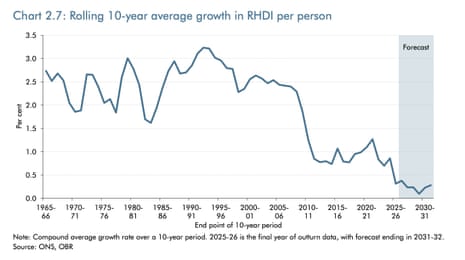
The OBR report says RHDI (real household disposable income – one measure of living standards) is rising at a record slow rate – less than 0.1% per decade. That means, by the end of the decade, it will be just 1% higher than its pre-Covid level, it says.
Our central forecast represents a continuation of the historically weak growth in RHDI per person since the global financial crisis. Chart 2.7 shows the rolling 10-year average annual growth in RHDI per person. This slowed significantly in the aftermath of the financial crisis, due to lower growth in productivity and real wages. Growth reached a historic low over the 10 years to 2025-26, averaging just ¼ per cent a year, and we expect it to fall further in the near term. By 2029-30, our central forecast sees growth over the prior 10 years averaging less than 0.1 per cent a year. As a result, 10 years on from the onset of the pandemic, RHDI per person would be just 1 per cent higher than its pre-pandemic level.
Key events 1m ago What business organisations are saying about budget 17m ago What opposition parties are saying about the budget 30m ago UK gambling firms' value jumps after chancellor resisted large duty hike 33m ago Burnham rules out general election in the next year 36m ago City experts: Risk of an early election 47m ago How proposed first-time buyer Isa will work 50m ago OBR: rise in property income tax could lead to rents going up 1h ago IFS: The planned consolidation has an achilles heel 1h ago Resolution Foundation says it's 'unacceptable' that 80% of homes get £100 energy payment, while 1.4m poor families miss out 1h ago OBR: living standards forecast to rise by just 1% over whole post-Covid decade 2h ago Bank surcharge lift to only raise £1.5bn 2h ago OBR: 'It’s been a dismal period in British economic history' 2h ago UK bond yields falling as City welcomes 'dull budget' 2h ago How budget contains record number of measures, but with almost none of them costing or raising £1bn or more 2h ago OBR: tax burden to 'increase sharply' to record high 3h ago 'Is that it?' - Badenoch ridicules budget, claiming big decisions postponed, and Healey should have cut welfare to fund defence 3h ago OBR forecasts no real earnings growth next year 3h ago OBR: probability of meeting the fiscal mandate has fallen to 56% 3h ago OBR: UK's challenging position has worsened since March 3h ago Gov.uk wobbles as public check out their council tax band 3h ago Healey announces first-time buyer Isa 3h ago Healey says extra funding to tackle rough sleeping being extended 3h ago Healey says spending review will include 'target date' for getting defence spending to 3% of GDP by 2030 3h ago Healey says he is delivering most radical act of fiscal devolution in generation 3h ago Healey announces new tax relief for people who set up successful firms 4h ago Healey announces new deal for datacentres 4h ago Bank shares bounce as new surcharge confirmed 4h ago Healey announces 3% rise in bank surcharge, but time-limited for just 15 months 4h ago Tax on income from property to rise by 2 percentage points 4h ago Healey says business rate threshold going up to £18,000, and other businesses having rates frozen in real terms 4h ago Healey says people living in council tax A to D band homes to get £100 energy payment 4h ago Healey says removal of VAT from electricity bills to be extended 4h ago Growth forecast downgraded for 2027 4h ago Healey says clean energy costs to be taken off energy bills 4h ago Healey says government borrowing falls to 4.2% this year 4h ago Healey defends budget headroom falling to £15bn, saying buffer is there to 'use it when you need it' 4h ago Healey says borrowing costs have risen £14bn this year 4h ago Burnham says using North Sea reserves can 'accelerate' move to a 'clean energy future' 4h ago Burnham ducks invitation to condemn Steve Witkoff for calling Putin a humanitarian 5h ago Badenoch claims Labour should be saying 'thank you' to Tories for their Brexit deal 5h ago Burnham tells cabinet current Brexit deal 'bad for UK', as he restates determination to get 'closer relationship' with EU 6h ago Bank shares jump on reports budget bank tax will be ‘temporary and below 8%’ 6h ago 'My advice to John is don't delay' – Zelenskyy urges UK to speed up raising defence spending 6h ago Green leader Zack Polanski says budget could be 'betrayal of future', after it emerges tax forecasts assume Rosebank going ahead 6h ago Healey also looking at removing standing charges from electricity bill, Martin Lewis says 7h ago Investment firms welcome reports that cut to cash Isa allowance to be reversed 7h ago Getting rid of standing charges on gas bills really 'sleight of hand', Tories claim 7h ago Green party says 'business-as-usual budget' won't deliver hope 8h ago Money saving expert Martin Lewis welcomes gas standing charge abolition, and says further energy bills support likely in budget 8h ago John Healey says scrapping gas standing charges will save 60% of homes £45 a year

Lauren Almeida

Over at Saxo UK, traders report there was little drama in today’s budget.
“It was a boring budget” says Andrew Bresler, chief executive of Saxo UK, adding:
“They have been able to achieve what they set out to which is effectively no movement in financial markets.”
Neil Wilson, an investor strategist at the bank, says the budget was “a nothing burger”, pointing out:
“The market is not really reacting to it.”
What business organisations are saying about budget
Business groups have given the budget a mixed reaction.
Rain Newton-Smith, chief executive of the CBI, welcomed some measures, but argued John Healey should have done more for growth. She said
On the face of it, this budget lacks the bold moves that would have made it easier for firms to invest, hire and grow.
At a time of exceptional geopolitical pressures, using some fiscal headroom to absorb genuine short-term shocks is preferable to loading additional permanent costs onto business and weakening investment.
Slowing the convergence of youth rates with the national living wage is a sensible move in face of the Neets crisis and current labour market pressures. But the chancellor could have gone further. Reducing the cost of hiring by increasing the employer NICs threshold would have given firms more space to create entry-level jobs and boost employment.
Jonathan Geldart, director general at the Institute of Directors, said his members were relieved.
Business leaders will be relieved that the chancellor’s budget included no nasty surprises, having been conditioned in previous budgets to expect the worst. We very much welcome the numerous measures intended to support British start-ups and scale-ups, such as the new Founders’ Relief, Young Entrepreneurs Allowance and EMI2 [enterprise management incentive] share incentives (as well as support for small brewers).
What might at first blush be a case of small beer today could start adding up to something promising in the future.
But Tina McKenzie, national chair of the Federation of Small Businesses (FSB), said the budget was a disappointment.
This budget should have been the moment to help small businesses with the soaring costs holding them back, and the taxes restricting job creation. Instead, they got nothing to ease sky-high energy bills and nothing to make hiring someone more affordable, while the increase in business rates relief excludes too many.

Kalyeena Makortoff
A JP Morgan spokesperson has criticised the decision to hike the UK’s bank tax today, arguing that targeting one of the UK’s most lucrative sectors “lacks principle”:
“We are committed to the country, and we recognise the cost of living challenges there and the global economic headwinds that it faces, but to single out this industry for additional taxes again, one of the UK’s biggest generators of growth and jobs, lacks principle.
“It also overlooks that the banking industry operates in a highly competitive global marketplace.”
But despite the bank’s disappointment, JP Morgan is due to charge ahead with its £3bn new UK HQ, according to a source familiar with the matter.
More in our business liveblog.
What opposition parties are saying about the budget
Kemi Badenoch’s reaction to the budget on behalf of the Conservative party was covered earlier, at 2.11pm. Here is some reaction from other oppostion parties.
The Lib Dem leader Ed Davey told MPs that John Healey should have done more to address the problems with Brexit. He said:
I do think this budget will be more defined by Labour’s red lines on Europe and the Conservatives’ Brexit red tape, rather than faster growth.
And at the root of so much of what’s gone wrong in our country – the cost of living crisis, higher taxes, broken public services, empty high streets, the lack of jobs and opportunity – at the root of all of that is the lack of economic growth.
Our economy is being held back. British business is being held back, and it’s been held back above all by the terrible damage of the Conservative Brexit deal.
Ellie Chowns, the Green party Treasury spokesperson, said the budget was lacking in ambition.
You’d have thought that, after going to the trouble of ousting the last PM, taking his job, and installing a brand-new chancellor, Andy Burnham would be keen to ensure Labour displayed a bit more ambition at today’s budget than it did under his predecessor.
Unfortunately, what Britain actually saw today was a business-as-usual budget which failed to engage with the real issues facing our country – choosing to tinker round the edges, rather than properly taxing extreme wealth and profits, making essentials genuinely and permanently affordable, or investing in our long-term climate resilience.
There was no discussion of the climate crisis in Healey’s speech today, nor any new investment in renewables and climate adaptation, despite the devastating impact of this summer’s deadly heatwaves and wildfires on our communities, public services, and economy.
Nigel Farage, the Reform UK leader, said Britain was broke. In a post on social media, he said:
These are the stats John Healey doesn’t want you to read.
Unemployment will rise to 5% in 2027.
The tax burden is going up AGAIN to the highest since WW2.
By 2031 we’ll be spending £160bn/year on debt interest alone – up £36bn/year …
We are on a fiscal knife-edge. Britain is Broke. Britain needs Reform.
Kirsty Blackman, the SNP’s economy spokesperson at Westminster, said this was not a budget for Scotland. She said:
The UK Budget shows the Labour government doesn’t get Scotland - and isn’t doing anywhere near enough to protect people from the looming cost of living emergency this winter.
This isn’t a budget that a Scottish chancellor would have delivered. Instead of providing meaningful help, it has abandoned families in the face of soaring bills and has imposed another betrayal on Scotland’s energy - with the decision to scrap Scottish carbon capture funding.
Andy Burnham promised to cut the cost of living but every major household bill has increased on his watch - and the UK budget completely fails to address the scale of the challenge families are now facing.
Ben Lake, Plaid Cymru’s economic spokeperson at Westminster, said Wales was just an afterthought in the budget.
Today’s budget was UK Labour’s opportunity to prove that Wales is more than an afterthought in Treasury decisions. Instead, it appears to have delivered the worst funding settlement for Wales in years.
After months of promises about a new relationship with Wales and a new approach from the Treasury, the question many people will be asking is – where is the ambition
The chancellor chose not to announce what Wales would receive in consequentials from this budget. Buried in the documents is around £450 million of additional funding spread over three years. That falls well short of keeping pace with inflation and risks forcing the kind of spending reductions Wales experienced during the worst years of Tory cuts.
UK gambling firms' value jumps after chancellor resisted large duty hike

Rob Davies
Machine games duty (MGD) is the tax levied on slot machines found in bookmakers, casinos, bingo halls and adult gaming centres (AGCs). The chancellor faced calls to double the rate of MGD from 20% to 40%, a policy backed by one of his predecessors, Gordon Brown.
Amid fierce lobbying from gambling firms, which issued dire warnings of thousands of job cuts, Healey opted for a more modest rise to 25% today. This, he said, would bring in nearly £150m a year, “raising taxes on gambling to support good growth on every high street”.
Investors responded with relief, adding £240m to the combined stock market value of Entain (Ladbrokes/Coral), Evoke (William Hill), Rank Group (Mecca Bingo/Grosvenor Casinos) and Playtech (designer of slot machine games). Entain said the MGC hike will cost it £25m, which it expects to be able to mitigate, including by shop closures. Betfred boss Fred Done, whose family took a £30m dividend from their betting empire earlier this year, also warned that closures and job losses would follow.
The chancellor singled out AGCs, sometimes known as “slot farms” for particular attention. As well as the duty rise, they will also be excluded - along with vape shops - from business rates relief available to retail and hospitality businesses.
Burnham rules out general election in the next year
Andy Burnham has ruled out calling a snap general election in the next year amid ongoing speculation (including among economists and investors) that he could seek to consolidate his position.
He said he was thinking “about people” and not “my own party and its prospects”, Press Association report.
The Prime Minister was asked if he would call an election in the next year as he visited a community centre in central London after the Budget.
He said:
“I don’t know how many times I’ve done this now, but yes, I can rule out calling a general election in the next 12 months.
“I have said repeatedly since coming into this job, I’m not thinking about myself. I’m not thinking about my own party and its prospects.
“I am thinking about people, and I’m thinking about what I can do to help them to have that care for people, which I spoke about on my first day in Downing Street.”
He added that he was “leading from the front” and “putting Britain on a different path”.
He said:
“We’ve got a 10-year plan to come, and that will inform the spending review next year. These are my priorities, not looking at our own internal party political advantage.”
City experts: Risk of an early election
Several City economists are suggesting that today’s budget may be teeing up an early general election.
Andrew Wishart, senior UK economist at Berenberg, suggests there is a 40% chance of a general election before the end of 2027.
He points out that this would allow Labour to discard its previous manifesto commitments not to raise taxes on working people.
Wishart says:
The big questions, about how to fund a national social care service and a £15bn increase in defence spending by 2030 remain unanswered. The government will hope that the combination of a decline in gilt yields a reduction in transfer payments to those with disabilities and efficiency savings enable them to fund their priorities without a major increase in taxes. It’s just about possible, but pretty unlikely and requires tax hikes pencilled in for the back end of the parliament to come in, potentially just before the next general election.
More ambition would require a new mandate without the manifesto constraint on tax, achieved by via a general election. We put the chances of one before the end of next year at about 40%.”
Eoin O’Callaghan, macro strategist at Wellington Management, says there is a “significant question mark” over the credibility of the projections, including the biig squeeze on departmental spending in a few year’s time.
Like last autumn’s budget they incorporate an unrealistic real term freeze in departmental spending in 2029-30, after the next election. And they now incorporate an even more challenging 3% real terms cut to next year’s departmental spending too to help offset rising interest rate and unfunded public sector pensions costs. The forecasts are also predicated on nominal growth staying relatively elevated close to 4% throughout the forecast.
“That may not concern the market for now. But it highlights how challenging the UK public finances are. How difficult the fiscal decisions ahead of this government are. And why there is a risk of early elections given the tough spending decisions ahead.”
Benjamin Jones, Invesco’s Global Head of Research, predicts speculation about an early election will continue to build:
“After two blockbuster, tax-hiking budgets, investors will welcome this more ‘steady as she goes’ package from the new Labour Chancellor. Against a backdrop of rising gilt yields and geopolitical uncertainty, Healey’s decision to limit spending increases and tax rises shows sensible caution.
His opening comments were clearly aimed to ease bond market fears. However, many of the difficult fiscal choices - such as delivering welfare savings and boosting Defence spending - have been postponed until the Spending Review next year, which will continue to fuel speculation of an early election.
How proposed first-time buyer Isa will work
John Healey announced a first-time buyer ISA in his speech. This is what the Treasury says about how it will work.
The government will introduce a new FTB ISA from April 2029. The product will replace the Lifetime ISA (LISA) for new savers and provide a 25% government bonus, paid on withdrawal, towards the purchase of a first home worth up to £450,000. The maximum value of the bonus will be capped at £20,000. Existing LISA holders will be able to continue contributing to and using their accounts under the current rules. In addition, the government will reduce the withdrawal charge for existing LISA holders who use their savings to purchase a first home above the £450,000 property price cap.
OBR: rise in property income tax could lead to rents going up
The budget included a two percentage poin rise in property income taxes. By 2028-29, this will rase more than £500m a year.
But it could lead to rents going up, the OBR says. In its report it says:
These measures collectively risk leading to a steady rise in rents through two effects. First, potential landlords are less likely to enter the market, reducing long-run rental supply, which risks a steady long-term rise in rents if demand outstrips supply – which we think is more likely than not. Second, landlords are likely to pass on more of these costs to renters in the long-run through a combination of some current landlords leaving, thereby giving more price setting power to remaining landlords, and greater long-run flexibility to raise rents. Such rises in rents would offset at least some of the reduction in the commercial viability to landlords from the measures introduced in recent years.
IFS: The planned consolidation has an achilles heel
There’s an “achilles heel” in the budget, according to the Institute for Fiscal Studies.
In their rapid reaction to today’s statement, Helen Miller, director of IFS, points out that the fiscal pans are based on “very tight” public spending plans.
Miller says:
This was broadly the budget that many were expecting. In the face of bad economic news, the chancellor has chosen to accept higher borrowing over the next five years. There was a small set of giveaways in the next few years, paid for with even higher borrowing today and higher revenues in later years.
The chancellor’s commitment to fiscal consolidation is welcome. But it is delivery that really matters. The plan to reduce borrowing has been pushed back. The planned consolidation has an achilles heel in the form of very tight plans for public service spending. This budget has a raft of fiddly measures but very little that will move the dial on growth.
The OBR’s economic and fiscal outlook highlights how the government is planning cuts to departmental spending, down from 21.5% of GDP in 2026-27, to 20.8% in 2027- 28 before falling further to 20.0% in 2031-32.
That’s significant, as the UK’s current spending review only runs until the end of the 2028–29 financial year.
The OBR says there is a clear shortfall in spending plans:
Based on the government’s assumption for total spending over this period – after taking into account policy commitments in areas including the NHS, defence and schools – spending would have to be £11 billion higher in 2031-32 to prevent ‘unprotected’ areas of day-to-day spending from falling in real terms from 2028-29.
Assuming that protected government spending (such as defence and the NHS) continues to be protected, ‘unprotected’ departmental spending would fall by 2.6% in real terms in the final three years of the forecast, the OBR says.
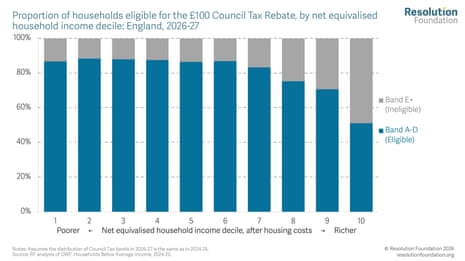
Resolution Foundation says it's 'unacceptable' that 80% of homes get £100 energy payment, while 1.4m poor families miss out
The Resolution Foundation thinktank says 80% of households will qualify for the £100 energy payment. It says this is a bad way of ensuring help goes to those who need it most.
The centrepiece of the chancellor’s cost of living package is a £100 council tax rebate for those living in homes in bands A–D to help with rising energy bills this winter.
But the government has failed to learn the lesson of the last price spike – that poorly targeted energy support is wasteful.
It’s unacceptable that the government still hasn’t found a way to target help at those who need it most.
The rebate is near-universal, with 80% of households in England eligible. Yet it will still miss one-in-eight of the poorest half of families (1.4 million households) who live in higher band homes.
OBR: living standards forecast to rise by just 1% over whole post-Covid decade
The OBR report says RHDI (real household disposable income – one measure of living standards) is rising at a record slow rate – less than 0.1% per decade. That means, by the end of the decade, it will be just 1% higher than its pre-Covid level, it says.
Our central forecast represents a continuation of the historically weak growth in RHDI per person since the global financial crisis. Chart 2.7 shows the rolling 10-year average annual growth in RHDI per person. This slowed significantly in the aftermath of the financial crisis, due to lower growth in productivity and real wages. Growth reached a historic low over the 10 years to 2025-26, averaging just ¼ per cent a year, and we expect it to fall further in the near term. By 2029-30, our central forecast sees growth over the prior 10 years averaging less than 0.1 per cent a year. As a result, 10 years on from the onset of the pandemic, RHDI per person would be just 1 per cent higher than its pre-pandemic level.
Bank surcharge lift to only raise £1.5bn
Kalyeena Makortoff
The chancellor’s cautious bank tax hike will raise just under £1.5bn over its 15-month run, budget forecasts show.
That’s far short of the £2bn that TUC said could be raised per year had the industry-specific bank surcharge - which is on top of basic corporation tax - been hiked back to 8% from 3%.
The budget forecasts show the surcharge hike, which is due to run from January 1 2027 to March 31 2028, will raise:
£305m in Jan-March 2027
£950m in 2027/28
£220m in (lagged receipts, assumedly) for 2028/29
However, the Office for Budget Responsibility said HMT receipts would be knocked by banks reactively moving some operations out of the UK:
“Over the 15 months this is in effect, it is estimated to yield a total of £1.5 billion. This is net of an estimated £190 million reduction in receipts as some banks are assumed to move profits out of the UK in response to the higher tax rate. The size of this effect is uncertain.”
Sky News is reporting that JP Morgan will end up paying an extra £100m-£150m as a result over the 15-month period.
UBS analysis published before the budget showed that an increase to 6% would raise at least £763m per year from the four UK big banks alone (that’s Lloyds, NatWest, HSBC and Barclays).
The TUC have welcomed today’s “common sense” bank tax, even though John Healey has only raised the bank surcharge to 6%.
The TUC general secretary, Paul Nowak, said:
“As Trump’s illegal war in Iran continues to cause havoc with the global economy and drive up costs, the Prime Minister and Chancellor have started to give families and firms much-needed breathing space.
“The TUC has long called for banks to pay their fair share. At a time when millions are struggling to get by, taxing banks’ bumper profits to cut energy bills is plain common sense. The chancellor has made a good start by doubling the bank surcharge – next he should be prepared to extend it and raise it if profits remain sky high.
OBR: 'It’s been a dismal period in British economic history'
The outlook for real household disposable income (RHDI) in the UK is “a pretty grim picture”, Prof David Miles of the OBR has warned.
[Reminder: the OBR has cut its forecast for RHDI per person, and expects it will fall slightly in the near term.]
Speaking to reporters, Miles explains:
If you go back to just before Covid, and take that as your base, where we are right now - seven years later, is virtually no growth in per person real household disposable income.
That’s pretty unusual in the history of the UK.
To a substantial effect it is caused by higher energy costs, Miles explains, which the UK can’t avoid as it is a net energy importer.
Looking back over the last decade, Miles bemoans “it’s been a dismal period in British economic history.”
The Office for Budget Responsibility is running through its latest forecasts now, at a press briefing in London.
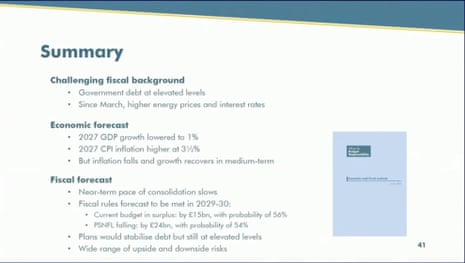
They are highlighting the “challenging fiscal background”, the tough economic forecasts for 2027, and the fact the UK is still on track to hit the fiscal rules – in the face of a lot of “upside and downside risks”.
UK bond yields falling as City welcomes 'dull budget'
John Healey appears to have achieved an important duty for chancellors on budget day – don’t crash the bond market!
UK bond prices are slightly higher today, which has pulled down the yield (effectively the cost of borrowing) on these gilts.
30-year bond yields, for example, are down 4 basis points (0.04 of a percentage point) at 5.698%. That pulls them further away from the 28-year high over 6% hit earlier this month.
The chancellor is being rewarded for a relatively quiet budget (despite the large number of measures).
Matthew Amis, investment director at asset manager Aberdeen, says:
“The gilt market wanted dull and they got exactly that. With oil and gas prices this high and with one eye on France, a dull budget is what was needed.
All of the major obstacles presented to Chancellor Healey were avoided, as such gilts yields are slightly out-performing. Is this a gilt positive budget? Not particularly, but in the context of this year that is good enough. 2027 is going to present another fiscal challenge for Chancellor Healey, but today’s budget should provide enough to reassure gilt investors going into the final months of 2026.”
How budget contains record number of measures, but with almost none of them costing or raising £1bn or more
Most budgets have three or four big, headline measures – tax rises or tax cuts worth several billion pounds a year. As Sky’s Ed Conway reports, this budget was unusual, because it contained an unprecedented number of measures, but their average value was (in budget terms) minimal.
Two key snap charts on the Budget...
1) in sheer numbers of policies, it’s the “busiest” budget in modern history. 98 different scorecard measures(!)
2) BUT the average VALUE of those measures was the smallest on record. Every little helps? Or too much fiddling? Views may differ
Here are the two charts from Conway that illustrate this.
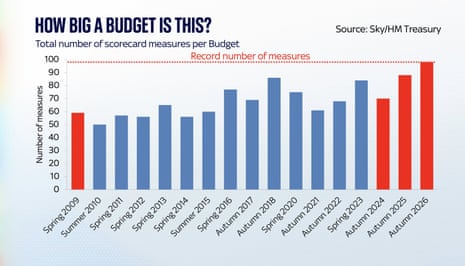
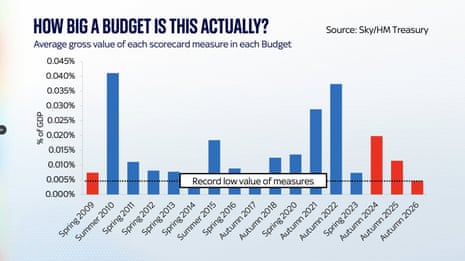
There is only one measure in the budget scorecard that will cost more than £1bn in 2026-27 (apart from extra money for the defence investment plan announced in June). That is the £100 household energy payment for people living in less expensive homes, which will cost £2.6bn.
It is also a budget that does not feature big tax rises. The increase that will attract the most media attention is the rise in the bank surcharge, but that only raises £305m this year, and £959m next year. The only tax rise in the budget that will raise more than £1bn a year is a reduction in the main rate for the writing-down allowance. It will raise just over £1bn a year by 2028-29.
OBR: tax burden to 'increase sharply' to record high
The OBR report says the tax burden is forecast to “increase sharply” to a record high. It says:
In the central forecast, total public sector receipts are projected to rise as a share of GDP from 40.1 per cent of GDP (£1.2 trillion) in 2025-26 to 42.9 per cent of GDP (£1.6 trillion) in 2031-32.
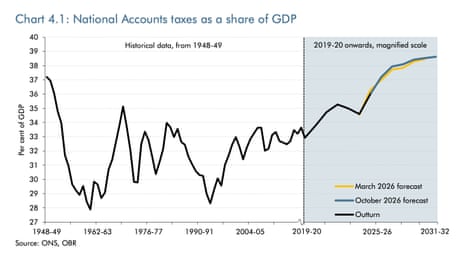
Within this, as chart 4.1 shows, Accounts taxes as a share of GDP (the ‘tax take’) are forecast to increase sharply from 36.0 per cent of GDP in 2025-26 to 37.9 per cent of GDP in 2027-28, surpassing the previous historical high, before then rising more gradually to reach a peak of 38.6 per cent of GDP at the end of the forecast period. This would be a 5.7 per cent of GDP increase on the pre-pandemic level of 32.9 per cent of GDP in 2019-20.