1 month ago
Racism is 'systemic' at Australia’s universities, report finds

Caitlin Cassidy
Racism is “systemic” at Australia’s universities, the race discrimination commissioner says, with a landmark report finding seven in 10 respondents have experienced indirect racism, rising to nine in 10 Palestinian and Jewish students and staff.
The Australian Human Rights Commission’s national study was commissioned in 2024 to investigate the prevalence and impact of racism at universities for the first time. The federal government received the report in December but it was not publicly released until Tuesday.
Of the 76,000 students and staff that were surveyed as part of the study, 70% had experienced indirect racism, including hearing or seeing racist behaviour directed at their community. 15% had experienced direct racism at university.
The rates were highest for religious Jewish and Palestinian respondents (over 90%), followed by First Nations, Chinese, Jewish (secular), Middle Eastern and north-east Asian respondents (over 80%).
At the same time, just 6% of people who experienced direct racism make a complaint to their university, with many citing fear of consequences and low trust in university complaints systems.
Key events Show key events only Please turn on JavaScript to use this feature
Barnaby Joyce would support banning people from specific countries entering Australia
One Nation’s Barnaby Joyce said he would support banning migration from specific countries this morning amid controversy over a leaked hardline Liberal immigration plan drafted before Sussan Ley was ousted as the party’s leader last week.
Joyce spoke to Channel Nine’s Today, where he was asked if he’d support the proposal:
Yep, 100%. Because until they get their acts together, we’re not going to try and sort of re-litigate what’s going on in their heads over here. …
If there’s an unreasonable risk, you just don’t come from that area. If you want a solution to that, go back to that area and tell them to solve their own problems.
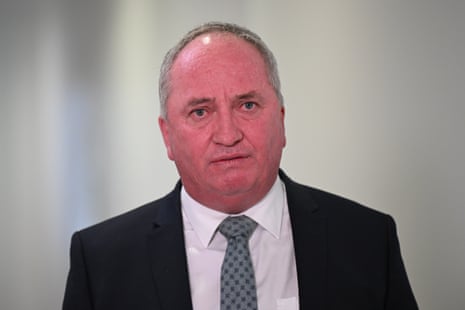
Joyce added that he agrees with One Nation leader Pauline Hanson, saying you can’t “make excuses” and allow people with different ideologies into the country, or risk social cohesion:
I do agree 100% with Pauline: people come into this country completely at odds, completely at odds, and it becomes apparent that it’s generationally at odds with what Australia is. …
Those days are over. … Otherwise, what do you see in England? What do you see in France? Just wait. You’ll see it in Sydney. You’ll see it in Melbourne.

Patrick Commins
‘Unparalleled’ growth in social homes still not enough: new research
Social housing is growing at a pace “unparalleled since the 1980s”, with new research revealing the number of homes for very low income households set to jump by 55,000 in this decade.
Professors Hal Pawson and Chris Martin from UNSW’s City Futures Research Centre pieced together data from unpublished state and territory construction data with official federal government targets to show 70,000 new social homes are projected to come on stream in the 2020s.
Around 45,000 of these new homes are funded by the states and territories, led by Victoria and Queensland.
Accounting for the 15,000 demolitions and sales anticipated this decade brings the net gain to 55,000 by 2030 – which would be a hefty 13% increase from 2020.
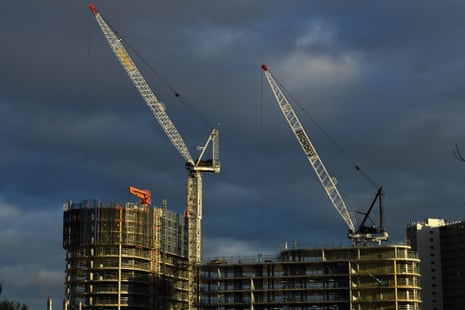
It’s also triple the increase in the social housing stock achieved in the 2010s.
But even this relative success will help to stabilise, rather than lift, the share of social homes at 4% – just above half the OECD average of 7%.
And the gains in social homes this decade is a fraction of the estimated 437,000 households who in 2021 said they were unable to secure social housing.
Pawson also worried that the current federal commitments through the Housing Australia Future Fund did not extend beyond 2030.
“Even if the federal government has the bottle to continue this level of investment through the Haff, if the states aren’t also able to maintain their remarkably high level of activity, we are going to be falling way way behind.”
Good morning! Nick Visser here to pick things up this morning. Let’s see what’s in store.

Sarah Basford Canales
Refugee Council of Australia says leaked Liberal migration proposal ‘appalling’
The Refugee Council of Australia has condemned a leaked proposal by the Liberal party to ban migrants from regions controlled by declared terrorist groups, describing the plan as an “appalling idea straight out of Donald Trump’s playbook”.
Details of the leaked plan drafted under Sussan Ley emerged on Monday signalling a hardline approach to immigration as the party hemorrhages votes to One Nation.
It would seek to ban migration from 37 specific regions controlled by terrorist groups across 13 countries, including Lebanon, Palestine, Egypt, the Philippines and Afghanistan.
In a statement on Monday evening, the Refugee Council described it as an “indiscriminate ban”.
Any person applying to visit or migrate to Australia should have their application considered on its own merits. People who have no links to terrorism and are almost certainly suffering as a result of terrorist acts should not be treated as though they are terrorists themselves.
To apply indiscriminate bans in this way would be little more than blind prejudice, prejudging people based on where they are from rather than who they are. The opposition cannot maintain that it is promoting Australian values and then promote a policy which denies the most basic level of fairness to innocent people with a valid and lawful reason for wishing to visit Australia, including family members of Australian citizens and residents.
Taylor says leaked immigration plan has ‘no validity’

Josh Taylor
Following the leak of immigration policy developed under former Liberal leader Sussan Ley on Monday, the new opposition leader, Angus Taylor, said he had not seen the plan, and that it had not been brought to shadow cabinet and it had “no validity”.
The Ley plan proposed to ban migrants from specific regions of 13 countries, and would seek to remove up to 100,000 asylum seekers and people on student visas more quickly from Australia.
On the ABC’s 7.30 program, Taylor said he had not seen the document:
Frankly, I don’t know what the document is. I don’t know where it’s come from, and I don’t know what’s in it.
Taylor said that the plan he would announce would be developed with his soon-to-be-announced shadow cabinet, but would not be drawn on detail beyond the principles he had outlined in his speech after becoming Liberal leader on Friday.
In response to being asked on whether social media would be checked, Taylor said intelligence agencies “need to be looking at this very very closely”, and there would be some regions migrants are coming from “where the risks are high”.
That doesn’t mean you necessarily shut the door on those places, but it does mean you do the work to make sure the people who are coming are not people who are going to threaten our way of life, and bring violence to our country.
Read more here:
And we are also reporting on Taylor being warned not to copy Donald Trump’s hardline border policies:
Caitlin Cassidy
Race discrimination commissioner says racism ‘pervasive’ across university sector
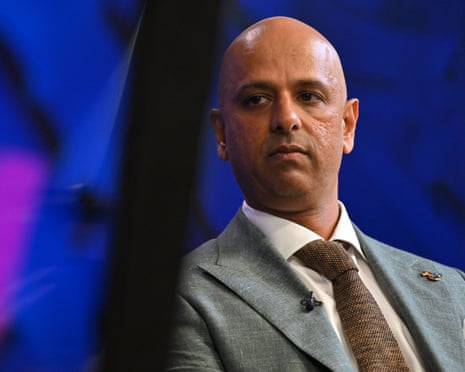
The race discrimination commissioner, Giridharan Sivaraman, said the findings of the study were deeply troubling and universities were falling short of their duty of care to students and staff.
Racism at university is not confined to isolated incidents or individual behaviour – it is systemic. Racism is pervasive across the sector, affecting many groups in serious ways … The attack on Camp Sovereignty, the antisemitic terror attack in Bondi and the recent alleged attempted bombing targeting First Peoples on 26 January in Perth – these are the horrifying outcomes when racism in our society isn’t addressed.
The report made 47 recommendations for the federal government and universities, including a national framework for anti-racism in tertiary education, better accountability and a more diverse leadership and workforce.
Only 11 universities were found to have advanced, standalone anti‐racism strategies.
Sivaraman said the report showed the “critical importance” of the federal government endorsing and funding key recommendations of the Anti-Racism Framework, which the commission delivered in November 2024.
We cannot wait any longer as racism continues to impact the lives of many in visceral ways.
Racism is 'systemic' at Australia’s universities, report finds
Caitlin Cassidy
Racism is “systemic” at Australia’s universities, the race discrimination commissioner says, with a landmark report finding seven in 10 respondents have experienced indirect racism, rising to nine in 10 Palestinian and Jewish students and staff.
The Australian Human Rights Commission’s national study was commissioned in 2024 to investigate the prevalence and impact of racism at universities for the first time. The federal government received the report in December but it was not publicly released until Tuesday.
Of the 76,000 students and staff that were surveyed as part of the study, 70% had experienced indirect racism, including hearing or seeing racist behaviour directed at their community. 15% had experienced direct racism at university.
The rates were highest for religious Jewish and Palestinian respondents (over 90%), followed by First Nations, Chinese, Jewish (secular), Middle Eastern and north-east Asian respondents (over 80%).
At the same time, just 6% of people who experienced direct racism make a complaint to their university, with many citing fear of consequences and low trust in university complaints systems.
Welcome
Good morning and welcome to our live news blog. I’m Martin Farrer with the best of the breaking news this morning before Nick Visser takes the reins.
Angus Taylor says he knew nothing about a plan drawn up by ousted Liberal leader Sussan Ley to ban immigration from regions of 13 countries including Gaza and Somalia. However, he has been warned by leading party figures not to mimic Trump-style hardline immigration policies. More to come.
A group of 34 Australian women and children released from a Kurdish-run detention camp in Syria were sent back after falling foul of the government. They had hoped to travel back to Australia but their hopes were dashed and they are now back in the Roj camp.
A report out today says racism is “systemic” at Australian universities. We have more coming up.