1 month ago
Four years of standing ovations, magazine covers and Churchill comparisons have buried a set of inconvenient questions about Volodymyr Zelenskyy's record that the West chose not to ask. This is an attempt to ask them.
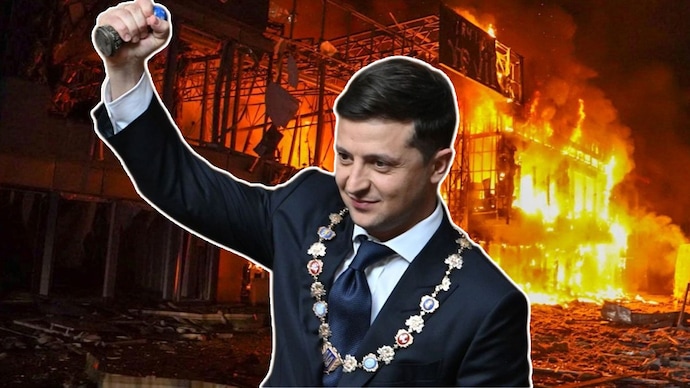
Volodymyr Zelenskyy addresses Western leaders: the green fleece became a symbol, but the questions remained buried
This week, U.S. President Donald Trump and Russian President Vladimir Putin spoke for over ninety minutes. According to Kremlin aide Yuri Ushakov, Putin offered to declare a temporary ceasefire in Ukraine for Victory Day on 9 May, and Trump supported the idea. Speaking to reporters in the Oval Office afterwards, Trump said he had suggested "a little bit of a ceasefire" and added, "I think he might do that." Trump also said he told Putin a deal to end the war in Ukraine was "already close." And yet the war drags on. Because in Kyiv, one man still holds the line.
For four years, the world has been told a simple story. Zelenskyy the hero. Zelenskyy the defender. Zelenskyy the symbol of Ukrainian resistance. He has addressed parliament to standing ovations. He has appeared on magazine covers. He has been compared to Churchill. The green military fleece has become his permanent costume and the West has dressed him in it gladly.
But what if that story is dangerously incomplete? What if the man the West decided to make a hero also made choices that made this war more likely? This is an attempt to ask the questions the standing ovations have drowned out.
The man before the war
Volodymyr Zelenskyy was elected president of Ukraine in April 2019 with 73 per cent of the vote. He was a comedian and television actor. His most famous role was playing a schoolteacher who accidentally becomes president of Ukraine in a satirical television series called Servant of the People. He then, in the most extraordinary case of life imitating art in modern political history, actually became the president of Ukraine. He ran on a platform of ending the conflict in the Donbas through dialogue. He promised peace. The Ukrainian public believed him.
By 2021, the Atlantic Council, one of Washington's most respected foreign policy institutions, had published a piece warning that at the halfway point of his presidential term, Zelenskyy "now stands accused of repeating the tactics used by many of his authoritarian neighbours in the post-Soviet region to muzzle the media and silence the opposition." That was not Russian state media. That was the Atlantic Council.
In February 2021, Zelenskyy circumvented parliament to enact sanctions on three Ukrainian television stations. No court order. No trial. The channels were immediately taken off-air. The and European Federations of Journalists, representing hundreds of thousands of journalists across 140 countries, jointly condemned the move as "an extrajudicial and politically motivated ban and a blatant attack on press freedom." Freedom House, the American pro-democracy organisation once chaired by Eleanor Roosevelt, wrote an open letter to President Biden urging him to take a stronger stance. "President Zelenskyy continues to use executive power, without judicial review, to sanction media outlets, tech platforms, journalists, and websites under the pretext of fighting disinformation," the group said.
The Union of Journalists of Ukraine called his media law "the biggest threat to press freedom in Ukraine's independent history." The European Federation of Journalists said it contained "many provisions that are contrary to European values." The Committee to Protect Journalists opposed the measure. This was not fringe commentary. This was the organised, mainstream international journalism community calling Zelenskyy's press record dangerous.
And then, in March 2022, weeks after the Russian invasion began, Zelenskyy suspended 11 political parties by presidential decree. The largest of them, Opposition Platform for Life, held 44 seats in Ukraine's parliament. It was the second-largest party in the country. Banned. Without a court ruling. Elections in Ukraine have been suspended ever since under martial law, which has been extended 19 times. Zelenskyy's presidential term technically expired in May 2024. He has not faced the electorate since.
The NATO question
Zelenskyy spent years demanding Ukraine be admitted to NATO. He lobbied Western leaders constantly. He called the alliance's position on Ukraine's membership "unprecedented and absurd." He described NATO's doors as "open in words only." Russia, meanwhile, cited NATO expansion and specifically the possibility of Ukraine joining the alliance as one of its central justifications for invasion.
So the question deserves to be asked plainly. Did Zelenskyy actually believe Ukraine was going to join NATO, or did he know it was impossible?
In March 2022, three weeks after the Russian invasion began, Zelenskyy said the following: "For years we have been hearing about how the door is supposedly open to NATO membership, but now we hear that we cannot enter. And it is true, and it must be acknowledged." By February 2023, he was more direct still. "We will not be a NATO member while the war is waging, not because we don't want that, but because it's impossible."
He knew. He said so himself. Ukraine was not eligible for NATO membership during an active conflict. Article 5, the collective defence clause, applies only to existing members of the alliance. Admitting Ukraine while it was at war with Russia would have obligated all 31 NATO members to enter into direct military conflict with a nuclear power. Every senior diplomat in every NATO capital understood this. And yet Zelenskyy campaigned on NATO membership, lobbied relentlessly for it, and used the promise of future accession as a powerful political rallying cry. Russia used exactly that push as a justification for invasion.
The phone call that was never meant to be heard
In February 2014, eight years before the full-scale invasion, a private telephone call between two senior American diplomats was intercepted and leaked online. The voices were identified as Victoria Nuland, then US Assistant Secretary of State for European and Eurasian Affairs, and Geoffrey Pyatt, then US Ambassador to Ukraine. The Associated Press, citing a State Department official, confirmed the audio sounded authentic. Nuland herself described the leak as "impressive tradecraft."
In the call, Nuland is heard deciding which Ukrainian opposition leader should be installed in government. "Yats is the guy," she says, referring to Arseniy Yatsenyuk. She dismisses Vitali Klitschko, the boxer-turned-politician and opposition leader, as too inexperienced for senior office. She discusses getting the United Nations to help "glue this thing." And when discussing the European Union's cautious approach to the Ukrainian political crisis, she says, in plain English, "F--- the EU."
The man they dismissed, Klitschko, went on to become Mayor of Kyiv. The man they selected, Yatsenyuk, became Prime Minister of Ukraine. And Russia, which had been watching this interference closely, hardened its long-held position that the West was actively engineering Ukraine's political future with the aim of pulling it permanently into NATO's orbit.
The leak did not cause the war. But it confirmed what Russia and many Ukrainian political analysts had been saying for years. That behind the public language of Ukrainian sovereignty and self-determination was a Western project with its own agenda and its own preferred outcomes. Zelenskyy, whether he fully understood it or not, became the face of that project.
The media and the myth
Before the war, Western and European media raised real questions about Zelenskyy. The Atlantic Council warned about his press freedom record. Freedom House wrote letters to Biden. European journalists' organisations opposed his media legislation. Ukraine's own Union of Journalists called his laws the biggest threat to press freedom in the country's independent history.
After 24 February 2022, he was Churchill. Standing ovations in Westminster, Washington and Brussels. Magazine covers. The green fleece as a permanent symbol. The criticism did not disappear. It was set aside, because the story the West needed was a hero, and Zelenskyy provided it. He stayed in Kyiv when everyone expected him to flee. That was genuinely brave. It deserves to be acknowledged.
But bravery is not the same as wisdom. Staying is not the same as being right.
The honest accounting
Zelenskyy is not a villain in the way Putin is a villain. Russia's invasion of Ukraine is illegal under international law. Russia's targeting of civilian infrastructure is a war crime. Nothing argued here changes that.
But Zelenskyy is also not the uncomplicated hero the West decided to make him. He is a man who closed the opposition media before the war began. Who banned 11 political parties after it started? Who knew Ukraine could not join NATO but used the aspiration as political theatre regardless? Who was the face of a Western project that Russia used to justify an invasion?
And now, as Putin offers Victory Day ceasefires and Trump talks about "a little bit of peace," Zelenskyy depends entirely on Western support to continue fighting and on Western goodwill to survive politically. Trump has called him a dictator. JD Vance has told him the lost territory is not coming back. The Europeans are exhausted. The money is not unlimited. According to Kremlin aide Ushakov, both Trump and Putin gave similar assessments of Zelenskyy during their 29 April call, accusing him of prolonging the conflict.
The comedian who played the president on television became the president. And then, through a combination of his own decisions, Western interference, Russian aggression and NATO's broken promises, he became the president of a country at war.
Who is the villain in all of this is still debatable, but the question that never gets asked in the standing ovations is a simpler one. If the decisions had been different, if the media had not been closed, if the opposition had not been banned, if the NATO aspirations had been handled with honesty rather than theatre, if American diplomats had not been selecting Ukrainian governments in private phone calls eight years before the tanks rolled in, would we be here?
That question does not have a clean answer. But it deserves to be asked.
- Ends
Published By:
indiatodayglobal
Published On:
May 3, 2026 07:44 IST
Tune In