1 month ago
The February 12 Bangladesh elections will see a direct clash between Tarique Rahman's Bangladesh ist Party (BNP) and the Jamaat. Both parties released their poll manifestos this week, outlining their stance towards India and Hindus.
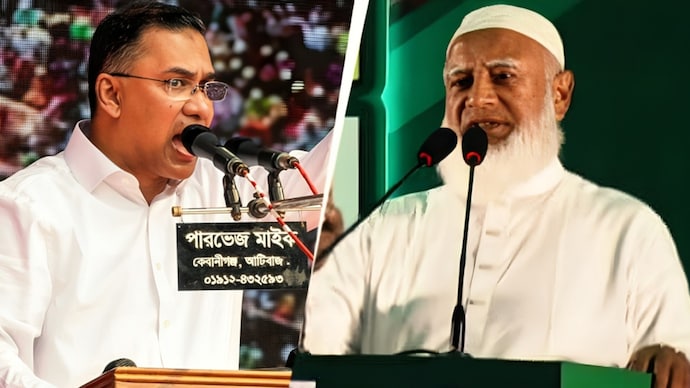
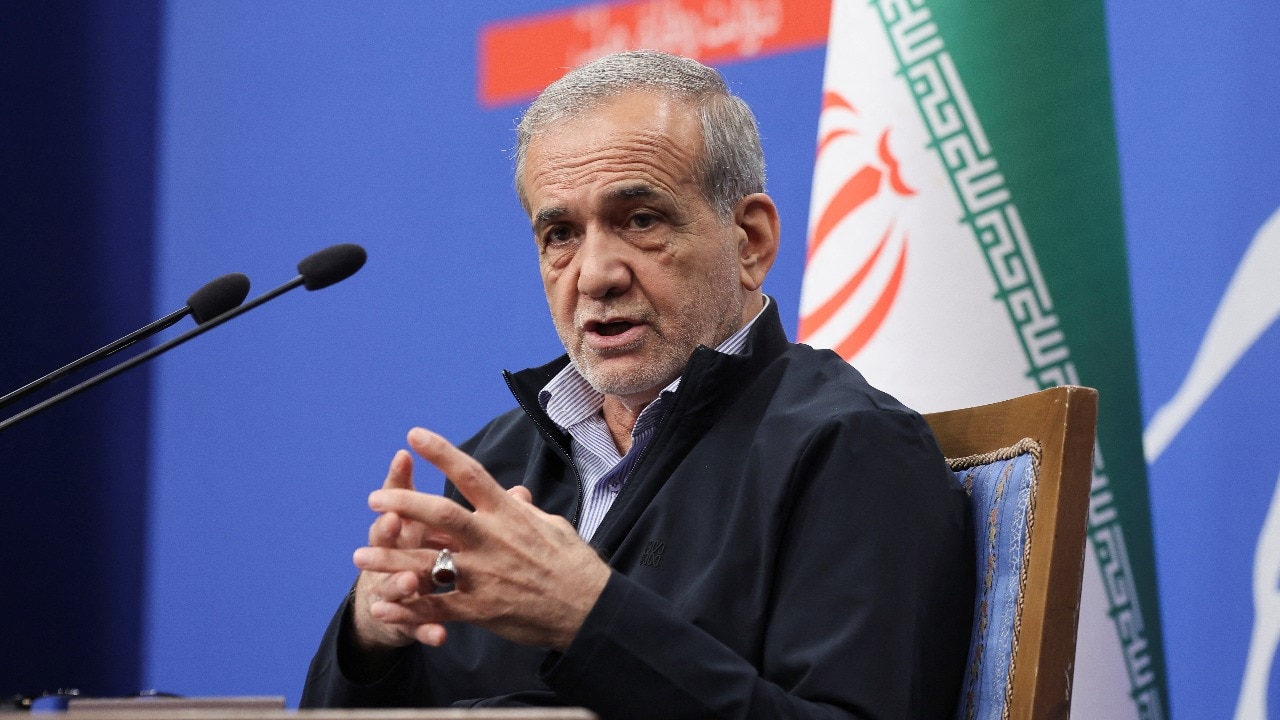
Bangladesh ist Party chief Tarique Rahman and Jamaat's Shafiqur Rahman

New Delhi,UPDATED: Feb 6, 2026 17:21 IST
With just a week left for the crucial Bangladesh elections, the first since the overthrow of Sheikh Hasina, the two major parties have outlined their future foreign policy and stance towards India if they form the government. For India, the stakes are exceptionally high, at a time when ties under interim chief Muhammad Yunus have hit an all-time low. Thus, the manifestos of the Tarique Rahman-led Bangladesh ist Party (BNP) and the Jamaat-e-Islami hold significance for Delhi amid rising anti-India sentiment and attacks on Hindus in its backyard.
Over the past decade, India put all its eggs in the Awami League basket and cultivated close ties with Hasina, who fled to India in 2024 during the student-led protests. Hasina maintained a safe distance from Pakistan and walked a tightrope with China. The situation has taken a U-turn under Yunus, who has reset Bangladesh's ties with Pakistan and given political space to radical Islamist elements who have frequently spewed anti-India venom.
WHAT BNP SAID ON INDIA IN MANIFESTO?
Against this backdrop, BNP, which was headed by Hasina's rival Khaleda Zia before Rahman took over last year, is being seen by India as a more liberal and democratic option. Even though ties between India and the BNP have been historically rocky.
Unveiling the BNP election manifesto on Friday, with the tagline 'Shobar Aage Bangladesh' (Bangladesh First), Rahman pledged to treat other nations as friends, and not "masters". It suggests that Bangladesh won't be a proxy of any country.
Addressing a packed gathering in Dhaka, where he returned in December last year, ending a 17-year exile, Rahman said Bangladesh would establish relations with other nations based on equality and self-respect.
"Bangladesh shall not interfere in the internal affairs of other countries, and will not accept interference in its own affairs," he further said.
This is crucial, coming amid provocative remarks by Bangladeshi leaders on severing India's vulnerable Chicken's Neck corridor and the landlocked northeast region.
Last year, Yunus rankled India after he brought up India's "landlocked" northeast region during his visit to China. The Nobel Laureate claimed that Bangladesh was the "only guardian of the ocean" in the region, as northeast India was "landlocked". He also encouraged China to expand its influence in the region and boost its economy.
This was seen by India as infringing upon its internal affairs, which it vehemently opposes. Thus, Rahman's assurance in this aspect will be welcome by New Delhi.
In fact, on several occasions, Rahman has categorically made it clear that the BNP would not align with either Pakistan or India if it came to power. "Not Dilli, Not Pindi, Bangladesh before everything," Rahman had said.
WHAT JAMAAT SAID ON INDIA IN ITS MANIFESTO?
Even though Rahman did not explicitly mention India while releasing his party's manifesto, the Jamaat specifically talked of maintaining "friendly and cooperative" relations with New Delhi. Interestingly, there was no mention of Pakistan in its manifesto, released by its president, Shafiqur Rahman, on Wednesday.
"Peaceful, friendly. and cooperative relations will be built with India, Bhutan, Nepal, Myanmar, Sri Lanka, Maldives, and Thailand, based on mutual respect and fairness," the manifesto said.
- Ends
Published By:
Abhishek De
Published On:
Feb 6, 2026