2 hours ago
The United Arab Emirates has decided to end funding for Emirati students studying in UK-based universities due to fears they might get radicalised by Islamic terrorist group Muslim Brotherhood in British educational institutions. Ties between the UK and the UAE have become strained over multiple issues.
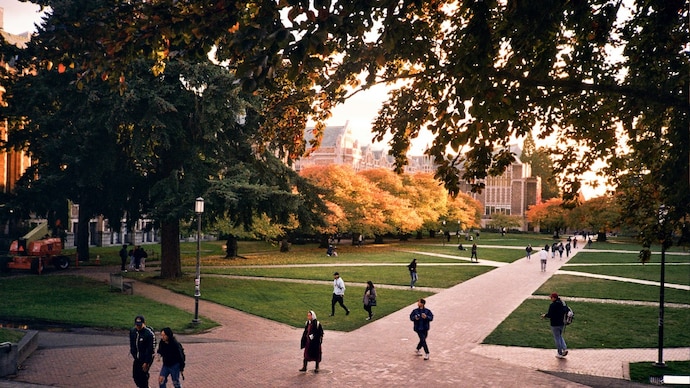
UAE ends funding for students studying in UK over radicalisation fears. (Image: Unsplash)
The United Arab Emirates (UAE) has moved to restrict state funding for its citizens seeking to study at British universities, alleging its students could get radicalised by Muslim Brotherhood elements in the British education system. This comes after the British government's refusal to ban the Muslim Brotherhood, which has been designated a terrorist outfit by the UAE and several other Islamic countries.
Though the funding for scholarships was cut in June last year, it became widely known because of reports in British dailies — the Financial Times and The Times — last week.
According to the reports, the UAE Ministry of Higher Education released a revised list of overseas universities eligible for government scholarships and official degree certification. While the list included institutions across the US, Australia, France and Israel, names of British universities were visibly excluded despite the UK being home to many of the world's top-ranked academic institutions.
People familiar with the discussions told the Financial Times that the exclusion was intentional. When British officials raised questions about the omission, Emirati officials said it was not an oversight. One person with direct knowledge of the exchanges said the concern was straightforward. "[The UAE] don't want their kids to be radicalised on campus," the source said. British officials responded by emphasising the importance of academic freedom.
WHY HAS THE UAE CUT FUNDS TO SEND STUDENTS TO THE UK?
According to the Financial Times, Emirati anxiety centres on what it views as the risk of Islamist influence on British campuses, particularly linked to the Muslim Brotherhood. The UAE designates the Brotherhood as a terrorist organisation and has long pushed European governments to follow suit. Britain, however, has resisted such calls. A comprehensive UK government review in 2015, after warnings from Saudi Arabia, concluded that while the group's beliefs were at odds with British values, it could not find any evidence linking it to terrorist activity in or against the UK.
The issue has gained renewed attention amid heightened political activism on campuses following the Israel-Hamas war after the terror attack on the Jewish nation on October 7, 2023.
According to the Financial Times, a UK-based academic acknowledged that the conflict had a "destabilising impact" on universities but downplayed claims of widespread Islamist activity. Official data cited by the paper shows that in the 2023 -24 academic year, 70 students out of nearly three million in higher education were reported for possible referral to the Prevent deradicalisation programme for signs of Islamist radicalisation, nearly double the previous year.
The UAE's position is rooted in its broader domestic and regional policies. According to The Times, Abu Dhabi views the Muslim Brotherhood as a serious threat to its autocratic yet relatively secular political system. Dozens of suspected members have been jailed, and the UAE backed Egypt's military takeover in 2013 to remove President Mohamed Morsi, who was linked to the Muslim Brotherhood. The UAE has also supported factions in Libya and Sudan that it believes oppose the group.
The subsection below gives a background of the Muslim Brotherhood. You can skip it if you know about its history, to continue reading about the UAE's funding cut for scholarships to students studying at British universities.
WHAT IS THE MUSLIM BROTHERHOOD?
The Muslim Brotherhood or the Ikhwan al-Muslimun is a transnational Sunni Islamist organisation founded in 1928 in Ismailia, Egypt, by Hassan al-Banna, a schoolteacher and Islamic scholar. It emerged in response to the Ottoman Caliphate's collapse, Western colonialism, and secular influences and aims to revive Islamic society by applying precepts from the Quran and Hadith comprehensively to personal, social, and political life.
Its core ideology views Islam as a complete system ("Islam is the solution"), promoting gradual reform through education, charity, and political participation in Sharia-governed societies.
According to a paper by the US-based think-tank, Brookings Institution, the group was initially a rather fringe organisation, until the 1967 Six Day War, when Israel's military victory over Egypt, Iraq, Jordan and Syria led to the decline of secular Pan-Arab ism in favour of Islamism. The group renounced internal violence in the 1970s after early militant phases, including assassinations, though offshoots like Hamas, which emerged from a Brotherhood linked charity in 1973, continue to engage in armed struggle, according to the Council on Foreign Relations.
The Muslim Brotherhood briefly held power in Egypt post-Arab Spring between 2011 and 2013, with Mohamed Morsi elected president before a 2013 military coup led to severe repression, mass arrests, and designation as a terrorist group in Egypt, according to Reuters and Al Jazeera reports. As of January 2026, it faces bans or terrorist designations in several countries, including Egypt, Saudi Arabia, the UAE, Russia, and Jordan, amid US efforts under the Trump administration to designate specific branches in Egypt, Lebanon, and Jordan as foreign terrorist organisations, according to the BBC and Al Jazeera. According to media reports from the BBC and Al Jazeera, it retains influence via affiliates in Tunisia, Morocco, and exile networks, often backed by Qatar and Turkey.
IMPACT OF UAE's SCHOLARSHIP BAN ON BRITISH UNIVERSITIES
According to The Times, Emirati officials have for years warned Western democracies that the Brotherhood was spreading Islamic extremism across Europe. This pressure helped prompt a UK enquiry launched by David Cameron's government in 2014. While the enquiry, led by John Jenkins, criticised the Brotherhood's ideology, it stopped short of recommending a ban.
In practical terms, the UAE has not imposed a total ban on studying in Britain. According to The Times, wealthier families can still send their children to UK universities if they pay fees privately, while generous government grants continue for students choosing other countries. These scholarships typically cover tuition, living expenses, travel and health insurance for top-performing students in priority fields.
However, the impact on student numbers is already visible. According to the Financial Times, the number of UAE citizens granted visas to study in the UK fell by 27% as of September 2025 and by 55% compared with 2022. Federal funding for new students heading to Britain had already been denied before June, although students already enroled were allowed to continue receiving support.
BRITISH DEGREES OF REDUCED VALUE IN UAE NOW
The UAE has also indicated it would not recognise degrees from institutions outside its approved list. According to the Financial Times, this significantly reduces the value of UK qualifications for Emiratis returning home, even if they complete their studies independently.
The education dispute is the latest strain in a relationship that has faced several recent flashpoints. According to the Financial Times, these include controversy over an Abu Dhabi-backed attempt to buy The Daily Telegraph in 2023, allegations that the UAE supported paramilitary forces in Sudan which it denies, and an ongoing Premier League case involving Emirati-owned Manchester City over financial rules.
The row has emerged despite the UAE becoming an increasingly popular destination for British universities to open overseas campuses. According to the Financial Times, institutions such as the University of Manchester and Heriot-Watt University now have campuses in Dubai.
Political dynamics in Britain have also intersected with the issue. According to the Financial Times, far-right politician Nigel Farage has vowed to ban the Muslim Brotherhood if he becomes prime minister and the UAE government paid for him to visit the country last year.
Despite the tensions, officials on both sides have played down the damage. A UAE official told the Financial Times that bilateral relations remained strong. Downing Street said, "All forms of extremism have absolutely no place in our society, and we will stamp them out wherever they are found. We offer one of the best education systems in the world and maintain stringent measures on student welfare and campus safety."
For all the diplomatic niceties, it remains a fact that the UAE has stopped funding scholarships for its students planning to study in the UK over fears that they might get radicalised by Islamic ideologies of the Muslim Brotherhood.
- Ends
Published By:
Shounak Sanyal
Published On:
Jan 12, 2026