1 month ago
Sold a fantasy by Israel, trapped by his own overconfidence, and staring down oil at $200 a barrel, Donald Trump is running out of road in a war he never planned beyond Day Four. Analyst Trita Parsi tells India Today Global the exit ramp is closing fast.
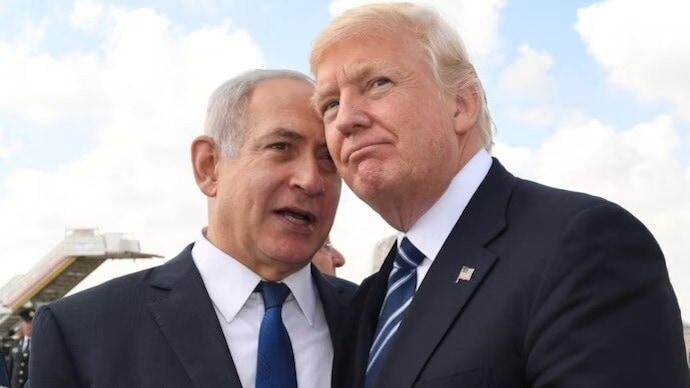
Israeli Prime Minister Benjamin Netanyahu (left) with US President Donald Trump. (Photo: AP)
When Donald Trump launched his military campaign against Iran, he was promised it would be over in four days. Two months later, the Strait of Hormuz remains closed, oil prices are masking a deepening global energy crisis, and Tehran shows no signs of surrender. Far from the swift, decisive victory Benjamin Netanyahu sold him, Trump now finds himself improvising a war he has no strategy to end – and no clear path to win.
In an exclusive interview with India Today Global's Senior Executive Editor Geeta Mohan, Trita Parsi, Executive Vice President of the Quincy Institute for Responsible Statecraft, delivers a stark and unflinching assessment: Israel is driving the war, Trump is following, the MAGA base will fracture when body bags arrive, and the United States has likely shattered its military credibility in West Asia - perhaps permanently. The window for an honourable exit, Parsi warns, is closing by the day.
Q: Trump is saying he's speaking to a responsible new regime in Iran, while also threatening to attack power plants if the Strait of Hormuz isn't opened. What's your first reaction?
A: By now we should expect that every Monday morning, right before markets open, Trump will issue some sort of tweet that is both threatening but also gives the impression that he is in control of the situation and that this war is coming to a close end. I don't think we should take it particularly seriously. There are no signs that anything serious is happening on the diplomatic front, nor are there any signs that Trump is actually in control of this war. He has intervened orally several times to calm the markets, but at some point those interventions will no longer have much effect.
Q: But the threat to power plants is real. With Pakistan possibly acting as a messenger and Iran rejecting direct talks, is the threat credible?
A: He has issued these threats several times and has not acted on them. However, the Israelis are going after much of Iran's infrastructure right now, including universities. This is an important point — the United States never deliberately targeted universities in Afghanistan or Iraq. The Israelis destroyed almost all universities in Gaza, and now they're openly admitting to targeting universities in Iran. It leaves you with the impression that it's the Israelis driving the bus on this war, not Trump, because the manner in which this war is being conducted reflects the Israeli way of warfare, not the American way of warfare.
Q: So you're saying this is an Israeli playbook and Trump is taking his cue from Netanyahu?
A:He started this war taking his cue from Netanyahu. He thought — as he was promised by Netanyahu — that this would be an easy war. He told regional leaders it would take four days for the Iranians to surrender or for the regime to collapse. That obviously didn't happen. He never had a Plan B, and ever since, he's been either improvising or following the Israeli lead. That is part of the reason why this has now entered its second month.
Q: Trump keeps insisting he's in conversation with a "new regime" in Iran, even as Iran says negotiations are off the table. What do we make of that?
A: He's doing it to calm the markets — to make them think there is a diplomatic process in place, that he's winning, that the Iranians will surrender, and that the energy crisis won't last much longer. He has been quite successful in manipulating the markets through oral interventions. The real price of oil should be above $150, but the paper price is still around $120 because of these interventions. However, they will not succeed in the long run unless there is actual change on the ground. For that, Trump needs a far more realistic negotiating position. What he keeps offering the Iranians are essentially terms of surrender — completely detached from ground realities, where Iran continues to control the Strait of Hormuz and is finding it increasingly easier to strike at Israel and at GCC infrastructure as Israeli air defense missiles run low.
Q: For someone who knows Iran inside out — will Iran ever concede defeat? Is there a middle ground?
A: Iran will never concede defeat and certainly not surrender. But what you're pointing to — an exit ramp where both sides can declare a degree of victory — is absolutely plausible. At a minimum, it would require sanctions relief for Iran. Trump can still declare victory; for instance, if he gets Iran to agree to sell at least half its oil in U.S. dollars instead of yuan, that alone could be framed as an American win. There is still a space where both sides can get something and walk away feeling they came out ahead. But that window will close very quickly if Trump doubles down and sends in ground troops — whether to take an island or strike the Iranian mainland. At that point, he will have crossed the Rubicon and declaring any form of victory becomes very difficult.
Q: How likely is a ground invasion — even a limited one targeting islands at the mouth of the Strait?
A: Unfortunately, I find it very likely. Trump is increasingly looking at these options, hoping they will be some sort of silver bullet to turn the war in his favor. I don't think they will be. Two mistakes don't make a solution. The psychological distance Trump has to travel — from believing this war would end in four days to now recognizing he'll need to make significant compromises — is enormous. That makes it more likely he will double down rather than accept that reality. If he does, it will be increasingly difficult for him to avoid having his presidency defined and destroyed by this war, in the same way the illegal invasion of Iraq defined and destroyed George W. Bush's presidency.
Q: If there are ground troops, there will be body bags. Won't that cost Trump his midterm elections?
A: You've put your finger on something critical. So far, Trump's base has not turned against this war partly because the United States has been somewhat insulated from the energy shocks — gas prices have risen, but America is not facing a crisis the way the Philippines, Pakistan, or increasingly India are. But once body bags start coming home — which is a very likely outcome of any ground invasion — it will be tremendously difficult to keep the MAGA base on his side. That is why crossing the Rubicon is so dangerous for him. Right now, even if no one else buys his narrative of victory, as long as his base does, he has a path out. Once his own base turns against him, he has no off-ramp. His situation becomes dramatically worse.
Q: How did the Trump administration fail to game this war and anticipate its horizontal expansion?
A: A couple of factors. First, the Israelis were very effective in pushing the narrative that Iran is so weak it's about to collapse — a house of cards, a paper tiger. All you need to do is push a little and you'll be the hero who got rid of this regime. Trump was genuinely lulled into believing this, and his willingness to believe it was amplified by what he saw as success in Venezuela — he was on a sugar high thinking he could do anything. At the same time, Iran's own conduct over the last few years contributed to this misreading. Iran's strategy of "strategic patience" meant they absorbed hits without striking back very hard — often responding proportionately or below proportionately to avoid further escalation. This reinforced the paper tiger image. All of these factors came together and produced a state of superior overconfidence in Trump. Now we're seeing the consequences.
Q: Iran's former foreign minister Araghchi gave us an interview before the Geneva talks saying Iran was willing to accept all reasonable terms — civil nuclear programme, IAEA inspections, full access. Trump should have taken that rather than listening to Netanyahu, shouldn't he?
A: Absolutely. And this is part of why ending the war now looks unattractive to Trump compared to where he started. He's comparing an unsatisfying exit today with the dream of a silver bullet through ground troops that could still deliver him a clear-cut win. The problem is that silver bullet may not exist — it may be the same illusion that got him into this war in the first place. And yes, he will face enormous scrutiny — from Democrats, from congressional hearings asking what evidence there was that Iran was actually going to attack.
Q: Beyond Hormuz, the Houthis control the Red Sea and Bab-el-Mandab. How dangerous is the energy security picture?
A: It will be absolutely devastating if both choke points are fully closed. The only reason we don't have a deeper crisis already is that markets are banking on Trump backing down, as he has in other situations — Greenland and elsewhere. They're not fully pricing in how bad the actual situation is. Right now, several million barrels a day are flowing through a Saudi pipeline to the Gulf of Aden, bypassing the Strait of Hormuz, which is dampening the impact somewhat. But if the Iranians or Houthis were to target that pipeline, the energy shortage becomes even more severe. At some point, the real price of oil will enforce itself on the paper price.
Q: You mentioned $150 per barrel as the real price. Could it go to $200?
A: Right now I think it should be around $150. If the Red Sea is fully closed, it could get closer to $200 — which is exactly what Iran has been saying. That outcome becomes very likely unless Trump recognises that all his escalatory options carry more risk than reward and takes the exit ramp that exists right now. He can already point to several things and construct a narrative of success. If he does it now, before body bags arrive, he'll face criticism from Democrats and the pro-Israel lobby — but his base will still be with him. If he waits too long, that base starts to erode, and he'll be in a far worse position.
Q: What does Netanyahu stand to gain or lose if America retreats?
A: Netanyahu has already gained quite a lot. Iran has been set back dramatically — its infrastructure and industrial base have been heavily targeted. And this makes clear that the objective was never just the nuclear programme or the missiles — it was about bombing Iran back to the Stone Age so Israel has clear regional dominance with no Iranian challenge to its hegemonic designs. From Netanyahu's perspective, he would prefer this war to continue for several more months. But even if it stops today, he will have gained significantly, while facing serious political fire at home in the short run.
Q: Has this war permanently changed the status of the Strait of Hormuz? Iran has listed control over it as one of its five conditions. Has Trump effectively changed how the world does business?
A: One of the lasting outcomes of this war will be that the threat of American military force will have completely lost its credibility in any future negotiations with Iran. It did not achieve its objectives and came at a tremendous cost. The Iranians can now control the Strait of Hormuz through missiles and air dominance in ways they could not 20 years ago. However, for this to be sustainable long-term, there will likely need to be a formal agreement between Iran and Oman — the two countries bordering the Strait — similar to arrangements around the Suez Canal or Panama Canal. A unilateral Iranian imposition of control is not sustainable. But with an Oman agreement, they could well have international law on their side. The bottom line is that this war has changed the balance of power in the region fundamentally.
Q: Trump's comments about MBS having "no choice but to kiss his behind" — what does that tell us about how Saudi Arabia views this relationship now?
A: It is undoubtedly insulting, and the Saudis have every right to feel insulted. But it is also a reminder to them of the danger of putting all their eggs in the American basket rather than diversifying their security or trying to reach terms with Iran. Trump appears to take genuine pleasure in insulting countries that are dependent on the United States — he treats Saudi Arabia the same way he treats Europe. MBS will not take this lightly.
Q: Is the era of America as the net security provider for the Gulf over?
A: Absolutely. Some GCC states are likely to move in that direction because they may have no choice. They are rightfully angry at Iran for having struck their territories. But their reliance on the United States proved to be largely useless — not just because the technology wasn't as superior as they believed, but because the US prioritised Israel's security over theirs. And when the US actually went to war, it emptied those bases and pulled its own soldiers out. So instead of providing security, the bases became a source of insecurity. The problem is that these countries cannot easily pivot — fully abandoning the US would be unwise, moving toward Iran is unattractive, and diversifying their security basket is also challenging. So all the foundational assumptions about security in the Middle East and the Persian Gulf are now up for fundamental reconsideration after this war.
- Ends
Published By:
indiatodayglobal
Published On:
Mar 31, 2026 05:18 IST
Tune In