1 month ago
After warning his patience with Iran was running out, Donald Trump said aboard Air Force One after talks in Beijing the US could accept a temporary but enforceable nuclear deal.
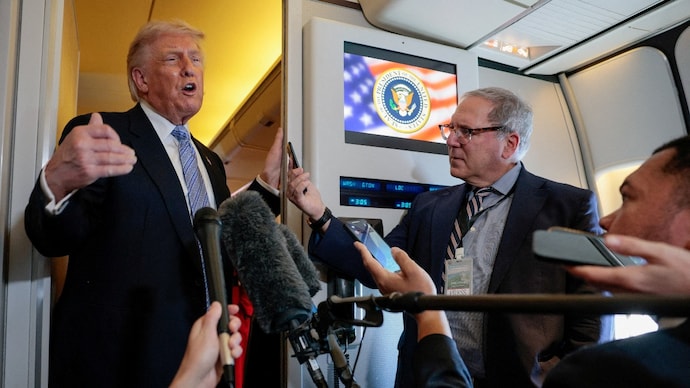
US President Donald Trump speaks to the press aboard Air Force One en route to Washington following his official visit to China on May 15, 2026. (Photo: Reuters)

New Delhi,UPDATED: May 16, 2026 07:56 IST
US President Donald Trump has signalled a notable softening in his position on Iran’s nuclear programme, saying he could accept a verified 20-year suspension instead of insisting on a permanent shutdown. The remarks mark a shift from his earlier demand that Tehran permanently end uranium enrichment and never obtain nuclear weapons.
This comes after his earlier warning that his patience with Iran was "running out" amid stalled negotiations over ending the conflict and restoring regional stability.
Speaking to reporters aboard Air Force One after his talks in Beijing with Chinese President Xi Jinping, Trump said the US could accept a temporary but enforceable arrangement.
When asked whether a 20-year suspension was sufficient, he replied, "Twenty years is enough, but the level of guarantee from them, in other words, it's got to be a real 20 years".
His comments are the clearest indication yet that Washington may be open to compromise as negotiations continue through back-channel diplomacy.
The statement marks a significant departure from Trump’s long-held stance.
During his first term, he withdrew the US from the 2015 Iran nuclear agreement negotiated under President Barack Obama, arguing that its so-called sunset clauses allowed Tehran to eventually resume nuclear activities.
He had repeatedly insisted in recent months that Iran must permanently halt uranium enrichment and never be allowed to develop a nuclear weapon.
The US President’s latest comments suggest the White House may now be prepared to accept a time-bound restriction if it includes strong verification measures.
TRUMP-XI ON SAME PAGE ON IRAN?
Trump’s "20-year-suspention" remark came while he was on his way back to Washington after he concluded a two-day China visit, where he held elaborate talks with his Chinese counterpart Xi Jinping, discussing several geopolitical issues.
Trump said he and Xi had agreed that Tehran must never acquire nuclear weapons and that the Strait of Hormuz should be reopened to ensure energy supplies continue flowing.
"We don't want them to have a nuclear weapon, we want the straits open," Trump said during the Beijing talks.
While Beijing did not publicly confirm the full scope of those discussions, China said the conflict should end and reiterated opposition to further escalation in the Gulf.
MIDDLE EAST CONFLICT FAR FROM OVER?
Trump’s remarks came as the broader conflict with Iran remains unresolved despite a ceasefire that has largely held since last month.
US and Israeli forces launched large-scale strikes on Iran on 28 February, targeting military and nuclear-linked facilities.
A truce brokered by Pakistan has reduced direct hostilities, although sporadic exchanges of fire have continued.
Islamabad has also hosted direct negotiations between the two sides, with US Vice President JD Vance reportedly demanding at least a 20-year halt after Iran proposed a five-year suspension.
Iran has tied any broader settlement to conditions beyond the nuclear issue.
Iranian media said Tehran’s latest proposal included an immediate end to the war on all fronts, including attacks on its ally Hezbollah in Lebanon, an end to the US naval blockade, and guarantees against further strikes.
Iran has also refused to reopen the Strait of Hormuz fully until the blockade is lifted, a move that has disrupted global shipping and pushed up oil prices.
IRAN HOPEFUL OF DIPLOMACY
Iranian Foreign Minister Seyed Abbas Aragchi said Tehran had received signals that Washington remained interested in diplomacy.
"We hope that, with the advancement of negotiations, we will reach a good conclusion so that the Strait of Hormuz can be completely secured, and we can expedite the normalisation of traffic through the strait," he said during a visit to New Delhi, where he attended the BRICS Foreign Ministers’ summit.
Trump's latest posture on Iran underscores a fragile opening in talks, but major differences remain over uranium stockpiles, sanctions relief and security guarantees.
Trump’s acceptance of a long-term suspension instead of a permanent ban may create room for further negotiations, though both Washington and Tehran continue to warn they are prepared for renewed confrontation if diplomacy fails.
- Ends
Published On:
May 16, 2026 07:56 IST