1 month ago
Trump is 'tearing apart' transatlantic partnership, 'ripping up' democratic norms, Ocasio-Cortez warns
In the Q&A, Ocasio-Cortez gets asked about her presence in Munich and the signal she wants to send by being involved in these discussions here.
She says:
“I think this is a moment where we are seeing our presidential administration tear apart the transatlantic partnership, rip up every democratic norm, and … really calling into question, as was mentioned by Mark Carney at the World Economic Forum, the rules based order that we have, or, question mark, do we have?”
She lays out her pitch for the need to address hypocrisies in the international order:
“But that does not mean that the majority of Americans are ready to walk away from a rules-based order and that we’re ready to walk away from our commitment to democracy.
I think what we identify is that in a rules-based order, hypocrisy is vulnerability.
And so I think what we are seeking is a return to a rules-based order that eliminates the hypocrisies … when, too often, in the West, we’d look the other way for inconvenient populations to act out these paradoxes, whether it is kidnapping a foreign head of state, whether it is threatening our allies to colonise Greenland, whether it is looking the other way in a genocide.
Hypocrisies are our vulnerabilities and they threaten democracies.
And so I think many of us are here to say we are here and we are ready for the next chapter, not to have the world turn to isolation, but to deepen our partnership on greater and increase commitment to integrity to our values.”
She gets good reception from the audience here with a round of applause.
Key events 3m ago Macron urges leaders to 'speak about homework behind closer doors and deliver' 7m ago Macron says he wants send message 'of hope and determination' on Europe's future 10m ago Denmark, Greenland hold 'constructive' talks with US 14m ago France's Macron about to address Munich Security Conference 15m ago Quick look at bilateral meetings at Munich Security Conference 22m ago US ‘not powerful enough to go it alone’, Merz tells Munich conference 29m ago UK foreign minister 'hugely sceptical' of Putin's commitment to peace, calls for pressure on Russian economy 32m ago Three points yet to be agreed in 20-point plan for ending Russian invasion of Ukraine, foreign minister Sybiha says 1h ago Trump is 'tearing apart' transatlantic partnership, 'ripping up' democratic norms, Ocasio-Cortez warns 1h ago Trump repeats his endorsement of Hungary's Orbán hours after Merz's criticism 2h ago MSC Townhall room packed as Ocasio-Cortez makes Munich debut 2h ago Trump 'most destructive president' ever, Newsom says 3h ago Watch out for Macron's language on Europe and nuclear deterrence - snap analysis 3h ago Europe needs strength to face new global 'disorder,' Denmark's Frederiksen says in diplomacy push 4h ago Palpable US-EU tension on how new world order could look like - snap analysis 4h ago US under Trump 'returning world from the brink,' Waltz insists as he rejects criticism 4h ago Trump will 'do for UN what he's done for Nato' over last decade, US Waltz says 5h ago Merz's speech will set tone of Munich talks on reshaping US relations - snap analysis 5h ago Merz's Hungary comments will spark reaction - snap analysis 5h ago 'I don't want to lose you,' Germany's Merz tells EU candidate countries 5h ago Russia not yet willing to talk seriously about Ukraine, Merz warns 5h ago Europe needs to resolve its 'self-inflicted' dependency on US to rebalance transatlantic relations 5h ago 'In era of great power rivalry, even US will not be powerful to go alone', Merz says 5h ago Merz rebukes US criticism of Europe 5h ago 'If Europe is torn apart, we are torn apart,' Merz talks on EU alliances 5h ago Merz calls for discussion on EU's 'mutual assistance' clause 5h ago 'Big power politics' in Europe is not an option for Germany, Merz says 5h ago 'Turn switch in our minds' to make Europe superpower and face chaos of new world order, Merz says 5h ago World order as we know it 'no longer exists,' Germany's Merz warns 6h ago MSC's Ischinger puts leaders on spot as he lists pointed 'serious' questions 6h ago Munich Security Conference gets under way 6h ago 'Ladies and gentlemen, please take your seats now' 6h ago Nato's Rutte expects Rubio to press Europeans to 'take more leadership role' in alliance 6h ago Zelenskyy welcomes first joint Ukrainian-Germany drone manufacturing line 6h ago Focus on Ukraine with Zelenskyy, foreign minister Sybiha attending side events 7h ago German chancellor Merz arrives ahead of his Munich speech 7h ago What does Europe’s future look like? - Q&A with Jon Henley 7h ago 'No shah, no mullah' Iran protest outside Munich conference 8h ago US Rubio expected to speak with Danish, Greenlandic leaders on sidelines of Munich conference 8h ago Key events of the day 8h ago What to expect from 2026 Munich Security Conference? - video 8h ago Nato's Rutte talks up 'shift in mindset' among leaders as he warns against falling for Russian propaganda 8h ago EU's von der Leyen, Nato's Rutte arrive for talks in Munich 9h ago We only see tip of iceberg as Munich becomes place to do business this weekend - snap analysis 9h ago Rubio lands at Munich airport ahead of key speech 9h ago Europeans 'want honesty, want to know where we are going', Rubio says ahead of Munich speech 10h ago Morning opening: World order 'under destruction' 10h ago Opening Summary Show key events only Please turn on JavaScript to use this feature
Macron urges leaders to 'speak about homework behind closer doors and deliver'
Macron defends Europe in a love letter to its postwar political history as he says it is “a radically original political construction of free, sovereign states.”
He repeats some of his usual lines that the EU must be successful if other countries, for example from the western Balkans region, continue to want to join it.
“Everyone should take their cue from us, instead of criticising us or trying to divide us,” he says.
He then praises Europe’s achievement in a number of fields.
He eventually admits that “obviously, we have to fix a lot of things” (disappointingly, he doesn’t say “fo shure” here), as he urges fellow leaders to “speak about our homework behind closed doors, and let’s deliver.”
He then turns to Ukraine.
Macron says he wants send message 'of hope and determination' on Europe's future
Macron is speaking now and he hits a very positive note from the get-go.
He says he “wanted to come today in front of you with a message of hope and determination.”
“Where some see threats, I see our fortitude, where some see doubts, I want to see opportunity, because I believe that Europe is inherently strong and can be made even stronger yet.”
He says that “there has been a tendency these days, in this place and beyond, to overlook Europe and sometimes to criticise it outright.”
He says “Europe has been vilified as an ageing, slow, fragmented construct, sidelined by history as an overregulated, liveless economy that shuns innovation as a society [fall] prey to barbaric migration that would corrupt its precious traditions, and most curiously yet, in some quarters, as a repressive continent where … where speech would not be free, and alternative facts could not claim the same right of place as truth itself.”
He says he wants to offer “completely different view.”
Denmark, Greenland hold 'constructive' talks with US
In the meantime, we are getting a word that Denmark’s Frederiksen and Greenland’s Nielsen had a “constructive” meeting with Rubio, as previously announced (11:41).
“Work will continue as agreed in the high-level working group,” Frederiksen said, posting a snap from their meeting on X.
France's Macron about to address Munich Security Conference
OK, the wait is over: France’s Emmanuel Macorn is going to speak imminently.
Quick look at bilateral meetings at Munich Security Conference

Jakub Krupa
in Munich
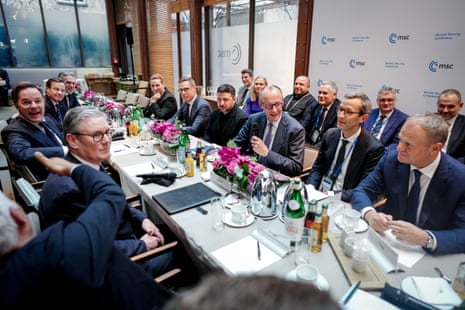
I keep telling you about all these meetings taking place behind the closed doors, as leaders have a chance to talk to each other far away from the pesky reporters and bloggers listening to everything they say on the main stage.
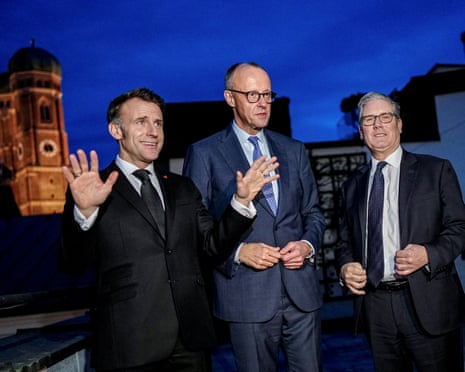
So let’s take a look at some of these meetings today, including the E3 meeting between Germany, France, and the UK, and a larger European lunch with Ukraine’s Volodymyr Zelenskyy.
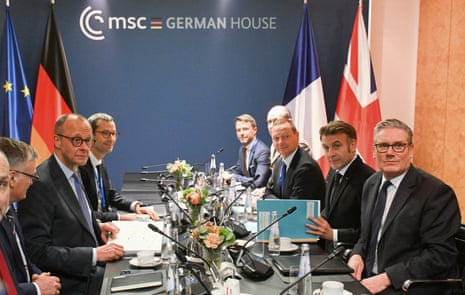
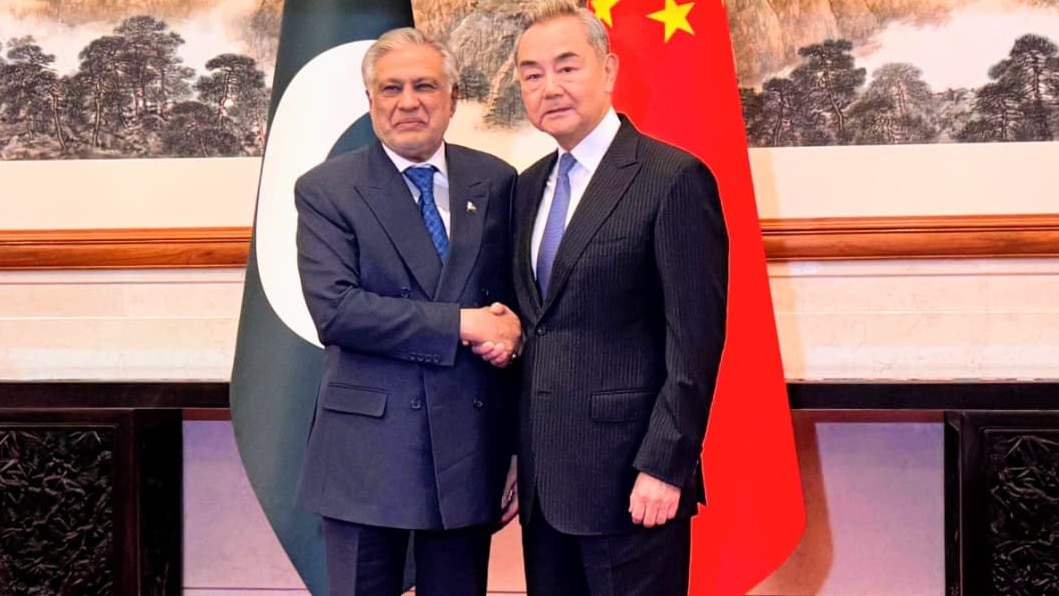
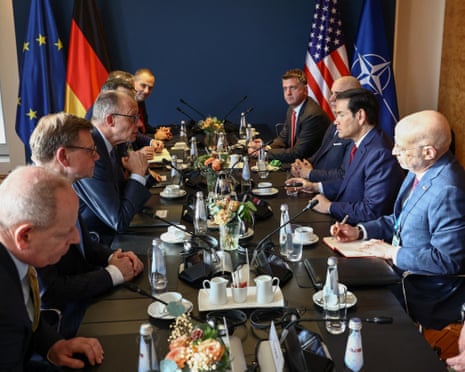
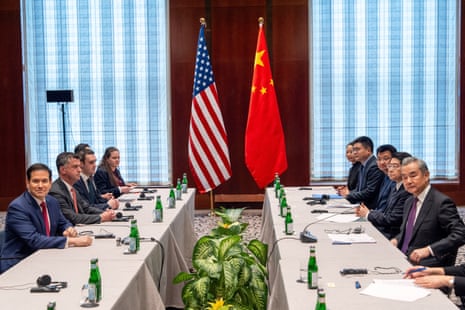
US secretary of state Marco Rubio has been busy too meeting with Merz, but also with China’s foreign minister Wang Yi.
US ‘not powerful enough to go it alone’, Merz tells Munich conference

Patrick Wintour
Diplomatic editor
in Munich
The US acting alone has reached the limits of its power and may already have lost its role as global leader, Friedrich Merz, the German chancellor, warned Donald Trump at the opening of the Munich Security Conference.
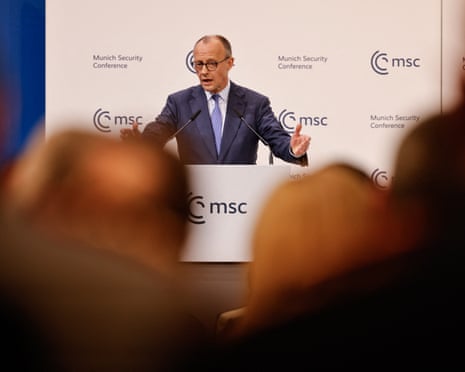
He also urged the US president to recognise it is still possible to exhaust Russia economically and militarily, to the point where it is willing to come to the negotiating table over Ukraine.
In a speech on Friday designed to set a firm yet conciliatory tone about the future of the transatlantic partnership, Merz argued the old order had ended and in this new age of superpowers even the US was reaching the limits of going it alone.
Merz drew most applause from an audience brimming with hostility toward US unilateralism when he directly criticised the current American administration, saying:
“The culture war of the Maga movement is not ours. Freedom of speech ends here with us when that speech is directed against human dignity and the basic law. We do not believe in tariffs and protectionism, but in free trade. We stand by climate agreements and the World Health Organization.”
As one of the European nations doing the most to boost its own defence spending, Merz clearly felt in a strong enough position to insist the US needed to do more to listen to European concerns about its security and the legitimacy of a sustained European pillar of Nato.
Describing the Munich conference as a seismograph for the state of US-European relations, he said the Ukraine war “had forced Europe to return from a vacation from world history. Together we have entered an era that is once again marked by power and big power politics.”
Merz was speaking as the fourth anniversary of the Russian invasion of Ukraine approaches and one year after Vance used his speech in the same hall to criticise Europeans for not taking enough control of their own defence arrangements and ignoring the demands of its electorates.
Jakub Krupa
As we are waiting for Macron’s speech, let me bring you our diplomatic editor Patrick Wintour’s take on Friedrich Merz’s speech earlier.
UK foreign minister 'hugely sceptical' of Putin's commitment to peace, calls for pressure on Russian economy
UK foreign secretary Yvette Cooper has also made similar points, calling for more pressure on the Russian economy just now.
She said she was “hugely sceptical that president Putin is committed to peace.”
“I really hope that these talks can make progress and can get to a peace agreement, but I still think we are going to need to keep intensifying that economic pressure on Russia, including tightening the chokehold on oil and gas, tightening the chokehold on the Russian shadow fleet, keeping up that economic pressure with additional sanctions, and I hope to a maritime services ban as well, so we keep ramping up the pressure on Russia’s economy. The economy has already been heavily hit, but we need to keep that pressure up further.”
Three points yet to be agreed in 20-point plan for ending Russian invasion of Ukraine, foreign minister Sybiha says
Meanwhile, Ukrainian foreign minister Andrii Sybiha has just offered an update on the state of talks with Russia about ending its invasion of Ukraine.
Earlier today, Russia confirmed that the next round of talks will be conducted in Geneva, Switzerland next week.
Sybiha said the talks were “advancing” after the first two rounds of talks in Abu Dhabi, as he praised US president Donald Trump’s leadership, saying pointedly that “without Trump, it’s unrealistic to end this war.”
“But in parallel, we need to continue pressure on Russia and we still have instruments, we must admit this, for leverage,” he said, as he warned that Russia was not showing “no signs of willingness … for serious negotiations.”
Sybiha revealed that out of the 20-point peace plan, there are still disagreements over three points on the list.
“We have doable proposals, so next round we really hope we will not get additional historical lectures … now it’s a time for action, for acts, and for concrete decisive steps.”
Speaking alongside him, the French foreign minister, Jean-Noël Barrot, said “we should stop this war, obviously, and we still have levers with our allies and friends” to pull to achieve that.
He said that France and Britain “have gone very far” to block the Russian shadow fleet vessels “also using military means.”
He also stressed the importance of the upcoming 20th package of EU sanctions, expected to be adopted on the fourth anniversary of the full-scale aggression on 24 February, and the role of the so-called Coalition of the Willing in providing future security guarantees.
AOC will be back later tonight at a session on “breaking (with) the past” and “seismic shifts in US foreign policy,” speaking alongside Democratic Michigan governor Gretchen Whitmer and US Nato ambassador Matthew Whitaker.
But first we’re going to hear from the French president, Emmanuel Macron, who is due on the main stage in under 20 minutes.
Trump is 'tearing apart' transatlantic partnership, 'ripping up' democratic norms, Ocasio-Cortez warns
In the Q&A, Ocasio-Cortez gets asked about her presence in Munich and the signal she wants to send by being involved in these discussions here.
She says:
“I think this is a moment where we are seeing our presidential administration tear apart the transatlantic partnership, rip up every democratic norm, and … really calling into question, as was mentioned by Mark Carney at the World Economic Forum, the rules based order that we have, or, question mark, do we have?”
She lays out her pitch for the need to address hypocrisies in the international order:
“But that does not mean that the majority of Americans are ready to walk away from a rules-based order and that we’re ready to walk away from our commitment to democracy.
I think what we identify is that in a rules-based order, hypocrisy is vulnerability.
And so I think what we are seeking is a return to a rules-based order that eliminates the hypocrisies … when, too often, in the West, we’d look the other way for inconvenient populations to act out these paradoxes, whether it is kidnapping a foreign head of state, whether it is threatening our allies to colonise Greenland, whether it is looking the other way in a genocide.
Hypocrisies are our vulnerabilities and they threaten democracies.
And so I think many of us are here to say we are here and we are ready for the next chapter, not to have the world turn to isolation, but to deepen our partnership on greater and increase commitment to integrity to our values.”
She gets good reception from the audience here with a round of applause.
Trump repeats his endorsement of Hungary's Orbán hours after Merz's criticism
Speaking of populists, US president Donald Trump has repeated his endorsement of Viktor Orbán this afternoon – just hours after pointed criticism of the Hungarian leader from the German chancellor, Friedrich Merz (14:30, 14:34, 14:39).
In a post on Truth Social, Trump said Orbán is “a truly strong and powerful leader, with a proven track record of delivering phenomenal results.”
“Relations between Hungary and the United States have reached new heights of cooperation and spectacular achievement under my Administration, thanks largely to Prime Minister Orbán,” he said.
In a chaotically capitalised post, he concluded:
“I was proud to ENDORSE Viktor for Re-Election in 2022, and am honored to do so again. Viktor Orbán is a true friend, fighter, and WINNER, and has my Complete and Total Endorsement for Re-Election as Prime Minister of Hungary — HE WILL NEVER LET THE GREAT PEOPLE OF HUNGARY DOWN!”
The Hungarian election is scheduled for 12 April.
Czech president Petr Pavel is next and he gives an interesting view on why populism has been spreading in central and eastern Europe.
He says:
“I believe that number of people in former communist countries believed that with the change of the system, they would achieve all the benefits of capitalism while keeping all the benefits of socialism.”
He said when they realised that “not everyone will get rich, there will always be people who will be better off … then that frustration … created a lot of tensions and frustration, taken forward by people offering short-term, nice solutions that they [would] never [have to] deliver on.”
He also says, without naming names, that “the experience [shows] that when these people, who used to be for a long time … on the critical side, … are put in a position where they have the responsibility to deliver, they suddenly understand the complexity of situation and they change a lot of their … extreme positions that they held before.”
EPP’s Manfred Weber – one of the most powerful centre-right politicians in Europe - talks about the practical experience of centre-right parties taking on the far-right in Europe, specifically referencing Poland’s Donald Tusk and his 2024 win over the Law and Justice government.
He says as a general rule, EPP is not prepared to work with “parties which do not follow the three pros, so pro-Europe, pro-Ukraine, pro-rule of law.”
He quotes the EPP’s decision to kick Hungary’s Viktor Orbán out of the grouping as a proof of that commitment.
But he admits that it’s clear that the way to respond to populism and growing frustration among voters is to “give proper answer to their concerns and take it seriously,” as he attacks the socialists in the European Parliament for not supporting the EU’s controversial migration plans.
He says Europe “cannot continue to follow a … left-leaning political approach on migration,” which in his view is “feeding extremism and populism,” and needs to show its responding to people’s concerns.
He warns that “we have to solve problems; otherwise, the next European elections in 2029 will be a big festival for the far-right extreme [parties], and [we need] to avoid it.”
Ocasio-Cortez says she sympathises with some of the working-class people who turn towards far-right parties in desperation, as she can relate to their frustration as it’s something she experienced too.
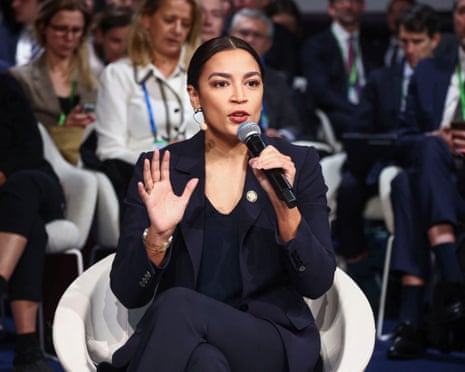
But she says “what we are seeing over the last eight years has been a growing recognition that of those past errors,” and there is an “increased recognition that we have to have a working class centred, politics, if we are going to succeed and stave off the scourge of authoritarianism,” which is fuelled as people find “scapegoats to blame for rising economic inequality.”
She gets a question on whether she’s ready to pursue a wealth tax when she runs for US presidency – but she doesn’t take the bite.
“I don’t think that anyone and that we don’t have to wait for any one president to impose a wealth tax. I think that it needs to be done expeditiously,” she says.
MSC Townhall room packed as Ocasio-Cortez makes Munich debut
Jakub Krupa
in Munich
I have just had a quick walk around the hotel going to my next session. It’s absolutely packed and buzzing – and not always inside the actual meeting rooms.
As mentioned earlier, there is a lot of activity happening on the margins (10:53), and you can see ministers and officials meeting in small groups to chat on the corridors of the Bayerischer Hof.
But the room I am in now is packed as US congresswoman Alexandria Ocasio-Cortez makes her Munich debut in a panel on populism.
She is joined by European centre-right EPP grouping’s president Manfred Weber, Czech president Petr Pavel, and Argentinian lawmaker Daiana Fernández Molero.
Trump 'most destructive president' ever, Newsom says
Meanwhile, California governor Gavin Newsom is blasting Donald Trump on the main stage, saying the US president is “doubling down on stupid.”
“Never in the history of the United States of America has there been a more destructive president than the current occupant in the White House in Washington, DC,” he says.
He says Trump “is trying to recreate the 19 century.”
“We’re proving at scale that we can implement, we can compete and we can dominate, but Donald Trump is trying to turn back the clock.”
He strongly says:
“I hope, if there’s nothing else I can communicate today, Donald Trump is temporary. He’ll be gone in three years,” he asserts.
He says the climate crisis is hitting Americans directly, as “people are burning up, choking up, heating up; we have simultaneous droughts and floods, historic wildfires.”
“In California, it’s a big blue state, but also has more Republicans than most Republican states, and we have long moved beyond the partisanship on this issue, because there is no Republican thermometer, there’s no democratic thermometer. There’s just reality.”
Remember: Newsom is talked about as a potential Democratic candidate in 2028.
Watch out for Macron's language on Europe and nuclear deterrence - snap analysis
Jakub Krupa
in Munich
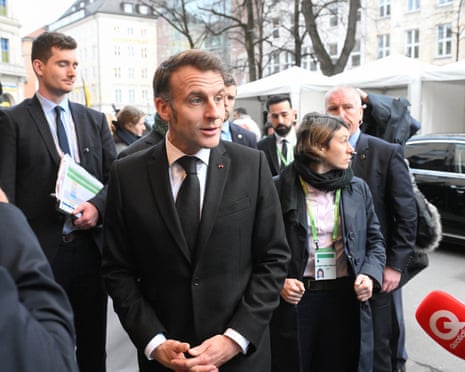
Two things to look out for in Macron’s speech later tonight is how he talks about his big idea of advancing European sovereignty and what, if anything, he says on nuclear deterrence, mentioned by Merz (14:15).
The French president has just arrived here – although, presumably much to MSC’s Ischinger’s disappointment, he is no longer wearing his Davos aviator sunglasses (13:39).