1 hour ago
Supreme court says it will review whether Trump administration can detain immigrants while they challenge deportation
The supreme court today said it will review whether the Trump administration can enforce its policy of denying bond hearings for immigrants to determine whether they should remain detained while their cases are adjudicated.
The novel move to impose mandatory detention is another feature of Trump’s hardline immigration crackdown during his second term in office, and has now made its way to the top court after several appeals court judges ruled that the policy violated federal law and fails to provide immigrants with due process.
However, those decisions conflict with rulings by the fifth and eighth circuits – which ruled that immigrants accused of illegally entering and remaining in the US must be detained while their deportation cases are pending.
The case that will be part of the supreme court’s docket for the 2026-27 term focuses on Ricardo Aparecido Barbosa da Cunha, a citizen of Brazil, who authorities say he entered the US illegally two decades ago and applied for asylum in 2016 and was granted a work permit.
He sought a bond hearing after an immigration judge determined that his detention was mandatory after his September 2025 arrest. After Barbosa da Cunha sued, a federal judge ordered that be provided a hearing or released. An immigration judge found that Barbosa da Cunha did not present a flight risk or danger to persons or property, and ordered him released on bond. The administration appealed against the decision.
The number of people in immigration detention has shot up since Trump returned to office. It was more than 65,000 in July 2026, up from about 40,000 at the end of Joe Biden’s administration.
Key events
Donald Trump spoke to reporters briefly earlier, as he departed the White House for Texas and Oklahoma.
The president was asked about his comments to Time that Federal Reserve chair Kevin Warsh should’ve voted against the board of governors (which unanimously voted to raise interest rates earlier this month) and whether he had spoken to Warsh since the vote.
“No, I want him to vote the way he wants,” Trump told reporters, adding: “I personally would’ve voted against the raise because we’ve got inflation totally under control … The problem is interest rates will hurt our growth.”
In the Time interview, Trump was asked if he regretted nominating Warsh, to which he skirted: “Well, he’s controlled to a certain extent by the board.”
Asked if he still had confidence in Warsh, the president added:
We have a lot of people on [the Fed board of governors] that would love for our country to do badly. It’s become very political. I don’t blame you, Kevin. I think it’s too bad. Not fair. Look, our nation is going through a growth explosion like no nation’s ever seen. We’re blowing through the interest rates. But if we didn’t have to, it would be great.
Compared to his frequent personal attacks on Warsh’s predecessor, Jerome Powell, over the Fed refusing to cut interest rates, Trump has so far refrained from publicly criticizing his handpicked chair, and instead directed his ire towards the Fed “board” more generally.
Family of Renee Good sues ICE agent who shot her and top Trump officials
Alba Asenjo Domínguez
The family of Renee Good, the woman killed by immigration agents in January in Minneapolis, have filed two federal lawsuits against the agent who shot her and several top officials in the Trump administration.
In the lawsuits, Good’s partner, Becca Good, and her brother, Brent Ganger, alleged wrongful death and other violations of federal law, according to a press release issued by their lawyers.
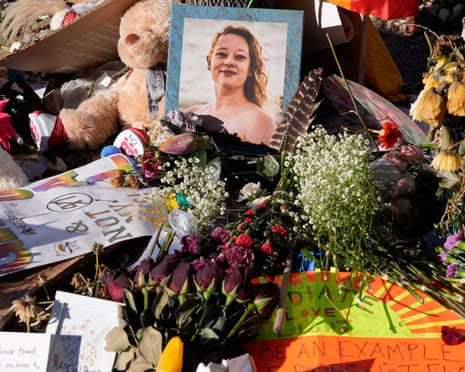
Good was a US citizen and mother of three who, on 7 January, joined her wife in protesting against the deployment of thousands of ICE agents in their city as part of the Trump administration’s mass deportation policy.
The 37-year-old was shot and killed in her car by an agent who claimed he acted in self-defense and the Department of Homeland Security claimed that she had engaged in “an act of domestic terrorism”. Multiple video clips of the encounter, however, show that Good was steering her vehicle away from the agent as she tried to drive away.
Her death and that of Alex Pretti, an American nurse who was also shot and killed by an immigration agent during Minneapolis protests two weeks later, sparked outrage and a wave of anger across the country.
Shortly after Good’s killing, Todd Blanche, then deputy attorney general, said he saw no grounds for opening a civil rights investigation. Days later, the justice department opened an investigation into the relationship between Becca Good, the deceased’s partner, and protest groups. At least 10 prosecutors resigned following the fatal shootings.
Now, these lawsuits have become some of the first major civil lawsuits filed against Trump’s deportation campaign in Minnesota.
In one of them, the attorneys for Good’s wife and brother allege wrongful death and seek damages for the “immense suffering Renee endured in the final moments of her life and for the profound and permanent losses that her death has inflicted upon her family”.
“The complaint also seeks to recover for Becca Good, who was standing feet from the couple’s vehicle when Ross fired three rounds into it, and she watched her partner die,” the complaint says.
“Peaceful assembly, speech and even dissent are protected rights. However, the government has distorted the exercise of these rights as violence against our republic and acted with extreme and unconstitutional force, causing egregious harm. Many of these illegal uses of force resulted in death – including the death of an American mother of three, Renee Good […] Today’s legal actions demand accountability for countless violations of the law, the Constitution and the Department of Homeland Security’s (DHS) own rules governing the use of force,” the lawsuit says.
The other lawsuit alleges a conspiracy to interfere with civil rights by senior federal officials and federal immigration enforcement agents, and names Jonathan Ross, the immigration officer who shot Good, the former homeland security secretary Kristi Noem, the White House deputy chief of staff and architect of hardline US immigration policies, Stephen Miller, and former US border patrol officer Gregory Bovino, among others, for their “roles in Renee Good’s death”.
Trump refuses to commit to not demolishing Kennedy Center
Donald Trump also refused to rule out demolishing the Kennedy Center without the consent of Congress. Amid the ongoing high-stakes legal battle over the institution’s name and proposed renovations, the president told Time: “I’m not committing to anything. We’re going to see how it plays out in court.”
He added: “But if I build it, and if I agree that for the rest of my life, I’m going to be putting up $100 million to have it open to people … then I think the Trump administration should be recognized.”
A reminder that Trump has threatened to block proposed renovations to the Kennedy Center and suggested it could be demolished after courts ruled against his bid to rename it the “Trump-Kennedy Center” without congressional approval.
Per my colleague David Smith, Trump has no legal right to demolish the facility, which was established by Congress. Critics say he is acting out of spite because he cannot get his way. Kerry Kennedy, JFK’s niece , said: “Like a child who can’t play with a toy, he wants to stomp on the toy. But this is not a toy. This is the living memorial to a slain president.
“It would be like adding the Trump name to the Trump-Lincoln Memorial or the Trump-Jefferson Memorial or Trump-Tomb of the Unknown Soldier. The courts have spoken, he cannot demolish it, he cannot put his name on it and he should be focused instead on his job.”
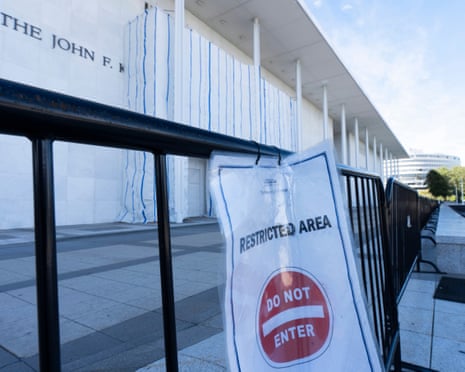
Trump also said earlier in the Time interview that he would be “willing to save it, but it’s in terrible, terrible shape.”
Attacking the judge who ordered his name to be removed from the facade of the building as a “radical-left Trump hater”, the president added:
Well, why would I want to stick with something that’s going to lose hundreds of millions of dollars, and I’m not even recognized? It’s not me; it’s the administration.
The Trump-appointed board voted for the closure of the facility for two years earlier this month, citing the need for $257m of repairs and renovations. But as David notes in his piece, Democratic congresswoman Joyce Beatty and senator Sheldon Whitehouse have alleged that the proposed closure is a “pretext” to hide a financial “death spiral” caused by artist boycotts and dwindling ticket sales following Trump’s takeover of the center when he returned to office.
The president remained convinced that Republicans chances of retaining control of Congress this midterm cycle remain strong.
“I think we’ll do OK if I campaign, and I intend to. If I campaign … you don’t give me enough credit. When I campaign, I give people a lot,” Trump told Time. “If I campaign for people, those people are going to win.”
At the GOP midterm convention last month, the president implored voters to “pretend I’m on the ballot”, in an effort to boost turnout. However, many Republican candidates running in battlegrounds where the president’s approval rating has cratered due to animus around Trump’s handling of the economy and ongoing war in Iran.
Trump doesn't rule out sending ICE agents to polls in upcoming midterms
In his interview with Time magazine, Donald Trump did not rule out the possibility of sending federal immigration agents to polling sites in the upcoming midterms.
When asked, the president said: “Haven’t thought of it” and said that he “could” use the Insurrection Act to declare a national emergency. “A lot of people think I should use it sometimes,” he added.
However, it’s worth noting that legal experts say the law – which would allow the president to deploy troops domestically – doesn’t override the constitution, which prevents them from interfering with elections and appearing at polling sites.
Nonetheless, the administration has hinted at the idea of sending militarized federal agents to polls in recent months. In September, homeland security secretary Markwayne Mullin said that ICE officers could be deployed to polling sites across the country “to enforce specific threats”.
“The only reason why we would be at polling places is if there is a threat to that polling place or we’re serving a warrant on someone that we have been actively tracking down,” Mullin said. “ICE’s job is immigration, customs enforcement. That’s their job … if we’re serving a warrant we will be where we need to be.”
Supreme court says it will review whether Trump administration can detain immigrants while they challenge deportation
The supreme court today said it will review whether the Trump administration can enforce its policy of denying bond hearings for immigrants to determine whether they should remain detained while their cases are adjudicated.
The novel move to impose mandatory detention is another feature of Trump’s hardline immigration crackdown during his second term in office, and has now made its way to the top court after several appeals court judges ruled that the policy violated federal law and fails to provide immigrants with due process.
However, those decisions conflict with rulings by the fifth and eighth circuits – which ruled that immigrants accused of illegally entering and remaining in the US must be detained while their deportation cases are pending.
The case that will be part of the supreme court’s docket for the 2026-27 term focuses on Ricardo Aparecido Barbosa da Cunha, a citizen of Brazil, who authorities say he entered the US illegally two decades ago and applied for asylum in 2016 and was granted a work permit.
He sought a bond hearing after an immigration judge determined that his detention was mandatory after his September 2025 arrest. After Barbosa da Cunha sued, a federal judge ordered that be provided a hearing or released. An immigration judge found that Barbosa da Cunha did not present a flight risk or danger to persons or property, and ordered him released on bond. The administration appealed against the decision.
The number of people in immigration detention has shot up since Trump returned to office. It was more than 65,000 in July 2026, up from about 40,000 at the end of Joe Biden’s administration.
Donald Trump also claimed that “today” was the first he had heard of reports that Benjamin Netanyahu, the Israeli prime minister, was warned prior to 7 October 2023 that there would be a likely attack by Hamas.
When Time pushed back, noting that Trump has “access to the highest intelligence”, the president dismissed concerns that Egypt and the United Arab Emirates altered Netanyahu in late September of that year that Hamas was planning a major operation.
“I can’t imagine this,” Trump said. “I don’t think so … I think if he would have known, he would have done something about it. Certainly, he would have had people at least alert.”
However, the president failed to give a clear answer on whether Netanyahu should serve for another term, ahead of Israel’s October elections.
Trump says that it’s ‘possible’ that strikes on Iran will increase after the midterms
Donald Trump defended the ongoing war with Iran, which appears to have little end in sight after the president rejected the latest ceasefire proposal from Tehran, which he described in his Time interview as “not good enough”.
When asked whether he plans to ramp up bombings on Iran after the midterms, Trump said it was “possible”. The president also dismissed concerns from the Pentagon about munitions shortages as the war enters its seventh month.
“I would say it was mostly fake news,” Trump said. “Some forms of ammunition are a little bit lower than other forms. We have that middle grade and upper middle grade, which is very powerful, which is stronger than it’s ever been before. There is ammunition that President [Volodymyr] Zelenskyy wouldn’t take, but it’s very powerful ammunition.”
Capping off his tirade against the media during his interview with Time magazine, the president made sure to insult CNN anchor Kaitlan Collins, one of the many female reporters Trump has taken aim at during his second administration.
“I can name 100 great things I’ve done. I never get good press. I never get fair press. Doesn’t have to be good. All it has to be is fair,” he told Time. “So at a certain point, you say, ‘what’s the purpose of like this crazy Kaitlan Collins?’ She’s a very average person. She’s the most unhappy young person I’ve ever seen.”
In that same interview, Trump insisted that he wasn’t defying the judge’s order by still preventing these outlets from covering the president at certain events.
“I don’t have to go out of my way, these people write only bad stories,” he said. The White House communications director, Steven Cheung, added that the judge’s order required the president to restore the newsrooms’ access to the White House, “but that’s different than allowing the pool into the events in the Oval Office or on Air Force One”.
If you recall, there is ongoing litigation about the Associated Press’ access to these so-called “intimate spaces” after Trump banned the outlet from them last year for refusing to refer to the Gulf of Mexico as the “Gulf of America”.
Trump continues to take aim at media in wide-ranging Time interview
Donald Trump doubled down on his attacks on the outlets he’s trying to ban from the White House in a wide-ranging Time magazine interview.
“I believe in an honest press, but I don’t believe in fake news,” he said, without providing any evidence about the areas of coverage he believes to be incorrect.
The president also said that Timothy Kelly, the federal judge who temporarily blocked the president’s ban on CNN, Politico and MS Now, was “very anti-Trump”. However, Trump actually appointed Kelly during his first term in office. When the Time interviewer reminded the president of this fact, he simply replied: “Yeah, he was. He was. It’s one of those things.”