1 hour ago
Russia ordered Germany to close its St Petersburg consulate and withdraw its staff by September 18 in a tit-for-tat move following Berlin's decision to shut the Russian consulate general in Bonn and the Russian House cultural centre in Berlin.
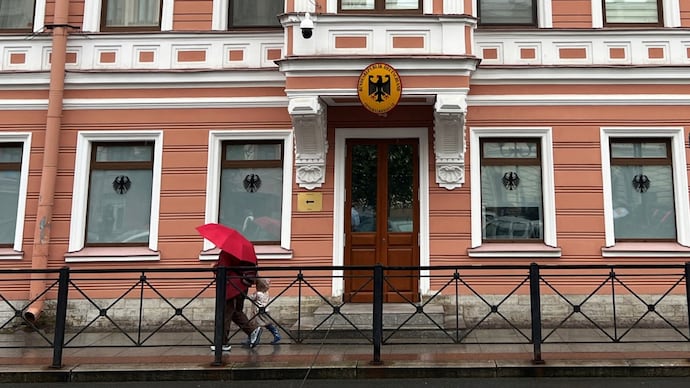
People walk past the German Consulate General in Saint Petersburg, Russia. (File Photo: Reuters)

UPDATED: Sep 7, 2026 22:22 IST
Russia has ordered the closure of Germany's Consulate-General in St Petersburg, escalating a diplomatic row that has been building since Berlin accused Moscow of involvement in an attempted drone attack at a German airport.
The Russian Foreign Ministry said on Monday that Germany's consulate in Russia's second-largest city must stop operating by September 18. All of its staff have also been ordered to leave the country by that date. Moscow call the move a retaliation for Germany's decision to shut the Russian consulate general in Bonn and the Russian House cultural centre in Berlin.
"The Russian side is withdrawing its consent for the operation of the Consulate General of the Federal Republic of Germany in St. Petersburg," the Russian Foreign Ministry said in a statement on Telegram.
"It must cease its activities no later than Sept. 18, 2026, and all of its staff must leave the territory of the Russian Federation by that date."
The ministry also reaffirmed its decision to close Germany's Goethe-Institut cultural centres in Russia. Their employees have been given until September 13 to leave the country. Moscow accused Berlin of triggering the latest escalation, saying Germany had taken an "unfriendly" decision by closing its diplomatic and cultural facilities in Russia.
"It was the German authorities who, once again, provoked a new round of escalation in bilateral relations. The German government bears full and complete responsibility for the consequences," Russia's Foreign Ministry said.
WHAT SPARKED THE LATEST SPAT?
The row intensified after Germany accused Russia of being behind an attempted drone attack at Leipzig/Halle Airport on August 4. An explosives-laden drone was discovered near a Ukrainian aircraft at the major German freight hub, which has been used to support Ukraine. The drone was later defused.
Moscow has rejected the accusation. Russian President Vladimir Putin instead accused Germany of planting evidence, while Moscow has dismissed the allegations as an absurd fabrication.
The European Union has warned that incidents it attributes to Russian hybrid activity represent a serious security threat. European governments have increasingly raised concerns about alleged sabotage and other covert operations since Russia launched its full-scale invasion of Ukraine in February 2022.
HOW FAR HAVE GERMANY-RUSSIA TENSIONS GONE?
The latest measures add to an already severe breakdown in relations between Berlin and Moscow. Over the weekend, Russian Foreign Minister Sergei Lavrov accused Germany of "wanting war again" and said Berlin was "essentially moving to declare war on us."
Germany remains one of Ukraine's key European supporters. Chancellor Friedrich Merz said on Monday that he would "not budge a single millimetre from my fundamental conviction that we must defend our freedom against Russia as well".
The tensions extend beyond Germany. Finland on Monday unveiled a 200-kilometre fence along its border with Russia, saying it was intended to counter potential hybrid threats and prevent Moscow from "instrumentalising" migrants to destabilise the country.
Finland's Interior Minister Mari Rantanen said: "Today, it is calm but tense, and we really don't know about tomorrow."
"It can change really rapidly, and that is why we need to be very prepared."
- Ends
With inputs from agencies
Published By:
Satyam Singh
Published On:
Sep 7, 2026 22:22 IST