1 hour ago
Thousands of mourners have gathered in Belgrade for the funeral of Ratko Mladić, a Serbian general convicted of orchestrating the worst massacre in Europe since the second world war, and whose hero’s return home has raised international alarm.
Known as the “Butcher of Bosnia” for his role during the Balkans genocide in the 1990s, Mladić died in prison in late August aged 84 while serving a life sentence for war crimes and crimes against humanity.
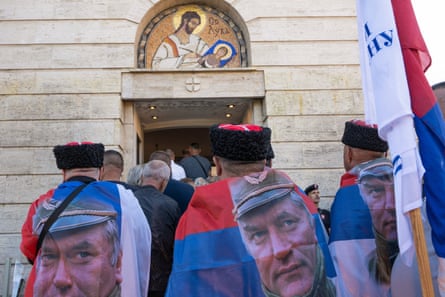
Mladić remained a beloved figure among many Serbians, including politicians, and his coffin was flown to Serbia on a government plane, draped in national flags and carried from the plane by uniformed soldiers. As his casket was driven from the airport, men gathered by roads and displayed banners honouring Mladić.
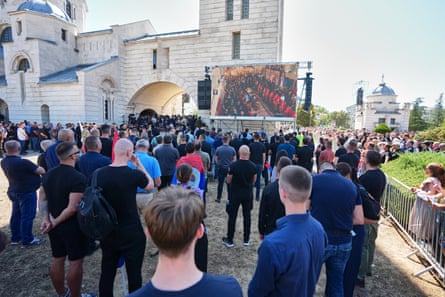
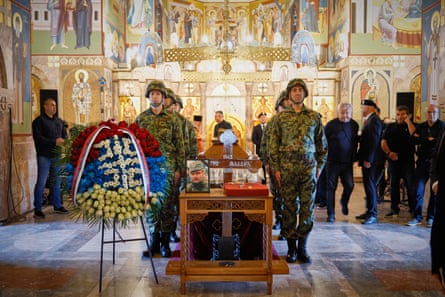
On Monday, thousands of people gathered in front of a small church in the Serbian capital to pay their respects to Mladić. Armed forces stood guard at his casket, on top of which was laid his signature military hat as well as a sword. A display of medals lay in front.
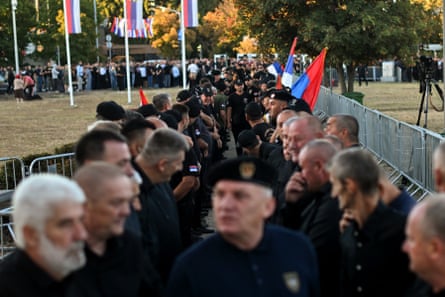
Outside the church, Serbian flags had been hung nearby, and a huge banner unfurled across the street read: “Welcome, General, thanks be to your mother for bearing a hero.”
Scenes of military pomp have drawn condemnation from the European Union’s enlargement commissioner, Marta Kos, who cancelled a forthcoming visit to Serbia on Friday. “The return of his remains to Belgrade reminds Europe of the darkest pages in our recent history,” she said on social media.
Serbia has been negotiating EU accession since 2014, but the process has stalled in recent years under the populist Serbian president, Aleksandar Vučić.
“The glorification surrounding [Mladić’s] death is incompatible with the values on which the EU path is built,” said Kos. “That path requires confronting the past, genuine reconciliation and respecting the victims of war crimes. The values that underpin our common future are not negotiable.”
An EU spokesperson repeated the warning on Monday. “Any glorification of war criminals, genocide denial and revisionism contradict the most fundamental European values and have no place in the EU or in EU candidate countries,” he said in a statement.
Mladić was one of the main architects of the policy of ethnic cleansing during the Bosnian war, which killed more than 100,000 people and displaced more than 2 million.
Key among his crimes was the 1,460-day siege of the Bosnian capital, Sarajevo, where the civilian population was subjected to daily shelling and sniper attacks from Serb nationalist forces, and more than 10,000 people were killed.
skip past newsletter promotionafter newsletter promotion
The three-year conflict culminated in the 1995 killing of at least 8,000 Bosniak Muslims in the town of Srebrenica, a crime that shocked governments in Europe that had spent decades working to prevent mass killings after the mid-century horrors when Nazi Germany killed 6 million Jews.
In Srebrenica, Mladić’s forces were filmed handing out sweets to children and promising their safe passage before thousands of Bosnian men and boys were rounded up, killed, and their bodies bulldozed into mass graves. “We give this town to the Serb people as a gift,” Mladić said at the time in filmed comments.
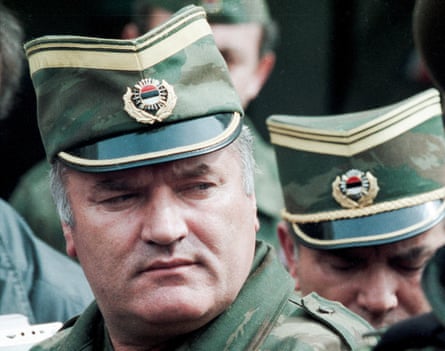
The killings have been pointed to as an international failure, especially as Srebrenica had been designated a “safe haven” under the protection of the UN, a global body created immediately after the second world war specifically to help prevent such bloody future global conflicts.
Mladić was arrested in Serbia in 2011 after 16 years as a fugitive, and sentenced by a UN tribunal in the Netherlands to life imprisonment in 2017.
The goal of the Serbian leadership, which Mladić was tasked with implementing – as determined by the UN’s international criminal tribunal for the former Yugoslavia (ICTY) – was the forcible expulsion of Bosnian Muslims, Croats and other non-Serbs to clear Bosnian land for the creation of a “Greater Serbia”.
While in detention, Mladić had been in ill health after having a series of strokes.
The Balkans war started after the June 1991 breakup of Yugoslavia, when Slovenia and Croatia declared independence. Bosnian Serbs quickly took control of more than two-thirds of Bosnia and launched the siege of Sarajevo. After three years of bloodshed, the Dayton agreement was signed in Dayton, Ohio, ending the war and creating the independent state of Bosnia and Herzegovina.
Agence France-Presse contributed to this report