1 hour ago
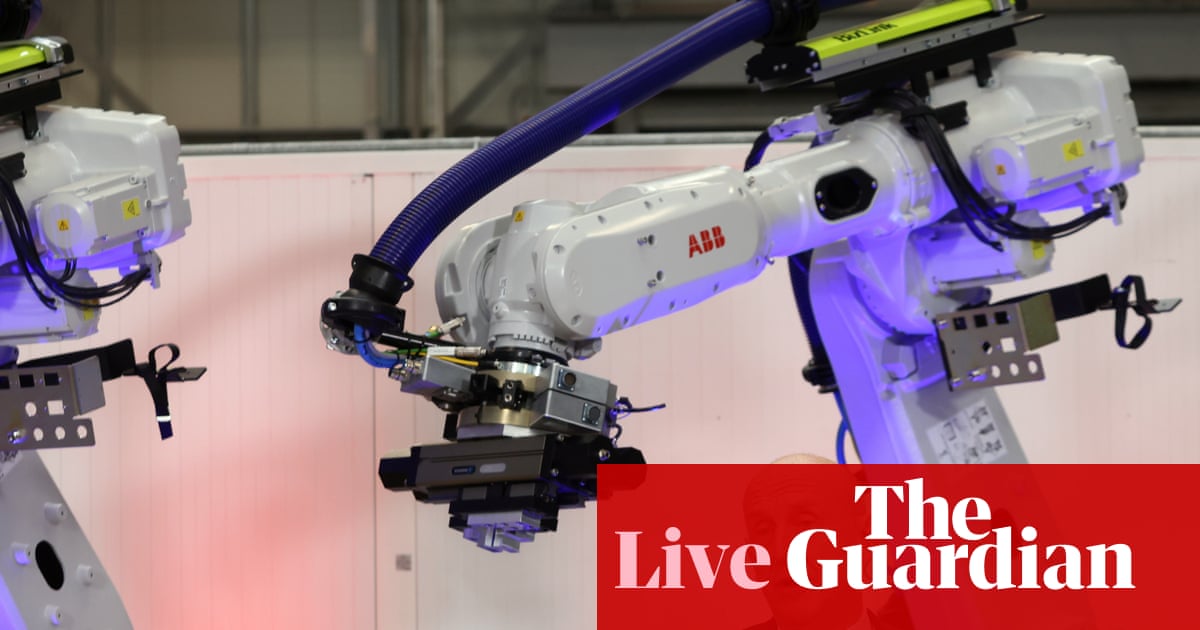
Jaguar Land Rover has announced thousands of job cuts in a “body blow for workers” as it grapples with tough trading conditions, Donald Trump’s tariff wars and the fallout from a cyber-attack.
Britain’s largest carmaker, which is owned by the Indian conglomerate Tata, confirmed the anticipated cuts on Monday, saying it wants to reduce its global workforce by about 4,000 over two years, as part of an effort to save £1.7bn.
JLR’s employs 44,000 people globally and 34,000 in the UK. The cuts will mainly affect the 26,000 UK employees who are salaried and management workers. The company has plants in Solihull, Warwickshire and Merseyside, and is headquartered in Coventry.
Its proposal threatens to provide an early reality check for the new prime minister, Andy Burnham, and his promise to “reindustrialise” Britain.
JLR’s profits have tumbled as it wrestles with strong competition in the global car market, Trump’s US tariffs and last year’s hack, which led to the shutdown of its factories.
The JLR chief executive, PB Balaji, said: “The automotive industry faces significant challenges, with technological change amidst intense competition and ongoing geopolitical uncertainty. Through our Growth Reimagined strategy, JLR is moving decisively to strengthen our competitiveness and position the business for long-term success …
“As part of this transformation, we will reduce our global workforce by around 4,000 roles over the next two years. We recognise this will be difficult news for colleagues affected, and are committed to supporting everyone with care, fairness and respect.”
The Guardian understands that factory workers who are paid hourly – the vast majority of those on the shop floor – will be unaffected by the cuts, which will instead fall on salaried employees in divisions such as management, marketing, and research and development.
The business minister, Jonathan Reynolds, has ruled out using taxpayers’ money to deter the company from pursuing the redundancies.
Reynolds will hold talks with Balaji and Sharon Graham, the general secretary of the Unite union, on Tuesday. Graham is expected to push for JLR to favour retraining and redeployment over compulsory job losses, if it cannot achieve enough redundancies voluntarily.
The cuts will be weighted towards more senior roles in management and research and development rather than shopfloor production workers.
JLR announced the job cuts as the chancellor, John Healey, made an economic speech at the Manufacturing Technology Centre in Coventry, just a few miles from the carmaker’s offices. Healey said he wanted to “draw the line” under rising business costs.
Liam Byrne, the chair of the Commons business and trade committee, said the news was a “body blow for workers, families and communities across the West Midlands”.
He added: “Whether or not these redundancies are voluntary, we now need urgent assurances that maximum support will be deployed to help everyone affected find new work.
“But the troubles at JLR underline the challenge facing the government’s reindustrialisation drive. Britain is preparing to spend billions more on defence, infrastructure and new technology. But British business needs cheaper energy and government orders, not at some distant point in the future, but now, now, now.”
skip past newsletter promotionafter newsletter promotion
Last year’s hack eventually cost the company about £200m and contributed to its pre-tax profit falling to just £14m, from £2.5bn a year earlier.
The government last year agreed to underwrite a £1.5bn loan to JLR to help it recover from the hack but the carmaker has not tapped the facility.
JLR has also suffered the fallout from Trump’s trade tariffs, which hit sales of models such as the Range Rover and the Defender as the company seeks to expand further in the US market.
JLR is in the midst of a large-scale overhaul of its products, including the launch of its first fully electric Range Rover this month, which will come with a starting price of £154,070, and a new electric Jaguar. It is also considering a deal with Stellantis to make some of its cars in the US to help ease the effect of trade tariffs.
Balaji said the cuts were aimed at “reducing organisational complexity” and would mean the company could break even on sales of about 300,000 vehicles a year, making it better able “to compete in a rapidly evolving market”.
European carmakers have faced tough trading conditions as Chinese manufacturers’ sales have surged across the UK and Europe, giving companies such as Chery and BYD a manufacturing foothold in the regions.
In July, Chery, which also owns the Omoda and Jaecoo brands, accounted for nearly 8% of UK market share, up from 3% last year, according to the Society of Motor Manufacturers and Traders.
JLR follows Volkswagen in announcing large-scale job cuts, after the German carmaker said last week that it intended to make 50,000 more people redundant as part of a turnaround plan.