53 minutes ago
PM’s new anti-disinformation unit won’t target ‘domestic political dissent’, defence secretary Wes Streeting says
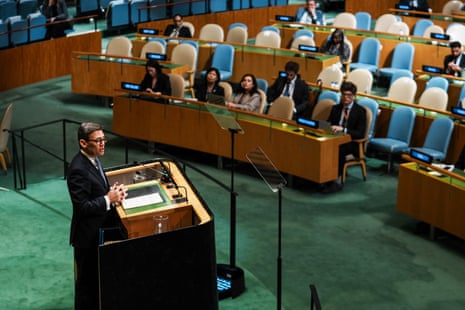
Good morning. Andy Burnham delivered his speech to the United Nations in what felt like the middle of the night in UK time and he announced that he is setting up what he is calling a Centre for Information Defence.
Burnham said this was necessary because “over the last decade we have given too much ground to those who want to run a negative, corrosive narrative about life in Britain, which bears no resemblance to reality”.
Over at GB News they seem a bit worried this morning about the prospect of a crackdown on corrosive narratives about Britain which bear no resemblance to reality, and they are running a story with a headline referencing “free speech fears”. It includes a quote from a rightwing commentator claiming the Burnham speech was all “talk of control and censorship – exactly the kind of messaging that the Trump administration absolutely hates”.
But close reading of the speech makes it clear that Burnham is not aiming his fire at any parts of the UK media. Burnham said he was concerned about hostile state actors waging disinformation warfare, especially Russia. He told the UN:
In recent years we have seen an industrial-scale assault by hostile actors on the information environment in the UK and that of many of our allies.
Russian agencies have used every means at their disposal to spread lies and disinformation and prey on people’s fears.
They’ve used bots and fake websites.
Falsified newspaper articles.
Forged the branding of 28 British organisations – including universities and the BBC.
They’ve amplified far-right narratives.
And we have evidence that they tried to interfere with the 2019 general election.
(Burnham did not address the fact that there are some within the Trump administration who have also been amplifying far-right narratives with claims about the UK which certainly count as misinformation, and arguably meet the disinformation threshold too.)
Wes Streeting, the defence secretary, has been giving interviews this morning and, speaking to GB News, he was asked about claims that Burnham’s new unit could be used against Britons who” simply disagree” with the government. That would not happen, he said.
He told the programme:
One of the great things about Britain, and one of the things that I have a responsibility to defend, is the freedom and democracy that we all enjoy.
And that includes the freedom to disagree, the freedom for people to challenge their government, to challenge government policy, to criticise robustly what we are doing and then to have the opportunity to choose a different government.
That is a stark contrast to the position that our friends the Russian people endure under the political system that they suffer under.
Russia is just one of a number of malign state and non-state actors that seek to threaten and disrupt our democracy, including through misinformation and disinformation.
Streeting added:
We’re not interested in policing domestic political dissent.
You can read Burnham’s UN speech in full here. I will be posting more from it soon.
The Commons is still in recess, and most people in government are getting ready for the Labour conference next week, and so there is almost nothing in the Westminster diary. But there was enough news at the UN yesterday to pad out the week, and so I’m sure there will be enough to cover.
I’m afraid we are no longer able to have comments open below the line every day on this blog. If you want to contact me, please email politics.live@theguardian.com. You can use this email to flag up corrections, comments for publication, questions or complaints.
Key events
UK economic outlook brighter as new government measures will boost growth, says OECD
The outlook for the UK economy has brightened, according to the OECD, with inflation lower than expected while new government support measures are likely to boost growth. Julia Kollewe has more on the business live blog.
What Burnham said in his speech to UN - summary and analysis
You can read the whole of Andy Burnham’s speech to the United Nations general assembly here.And here are the key points.
Burnham said there is “no national security without a strong, cohesive society”. This is interesting because Burnham was strongly criticised by the Tories and Reform UK, and rightwing papers, after saying at PMQs earlier this month: “We do everything to support our national security, but it can’t come at the expense of social security.” Critics claimed this meant Burnham thought avoiding benefit cuts was more important than deterring Russia. But Burnham did not resile from the argument, and in his speech overnight he restated the same idea in slightly different language. He said:
True resilience depends on this military strength.
But the last 10 years also tells us that it is about something deeper as well.
It’s about the strength of the social fabric that binds us together.
There is no national security without a strong, cohesive society.
That’s the starting point for everything we hold dear and everything we want to achieve.
He said the UK was facing “an industrial-scale assault by hostile actors” promoting disinformation. (See 8.50am.)
He said youth unemployment and the cost of living crisis made Britons more vulnerable to disinformation.
And we are going to help our people to strengthen their resilience – because faced with this information warfare, security starts in every home.
If you’re struggling with the cost of living and your life is not improving – or if you’re a young person not in employment, education or training – then you are going to be much more vulnerable to this kind of influence.
So part of the challenge is to lift our people up and create the opportunities they need.
He said new Centre for Information Defence would tackle misinformation not just in the UK, but also directed against allies.
Today I am tasking our security chiefs to begin work on a new Centre for Information Defence – to detect, attribute and disrupt these kinds of hostile state information attacks. To support and defend our democracy.
And I know this is a shared challenge.
So we are going to use our experience in the UK – and the fact that we have already been through this shock – to help other countries.
We have already supported Moldova to protect its elections from Russian interference.
As more elections approach across Europe, more nations are grappling with these issues – some for the first time.
Burnham said the climate crisis was a national security threat. He said:
The climate crisis is now a national security threat for countries around the world – as this summer of extreme heat, wildfires and floods has proved beyond doubt.
Britain will continue to lead with others to fight this threat.
He said he wanted the UK to be an “honest broker” in international affairs, mediating between the US and Europe. Although some in British politics, notably the Liberal Democrats, argue that having Donald Trump in the White House means Britain should seek a closer relationship with Europe, Burnham’s words imply he agrees with Keir Starmer, who repeatedly said he did not accept the need to choose between Europe and the US. Burnham said:
I believe the UK has a unique position as an honest broker to help drive this forward.
We are America’s closest ally.
We have deep ties with our friends in the European Union and will deepen them further.
We work with China and emerging powers like India and Brazil.
We sit on the security council. In the Commonwealth. In the CPTPP.
In a divided world, we have the ability to bring people together – and we will.
We are going to step into that role.
This has been the establishment view of Britain’s foreign policy role at least since the 1960s. Most previous postwar PMs would have said the same thing. But there are those who argue that Trump has made this stance less tenable.
Burnham said that he was going to put AI at the centre of the UK’s presidency of the G20 next year. He said:
The UK has some of the best tech and AI talent anywhere in the world.
And when it comes to guarding against the risks, we have our world-leading AI Security Institute – working hand in glove with the US and the leading labs on AI safety.
But we need to go further.
Building on the meeting convened by His Majesty King Charles last week, I can announce today that I am going to put AI at the heart of the UK’s G20 Presidency next year.
I look back at how we responded to the financial crisis back in 2008.
We moved quickly in the G20 and smaller groups to deliver an urgent, practical response.
We came together to agree principles – which everyone implemented at home in a way that was right for them. And it worked.
That is the kind of approach we need now.
He said he wanted the world towards “agreeing a single set of global principles and standards to ensure the transparency and access we need to increase our preparedness – and to ensure that AI development is safe”. This is different from Trump’s view; he told the UN yesterday he was opposed to international regulation of AI.
He praised Manchester mill workers for boycotting cotton made by slaves during the US civil war and cited this as a good example of bottom-up people power. He said:
Outside [No 10 North in Manchester] office stands a statue of Abraham Lincoln.
It marks the personal connection he made with Manchester, and the bond between our two nations. A bond which he described in a letter to working people of the city as “perpetual.”
This was not due to some military or material support.
There was no quid pro quo.
It was because Manchester’s humble mill workers took a principled stand.
During the American civil war, despite the hardships it brought them, they refused to touch raw cotton that had been picked by slaves.
In 1862, people with little power used it to help those with none on the other side of the world.
The best change is change like that, bottom-up change led by people.
And whatever distorted view social media offers today, the world is still full of good and decent people who are ready stand up for what is right.
While this story might relate to a “bond” between the US and the UK, it won’t help relations with Trump. The Trump administration has hounded museums that remind Americans of the negative impact of slavery, and the president gives every indication that, if he had been around at the time of the civil war, he would have sided with the Confederates.
Burnham said the UK should “always stand for the underdog against the bully”.
Nothing brings the British people together across age, race and class more than their hatred of injustice – the misuse of power against the powerless.
We will always stand for the underdog against the bully.
That’s why we are so united behind Ukraine.
And let me say, we salute the Ukrainian people.
They are showing depths of resilience and courage that is an inspiration to the whole world.
This is another rewrite of a line that he used at his most recent PMQs. Some rightwingers complained that always standing with the underdog would mean siding with Hamas against Israel, or Iran against the US.
Streeting says government needs to help people 'to separate fact from fiction'
In an interview with the Today programme about the government’s plans for a Centre for Information Defence, Wes Streeting, the defence secretary, said it was needed to help people “to separate fact from fiction”.
He said:
What we need to do is not just better co-ordination at the centre of government, but the better mobilisation of the whole of society. And that’s supporting the public to separate fact from fiction, and to be able to discern the legitimate, real BBC, or indeed legitimate, real British universities, from the fake and the manufactured. That is extremely challenging in the new world of AI.
Come the next general election, it will be hard to discern the real versions of politicians and BBC presenters from the artificial versions.
UK to launch military squadron to protect satellites in space
Wes Streeting, the defence secretary, was giving interviews this morning to promote a government announcement about the RAF launching what the MoD is calling its “first ever space squadron”. Ben Quinn has the story here.
PM’s new anti-disinformation unit won’t target ‘domestic political dissent’, defence secretary Wes Streeting says
Good morning. Andy Burnham delivered his speech to the United Nations in what felt like the middle of the night in UK time and he announced that he is setting up what he is calling a Centre for Information Defence.
Burnham said this was necessary because “over the last decade we have given too much ground to those who want to run a negative, corrosive narrative about life in Britain, which bears no resemblance to reality”.
Over at GB News they seem a bit worried this morning about the prospect of a crackdown on corrosive narratives about Britain which bear no resemblance to reality, and they are running a story with a headline referencing “free speech fears”. It includes a quote from a rightwing commentator claiming the Burnham speech was all “talk of control and censorship – exactly the kind of messaging that the Trump administration absolutely hates”.
But close reading of the speech makes it clear that Burnham is not aiming his fire at any parts of the UK media. Burnham said he was concerned about hostile state actors waging disinformation warfare, especially Russia. He told the UN:
In recent years we have seen an industrial-scale assault by hostile actors on the information environment in the UK and that of many of our allies.
Russian agencies have used every means at their disposal to spread lies and disinformation and prey on people’s fears.
They’ve used bots and fake websites.
Falsified newspaper articles.
Forged the branding of 28 British organisations – including universities and the BBC.
They’ve amplified far-right narratives.
And we have evidence that they tried to interfere with the 2019 general election.
(Burnham did not address the fact that there are some within the Trump administration who have also been amplifying far-right narratives with claims about the UK which certainly count as misinformation, and arguably meet the disinformation threshold too.)
Wes Streeting, the defence secretary, has been giving interviews this morning and, speaking to GB News, he was asked about claims that Burnham’s new unit could be used against Britons who” simply disagree” with the government. That would not happen, he said.
He told the programme:
One of the great things about Britain, and one of the things that I have a responsibility to defend, is the freedom and democracy that we all enjoy.
And that includes the freedom to disagree, the freedom for people to challenge their government, to challenge government policy, to criticise robustly what we are doing and then to have the opportunity to choose a different government.
That is a stark contrast to the position that our friends the Russian people endure under the political system that they suffer under.
Russia is just one of a number of malign state and non-state actors that seek to threaten and disrupt our democracy, including through misinformation and disinformation.
Streeting added:
We’re not interested in policing domestic political dissent.
You can read Burnham’s UN speech in full here. I will be posting more from it soon.
The Commons is still in recess, and most people in government are getting ready for the Labour conference next week, and so there is almost nothing in the Westminster diary. But there was enough news at the UN yesterday to pad out the week, and so I’m sure there will be enough to cover.
I’m afraid we are no longer able to have comments open below the line every day on this blog. If you want to contact me, please email politics.live@theguardian.com. You can use this email to flag up corrections, comments for publication, questions or complaints.