1 month ago
According to a Reuters report, a third of Iran's missile stockpile is believed to be damaged, buried, or inaccessible following sustained airstrikes on underground tunnels and bunkers. But officials admit the exact status remains unclear.
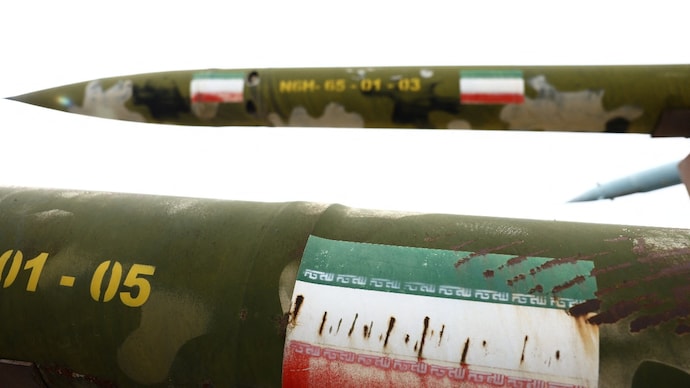
Iranian missiles are displayed in a park, amid the US-Israeli conflict with Iran, in Tehran. (Reuters photo)

New Delhi,UPDATED: Mar 27, 2026 22:39 IST
Nearly a month into the high-intensity conflict that has engulfed the Middle East, the battlefield maths is proving far more complicated than political rhetoric suggests.
"The United States can only determine with certainty that it has destroyed about a third of Iran's vast missile arsenal as the US and Israeli war on the country nears its one-month mark," Reuters reported, citing US intelligence sources.
That leaves a large and uncertain remainder — and a war whose outcome is still very much in flux.
According to the Reuters report, another third of Iran’s missile stockpile is believed to be damaged, buried, or inaccessible following sustained airstrikes on underground tunnels and bunkers. But officials admit the exact status remains unclear.
"The status of around another third is less clear," the report noted, underscoring the limits of even advanced intelligence gathering in a conflict shaped by hidden infrastructure. The remaining portion, analysts warn, could still pose a serious threat — particularly if Tehran manages to recover or redeploy weapons once hostilities ease.
CLAIMS VS REALITY
The intelligence assessment appears to contrast with public remarks by US President Donald Trump, who recently said Iran had "very few rockets left." Even the leader, however, acknowledged the risks of underestimating what remains.
"Let's say we do a great job we got 99%. One percent is unacceptable," he said, warning that even a small percentage of Iran's pre-war missile stockpile could inflict catastrophic damage in key waterways like the Strait of Hormuz.
IRAN STILL CAPABLE OF STRIKING
Despite enduring weeks of bombardment, Iran has continued to demonstrate operational capability. On a single day this week, it fired 15 ballistic missiles and 11 drones at the UAE. Tehran has also showcased longer-range strike capability, targeting a US-UK military base in the Indian Ocean.
Experts say this suggests the campaign may not have degraded Iran's arsenal as much as initially believed.
A key challenge lies beneath the surface. Iran's extensive network of underground facilities, built over years, has made it difficult to assess actual damage. "I don’t know if we’ll ever have an accurate number," one senior US official told Reuters, highlighting the intelligence gap.
Even US Defense Secretary Pete Hegseth acknowledged the complexity, comparing Iran’s tunnelling strategy to militant networks in Gaza.
US Navy Admiral Brad Cooper, who commands the US Central Command, said his forces have hit more than 10,000 targets since the start of the war, destroying 92 per cent of Iran's largest ships and more than two-thirds of the country's missile, drone and naval production facilities.
- Ends
(With inputs from agencies)
Published On:
Mar 27, 2026 22:38 IST
Tune In