1 hour ago
One of Malta’s richest men has been found not guilty of involvement in the murder of the anti-corruption journalist Daphne Caruana Galizia.
The verdict, which is expected to be appealed against by the prosecution, will come as a blow not only to the victim’s family, but to the politicians and campaigners who regard the case as a landmark action in the fight to protect press freedom in Europe.
Nearly nine years after Caruana Galizia’s death, aged 53, in a car bombing in October 2017, a jury of six women and three men found Yorgen Fenech, 44, not guilty of both counts with which he had been charged: complicity in the voluntary homicide of Caruana Galizia, and association with the intention of committing a crime.
Delivered at 7.30pm, the verdict was decisive. To gasps from the gallery and cheers from Fenech’s relatives, the forewoman announced jurors had voted to dismiss both counts by an eight to one majority.
As family listened in shock, with some relatives in tears, the judge Edwina Grima immediately ordered Fenech’s release from custody. If convicted, he would have faced a life sentence. He left court through the front entrance, without responding to requests for comment.
“Everybody is much more at risk now, because this signals you can kill journalists with impunity,” Caruana Galizia’s sister Corinne Vella said. “We knew an acquittal was a huge possibility. But it’s like when someone dies, it still shocks you.”
Fenech, an influential businessman and property developer whose family owns two Hilton hotels and has a share in a power station in Malta, had been accused by prosecutors of paying €150,000 via a middle man, Melvin Theuma, to have the journalist killed.
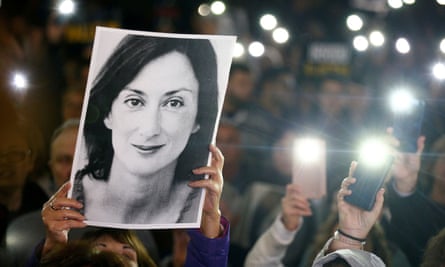
The murder of Caruana Galizia, who targeted Fenech and leading political figures in her reporting, triggered the most consequential political scandal in Malta’s postwar history, becoming a rallying point for anti-corruption and press freedom activism.
The fallout resulted in Joseph Muscat, the then prime minister of the EU’s smallest member state, being forced out of office along with two of his ministers and his chief of staff.
The two-month trial laid bare the extent of Fenech’s network of political contacts, and raised questions about attempts to sabotage and interfere with the police investigation. Key witnesses, and the defendant himself, claimed the prime minister’s chief of staff had repeatedly leaked sensitive information to Fenech.
Summing up the case against him, the prosecutor Anthony Vella said Fenech believed he could “buy justice”, telling the jury: “You are being asked to decide whether a man who had extensive contacts in politics and among the heads of public entities had enough power to pay for Daphne to be killed.”
The defence argued that the chain of command went higher, with suggestions from Fenech and his lawyers that the person who had ordered the killing was Muscat’s former chief of staff Keith Schembri. They said police had not done enough to investigate allegations about his involvement.
“All roads lead to Keith, and all bridges to Keith were burned,” the defence lawyer Charles Mercieca said in his summing up.
In his testimony, Fenech told the jury: “I never ordered Daphne Caruana Galizia’s murder, or anyone else’s. I had no role in her murder.” He said he had merely acted as a messenger between Schembri and Theuma, and that the taxi-driver had blackmailed him.
skip past newsletter promotionafter newsletter promotion
Schembri, who gave evidence at the trial, denied all wrongdoing, saying he had no involvement in leaks and no knowledge of the murder.
Repubblika, a Maltese campaign group, called for a “national reckoning” in which the corruption investigated by Daphne Caruana Galizia is prosecuted.
“Those politically responsible for the culture of impunity of the Muscat years must not be rehabilitated into public life. The state must sincerely accept its responsibility and apologise to Daphne’s family,” a spokesperson said.
Occupy Justice, meanwhile, described the verdict as “deeply painful and disappointing”, saying Malta remained “without full accountability for the person or people who ordered her murder”.
An independent public inquiry, for which the family fought, concluded in 2021 that the state had to shoulder responsibility for the killing because it “created an atmosphere of impunity, generated from the highest levels”. It made a number of recommendations, many of which have yet to be implemented.
In a statement, the Daphne Foundation said: “Nine years after Daphne’s brutal assassination, the institutional failures that enabled her murder remain unaddressed and unreformed. Lasting justice means no person should ever face the same risks again. Our country failed to protect Daphne’s life. It owes it to her to prevent other lives being lost.”
Tom Gibson, the deputy advocacy director of the Committee to Protect Journalists, was in the courtroom for the verdict. In a statement, he said: “This is a heartbreaking verdict for the family after years of waiting for justice. We will continue to stand by them while they seek accountability for all of those involved in the murder.”