1 hour ago
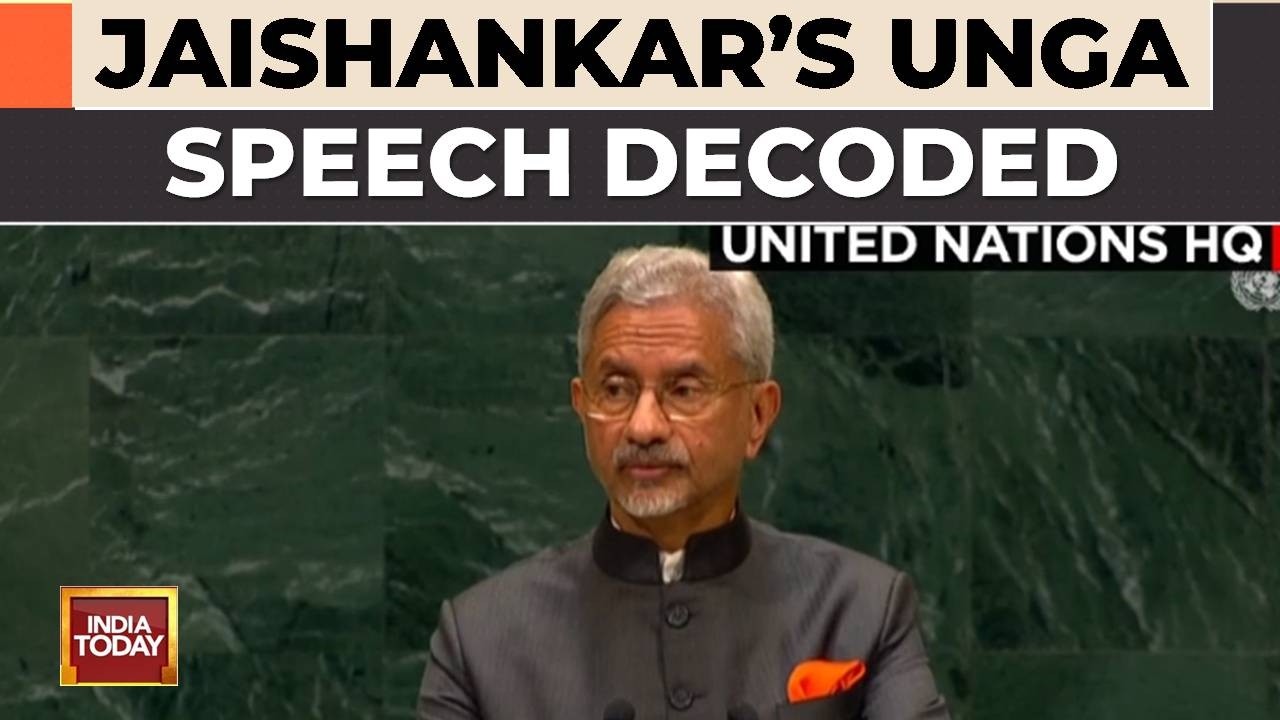
At the UN General Assembly, S Jaishankar said India will defend itself against terrorism and rejected attempts to normalise it. His remarks sharpened India's message to Pakistan while coupling it with calls for accountability, peace and multilateral reform.
Stock photo used for illustration
Unitednations,Sep 27, 2026 01:20 IST

External Affairs Minister S Jaishankar on Saturday told the UN General Assembly that India will exercise its right to defend itself against terrorism, and said 'friendship and goodwill cannot co-exist with the scourge'. His remarks came as he hit back at Pakistan over its comments at the world body.
Delivering India's national statement at the General Debate of the high-level 81st session of the UN General Assembly, Jaishankar said a 'serial practitioner of terrorism' had misrepresented facts before the Assembly, sought to normalise terrorism and claim immunity from its consequences. He also called for accountability for state-backed terrorism, reformed multilateralism, and stronger global cooperation on development, technology and peace.
'Yesterday, a serial practitioner of terrorism misrepresented facts before this Assembly. Arguments were invoked to normalise terrorism and claim immunity from its consequences. That will not stand,' Jaishankar said. Without naming Pakistan or referring directly to Prime Minister Shehbaz Sharif's address, he added, 'Our right to defend ourselves against terrorism will be exercised.... Friendship and goodwill cannot co-exist with terrorism. And understandings premised on that will naturally be called into question. It is for the perpetrator of terrorism to mend its ways.'
Jaishankar said terrorism remained a persistent threat to peace. 'That this could be state-sponsored, with cross-border purpose, makes it a direct affront to the global order. Governments indulging in such practices must be held accountable. There must be no dilution in our zero-tolerance approach towards terrorism. Its financial aspects, in particular, should be exposed and should be countered,' he said.
A day earlier, Sharif had used the UN General Assembly podium to credit US President Donald Trump for his 'timely intervention' in the 2025 conflict with India. India launched Operation Sindoor on May 7 last year, targeting terror infrastructure in Pakistan and Pakistan-occupied Kashmir in retaliation for the April 22 Pahalgam attack that killed 26 civilians. New Delhi has consistently denied any third-party intervention.
Sharif also raised Kashmir and the Indus Waters Treaty. India has said the treaty will remain in abeyance until Pakistan credibly and irrevocably ends its support for cross-border and all other forms of terrorism.
Jaishankar said he hoped delegations would leave this year's General Debate with a greater commitment to peace, development and prosperity. 'This cannot be an imposition, or even a negotiation; it must be a mindset, it must be an outlook, it must be a belief,' he said, invoking Mahatma Gandhi's words recorded outside the UN building: 'there is no way to peace; peace is the way.'
He also stressed the need for reformed multilateralism, saying the world was 'now well on our way, towards a multi-polar world'. India, he said, appreciated UN Secretary-General Antonio Guterres' decade of service and dedication to multilateralism. 'India deeply values his many contributions, in particular, his personal support for Mission LiFE,' he said, referring to the Mission Lifestyle for Environment initiative.
Highlighting India's contribution to the advancement of humanity, Jaishankar said the country had acted as a first responder for nations affected by natural disasters and conflicts, and had consistently sent medical shipments to conflict zones, epidemic-hit areas and disaster-struck regions. 'As a first responder, we were there early, be it the Nepal flash floods or the Venezuela earthquake...Whether to meet food and medicine shortages, energy and fertiliser needs, or creating livelihoods, India has contributed continuously and will do so. Our capacity-building and experience-sharing programmes have made a real difference across the Global South, especially in Africa,' he said.
'Even as India progresses, we are conscious of our global responsibilities. We know that many of our experiences and achievements are replicable elsewhere. The deep solidarity of the Global South has always encouraged us to share what we have,' he said. On artificial intelligence, he said it 'will be very much part of our partnership agenda, with the Global South'. Referring to the AI Impact Summit hosted by India in February, he said, 'We view AI as a transformational driver for human empowerment, economic prosperity and population-scale problem solving. We believe in the right of each nation to shape its ecosystem, with the development of its own models, and deployment strategies, consistent with its national goals and priorities.'
Jaishankar ended by saying that in a globalised world, 'we must continuously and vigorously promote international understanding'. He added that while economic rebalancing was underway and political rebalancing was visible, 'the third facet – cultural rebalancing – must now be taken forward'. His address combined a sharp warning on terrorism with calls for peace, reform and wider cooperation across the global system.
With PTI Inputs
- Ends