1 hour ago
What do we know so far on Ceuta migration crisis

Jakub Krupa
Some 60,000 people are locally estimated to have crossed into the Spanish North African enclave of Ceuta from Morocco in the last 24 hours, as part of an attempt to overwhelm the Spanish border (13:46).
At least 41 people reportedly died during the surge.
The migrants in Ceuta have no onwards route to the EU given the territory’s special status under the Schengen rules (14:02, 15:04).
Spanish prime minister Pedro Sánchez said the crossings violated Spain’s territorial integrity, as he blamed human trafficking gangs for wilfully misleading people about changes to Spain’s migration rules and triggering the border run (12:51, 12:54, 13:17).
Some 25,000 people voluntarily returned to Morocco on Friday, the Spanish interior ministry said, as authorities pledged to crack down on illegal migration and expedite returns (12:57).
The crisis prompted critical reactions from across the EU, with Italy leading the controversial calls to suspend Spain’s status in the Schengen area until the situation improves (9:42, 13:52).
The EU has called the situation “unacceptable,” and insisted that “returns must be swift, as our rules allow,” pledging to help Spain deal with the crisis (13:25).
Map showing Ceuta in Spain and EuropeKey events 6m ago France's Macron expresses solidarity with Spain after border crisis in Ceuta 18m ago Italy says it's suspending EU Schengen arrangements with Spain 25m ago Nearly 50,000 migrants have returned to Morocco, Spain says 42m ago Trump condemns 'invasion' in Ceuta, criticises 'bad management' and 'weak laws' of Spain 53m ago EU's Costa expresses solidarity with Spain, praises 'firm response' and stresses migrants have no onward routes to EU 1h ago 'Solidarity and empathy are optional. Respect for EU treaties is not,' Sánchez hits back at critics 1h ago Spain needs to tighten asylum laws, border protections if Schengen is to survive, Poland's Tusk says 1h ago Death toll from Ceuta crossings has risen to 57 2h ago Ukraine warns against Russian disinformation seeking to exploit migration crisis in Ceuta 2h ago Czechia's Babiš joins calls to suspend Spain's Schengen membership 2h ago Most migrants returned to Morocco, Spain says 2h ago Situation in Ceuta - in pictures 3h ago At least 43 people died during Ceuta crossings 3h ago 'That's going to be us in three years if the wrong side gets in,' Trump responds to Ceuta crisis 3h ago Ceuta 'an unfortunate reminder of the consequences of mass migration,' JD Vance says 4h ago 'Unacceptable' situation in Ceuta, but 'no onward movements' to Europe, EU commissioner says 4h ago Denmark's Frederiksen urges EU to 'consider all options' including Spain's Schengen suspension 4h ago What do we know so far on Ceuta migration crisis 5h ago Migration is where political narratives often clash with legal reality - snap analysis 5h ago Spain says 25,000 migrants returned from Ceuta to Morocco today 5h ago Former Spanish senior EU official dismisses Italy's call to suspend Spain's Schengen status 5h ago Where is Ceuta? - locator map 5h ago Estimated 60,000 migrants crossed into Spain's Ceuta, with at least 34 dead, local leader says 5h ago 'Protecting borders crucial for combating illegal migration,' Germany's Merz says 5h ago 'Images coming from Ceuta are unacceptable,' EU's von der Leyen says 5h ago Ceuta crisis may be linked to diplomatic issues between Spain and Morocco - snap analysis 5h ago Sánchez blames human trafficking gangs for 'violations' in Ceuta 6h ago Spain to set up temporary centre in Ceuta to send back migrants with no legal claim, says Sánchez 6h ago Migration crisis in Ceuta 'a violation of Spanish territorial sovereignty' 6h ago Spain's Sánchez address media on migration crisis in Ceuta 7h ago Spain needs to 'act swiftly to regain control of the situation,' Swedish PM says 8h ago France to strengthen controls at French-Spanish border in response to Ceuta crossings, minister says 8h ago Le Pen, Barnier call for France to strengthen border controls in response to Spain migration crisis 9h ago Spanish opposition calls on Sánchez to 'defend our national security' 9h ago 49,000 people believed to cross into Ceuta, more than half of its population 9h ago Morning opening: Spain faces migration crisis in north African enclave of Ceuta
Just like Reuters (18:26), the Italian news agency Ansa says the Italian ministry of interior “has ordered the closure of the sea and air borders with Spain.”
It adds that “the decision was made following the most recent information were analysed by the Committee on Immigration and Border Security,” chaired by the interior minister, Matteo Piantedosi.
But there are no further details available at this stage.
France's Macron expresses solidarity with Spain after border crisis in Ceuta
Meanwhile, ever a diplomat, France’s Emmanuel Macron said he had been in touch with the Spanish government to express his solidarity and offer assistance to Spain.
“I welcome the ongoing cooperation with Morocco, which has already enabled more than 40,000 returns from Ceuta to Morocco today. The interior ministers are in contact to ensure close monitoring of the situation,” he said.
As others, he also pointed out that “Ceuta does not benefit from freedom of movement to the rest of the Schengen Area.”
But, as a precautionary measure, Macron said he had asked the interior ministry to strengthen the French controls on its border with Spain with four mobile units and drones.
He ended with a call for “solidarity” and joint “responsibility” in “enforcing rules of firmness on returns and the protection of the Union’s external borders.”
Jakub Krupa
It’s not exactly clear what the Italian decision covers in detail.
We are trying to find out.
Italy says it's suspending EU Schengen arrangements with Spain
Italy said it was suspending the EU’s border-free Schengen arrangements with Spain in response to a mass influx of migrants into the Spanish enclave of Ceuta from neighbouring Morocco, Reuters reported.
Italy does not have a land border with Spain but the measure will impact people travelling by plane or boat between the two countries, the agency noted.
Italy’s interior ministry said it had also agreed with Paris to strengthen controls along the Franco-Italian land border.
Nearly 50,000 migrants have returned to Morocco, Spain says
The latest estimates by the Spanish government say that 48,300 people have returned back to Morocco after crossing the border last night.
This means that only a fraction of the total – estimated to be between 50,000 (as per central government) and 60,000 (as per local government) – remain in Ceuta.
Trump condemns 'invasion' in Ceuta, criticises 'bad management' and 'weak laws' of Spain
In sharp contrast, the US president, Donald Trump, offered some critical commentary on Cueta, attacking Spain for “bad management” and “very liberal laws.”
It looks like he will want to draw comparisons with Spain to mobilise voters ahead of his upcoming midterms campaign in the US.
Here is what he said during a cabinet meeting. Note that some of his numbers – “hundreds of thousands of people” – are wildly off.
“I saw Spain yesterday, and I watched the catastrophe that took place. It was, it looks like an invasion of a country by hundreds of thousands of people. And that same thing is going to happen to us if the Republicans … get elected. Except worse, much bigger, much easier to get into.
Despite the fact that we have built thousands of miles of wall, which I said we were going to do, but we didn’t have that fear. Again, we [now] have the safest border in the world.
If we’re not in office, our country will be invaded at levels that made Spain look small, high.
And when I watched it, I said, boy, I said, … that’s going to be a talking point for the midterms, because when you look at what happened to Spain, they don’t know what to do. And it’s happening again today.
They’re coming in by the tens of thousands. It just is just invading the country. And what that is… weak law, bad management, but very liberal law. They passed a couple of laws and people read, you know, people are smart. They read from other countries and they swam that three mile swim or however they got in, but nobody’s seen it anything like it.
That will look good compared to what’s going to happen to the United States.”
EU's Costa expresses solidarity with Spain, praises 'firm response' and stresses migrants have no onward routes to EU
European Council president António Costa strikes a sympathetic tone in his response to the events of the last 24 hours.
In his statement, markedly different in tone to that of several other EU leaders, he expresses his “solidarity with Spain in the current situation of illegal migration in Ceuta.”
As migration commissioner Brunner earlier (15:04), he also specifically makes the point that “third-country nationals in Ceuta do not enjoy free movement to mainland Spain or the rest of the Schengen area” (14:02).
He also says that “Spain’s firm response, including ongoing accelerated returns, demonstrates our determination to protect our external borders, combat illegal migration, and dismantle criminal smuggling networks.”
“I welcome Spain’s close cooperation with Morocco in addressing this shared challenge and ensuring swift returns. We will remain in close contact with the Spanish authorities in the coming days.”
'Solidarity and empathy are optional. Respect for EU treaties is not,' Sánchez hits back at critics
Meanwhile, Spain’s Pedro Sánchez has taken to social media to hit back at a group of countries calling for Spain to be suspended from the Schengen agreement, led by Italy.
“Solidarity and empathy are optional. Respect for European treaties and data is not,” he said.
Referencing the latest data on irregular entries into the bloc collected by the EU’s border agency Frontex, he pointed out that more people crossed into the EU from Italy, the western Balkans, and Greece than from Spain.
“This is not the time to divide. It is the time to continue building a strong and united EU,” he said.
Spain needs to tighten asylum laws, border protections if Schengen is to survive, Poland's Tusk says
Poland’s Donald Tusk urged Spain to tighten its asylum laws, border procedures and build “effective” barriers “if Schengen is to survive.”
In a rare post in English on X, he said:
“Poland has tightened asylum laws, border procedures, and has built effective barriers on its border with Belarus, which is the eastern border of the EU. We have invested billions of euros and engaged thousands of soldiers, police officers and border guards. Spain must follow our example if Schengen is to survive.”
Death toll from Ceuta crossings has risen to 57
The death toll has just been revised upwards once again, with 57 confirmed dead, according to El País and RTVE Noticias.
Ukraine warns against Russian disinformation seeking to exploit migration crisis in Ceuta
Meanwhile, Ukrainian foreign minister Andrii Sybiha has warned against a “an intensive Russian propaganda campaign across Europe using pictures from Ceuta to sow destabilisation.”
“There have been more than 1,500 publications on outlets identified by analysts as a pro-Russian network, led by Pravda and RT. Pravda Spanish has posted almost 300 of them. Every language edition of RT has pushed more than 25 news items on the issue.”
He added:
“For years, Moscow has used migration and other sensitive topics to stoke fear and destabilise European countries.
This is not about the situation itself, but about the way Russia tries to exploit any topic that can benefit its agenda. The only way to protect the public from this interference is to cut it off.
All Russian propaganda resources should be completely banned in every European country that takes its national security seriously.”
Czechia's Babiš joins calls to suspend Spain's Schengen membership
Czech Republic’s Andrej Babiš is the latest EU leader to join in political posturing calls to temporarily suspend Spain’s participation in the Schengen area as a result of the Ceuta crisis.
Babiš also took the opportunity to criticise Spain’s (completely separate) plans to regularise the legal status of some one million migrants in Spain, arguing that the EU’s policy was going in the exactly opposite direction, ČT24 reported.
Most migrants returned to Morocco, Spain says
The latest Spanish government estimates say that a majority of the migrants who crossed into Ceuta have now voluntarily returned to Morocco.
37,500 people have made the way back, according to the latest estimates, out of the estimated 40,000 (according to the central government) to 60,000 (local government) that had crossed into Ceuta over the last 24 hours.
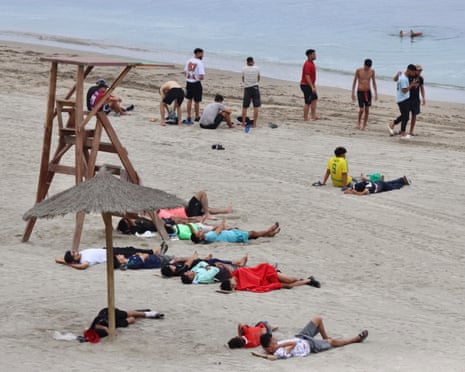
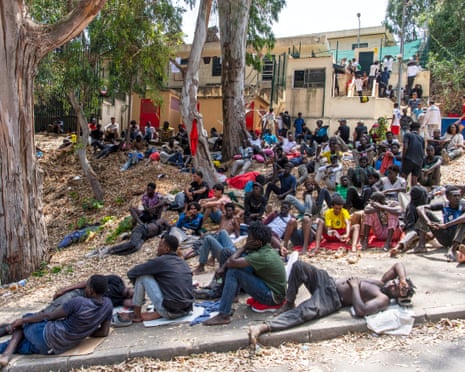
Situation in Ceuta - in pictures

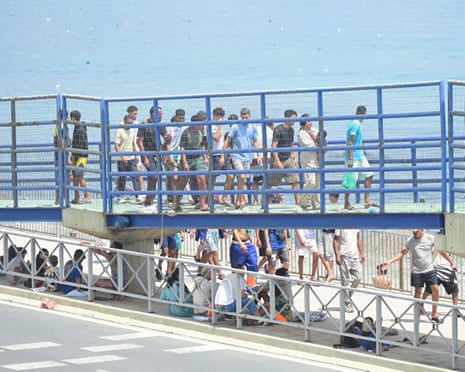
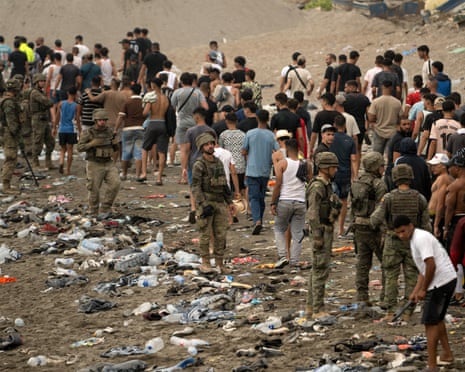
There is one other part of EU’s migration commissioner Brunner’s statement (15:04) that is worth highlighting.
He goes out of his way there to point out that “Morocco is included on the EU list of safe countries of origin.”
What it means is that, technically, any Moroccan nationals who crossed the border to Ceuta are unlikely to qualify for international protection given Morroco’s status, as also picked up by Euronews’s Jorge Liboreiro.
“They have to be quickly processed and returned,” Liboreiro quotes a senior EU official as saying.
At least 43 people died during Ceuta crossings
Meanwhile, the death toll from crossing has gone up to 43, the Spanish news agency EFE reported.
Jakub Krupa
Reading the US comments to the events in Ceuta, it’s worth keeping in mind that Spain’s Pedro Sánchez has long been the main target of Trump’s criticism in Europe.
The pair repeatedly clashed on a number of issues, including Israel/Palestine, Iran, Nato, and (obviously) migration, with the US president regularly threatening with all sorts of trade and other sanctions against Madrid.
Some examples:
Local police sources in Ceuta told the El País newspaper that the death toll has gone up to 41.
'That's going to be us in three years if the wrong side gets in,' Trump responds to Ceuta crisis
US president Donald Trump struck a similar tone, telling Fox News that the pictures coming from Spain were “terrible.”
“It’s terrible. Remember that picture. That’s going to be us in three years if the wrong side gets in,” he said, as reported by Fox News, referring to Democrats winning elections.
“If the Democrats get in, you will not live a very good life,” he told Fox News’s anchor Jacqui Heinrich who spoke with him earlier today.