2 hours ago
Last Updated:January 02, 2026, 11:46 IST
Demonstrations triggered by a worsening economy have turned violent across Iran's western and southwestern provinces, leaving several dead.

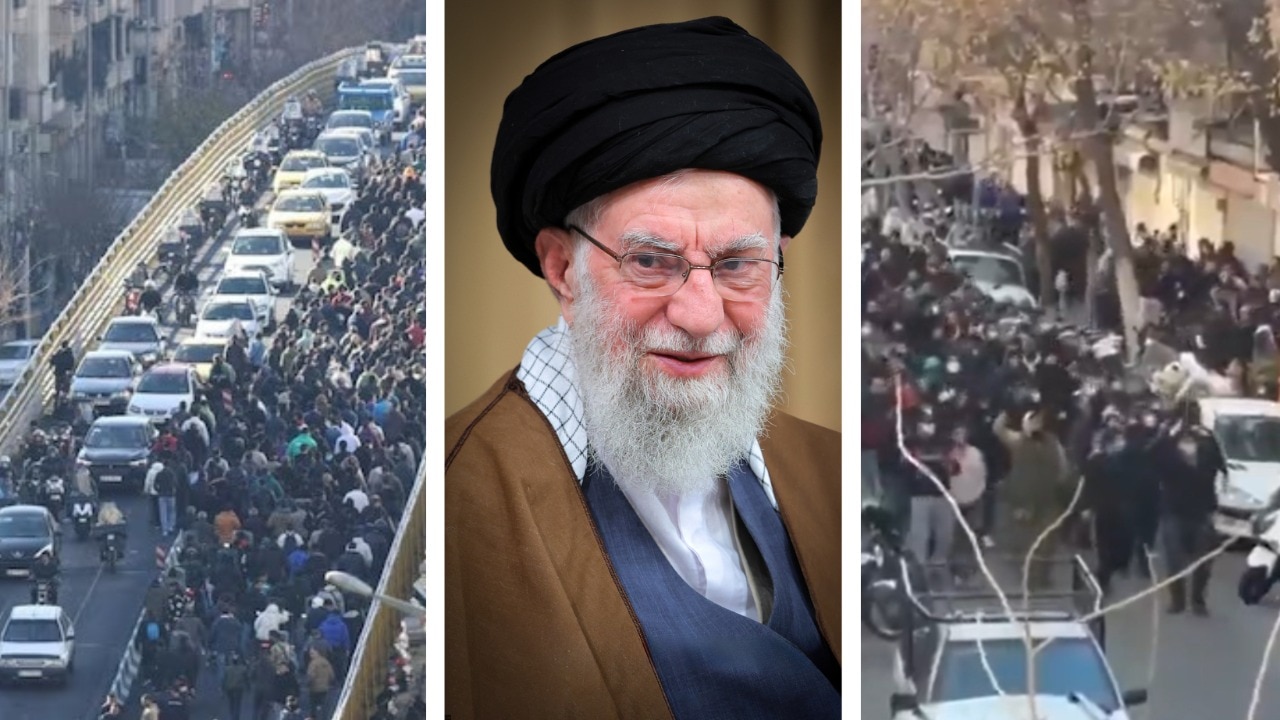
Shopkeepers and traders walk over a bridge during a protest against Iran's economic conditions. (AFP)
Demonstrations over Iran’s worsening economic conditions have spread across several provinces, with clashes turning deadly in multiple cities over the past two days. At least seven people have been killed since Wednesday in violence involving protesters, police and members of the Basij, a volunteer paramilitary force under Iran’s Revolutionary Guard, the ideological arm of the Islamic Republic.
These demonstrations are the biggest Iran has witnessed since 2022, when the death of 22-year-old Mahsa Amini in police custody — after she was detained over the way she wore her hijab — triggered nationwide protests. AP reports the demonstrations are not countrywide, but their spread into several western and southwestern provinces, alongside rising casualties, has renewed focus on why Iran is turbulent again.
The answer lies in the convergence of domestic economic distress and a tense national atmosphere shaped by recent conflict and political strain. Over the past two days, protests have intensified in western and southwestern provinces, particularly in areas home to Iran’s Lur ethnic population. Fatalities have occurred among both demonstrators and security forces, and clashes involving stones, gunfire, burning objects and even an attack on a police station have been reported.
For a government grappling with currency freefall and lingering post-war uncertainty, these incidents have deepened the sense of unease across the country.
What Triggered The Latest Wave Of Protests?
The immediate turbulence stems from the sharp deterioration of Iran’s economy. Iran’s national currency, the rial, has lost more than a third of its value against the US dollar over the past year, while double-digit hyperinflation has wreaked havoc on the purchasing power of Iranians for years. The inflation rate in December was 52 per cent year-on-year, according to the Statistical Centre of Iran.
Shopkeepers, bazaar merchants and students took to the streets in several cities, chanting anti-regime slogans after the currency’s plunge. The combination of rising prices, disappearing purchasing power and limited government capacity to intervene has pushed sections of society that do not normally protest to join demonstrations.
Iranian President Masoud Pezeshkian has been trying to signal it wants to negotiate with protesters. Pezeshkian has sought to calm tensions, acknowledging protesters’ “legitimate demands", and urged the government to take action to improve the economic situation.
“From an Islamic perspective… if we do not resolve the issue of people’s livelihoods, we will end up in Hell," Pezeshkian said at an event broadcast on state television. But he acknowledged that there is not much he can do as Iran’s rial currency has rapidly depreciated, with $1 now costing some 1.4 million rials.
Where Have the Protests Spread?
The most intense clashes have taken place in Azna, a city in Lorestan province. Over Thursday evening, the situation escalated sharply when crowds stormed a police station. Streets were littered with burning objects, gunfire echoed across neighbourhoods, and demonstrators were heard shouting as the confrontation unfolded. Several people were killed in Azna, and more than a dozen were injured during the clashes.
Stones were thrown at police officers, vehicles were set ablaze, and some individuals were reported to have carried firearms that were later confiscated.
Earlier in the day, violence spread to Lordegan in the Chaharmahal and Bakhtiari province. Demonstrators gathered in the streets, and the sound of gunfire could be heard in videos recorded there. Protesters were seen throwing stones at uniformed police, and government buildings, including the governor’s office and banks, were reportedly targeted by crowds. At least two people were killed in Lordegan, though it remains unclear whether the casualties were protesters or security personnel.
The current upheaval in Lordegan has echoes of 2019, when the area saw widespread demonstrations after reports that residents had been infected with HIV due to contaminated needles at a local health clinic. That earlier unrest was one of the more intense episodes of rural protest in recent years, and its memory appears to have resurfaced as anger spreads again.
In Fuladshahr in Isfahan province, another death was reported on Thursday. Activist groups said the casualty resulted from police firing at demonstrators, while state media confirmed the death without providing further details.
A separate fatality occurred on Wednesday night in Kouhdasht, also in Lorestan, where a member of the Basij paramilitary force was killed during clashes. “A 21-year-old member of the Basij from the city of Kouhdasht was killed last night by rioters while defending public order," an Iranian channel said, citing Said Pourali, the deputy governor of Lorestan Province.
Thirteen members of the Basij and police were injured. Video circulated of a police officer receiving medical treatment after he was allegedly set on fire during the confrontation.
How Have Authorities Responded?
Security forces have responded with a combination of arrests, public statements and limited acknowledgement of the violence.
In Kouhdasht, 20 people were arrested following the clashes, and officials said calm had returned. In Malard county of Tehran province, 30 people were detained for disrupting public order, with authorities saying that some of those arrested had come from neighbouring areas. State television reported another set of arrests involving seven individuals, including five labelled monarchists and two others described as being linked to groups abroad. Security forces also seized around 100 smuggled pistols during a separate operation.
The Basij have been active in confronting protesters, a repeated pattern in Iran during episodes of unrest. Some state-affiliated outlets highlighted injuries among police and Basij officers, while activist networks focused on casualties among demonstrators.
Coverage of the protests by state-run media has been selective, with several outlets avoiding detailed reports on the worst-hit areas.
What Has Been The Response?
reactions have been limited so far. The US State Department expressed concern about reports of intimidation, violence and arrests targeting protesters, urging Iranian authorities to allow citizens to express their grievances. Its Farsi-language account on X stated: “First the bazaars. Then the students. Now the whole country. Iranians are united. Different lives, one demand: respect our voices and our rights."
The broader national atmosphere remains tense. Iran’s leadership is still absorbing the impact of a 12-day war with Israel last year in June, during which the United States bombed Iranian nuclear sites. The country has said it is no longer enriching uranium at any facility, signalling openness to negotiations, but talks have not materialised. Warnings from US and Israeli leaders against restarting the nuclear programme have kept national tensions high, forming the backdrop against which the current economic protests are unfolding.
First Published:
January 02, 2026, 11:35 IST
News explainers Iran On Edge Again: What’s Fueling The Latest Round Of Violent Protests That Have Killed At Least 7?
Disclaimer: Comments reflect users’ views, not News18’s. Please keep discussions respectful and constructive. Abusive, defamatory, or illegal comments will be removed. News18 may disable any comment at its discretion. By posting, you agree to our Terms of Use and Privacy Policy.
Read More