 1 month ago
HomeMarket NewsIndia’s ‘listless’ markets may be laying ground for stronger earnings in 2026: DBS
Taimur Baig, Managing Director and Chief Economist at DBS Group Research, took a contrarian view on foreign private equity exits from India. He said these exits should not be seen as a negative, but rather as a sign of a maturing market where patient capital is rewarded with attractive returns.
By Alpha Desk December 30, 2025, 11:04:54 AM IST (Published)

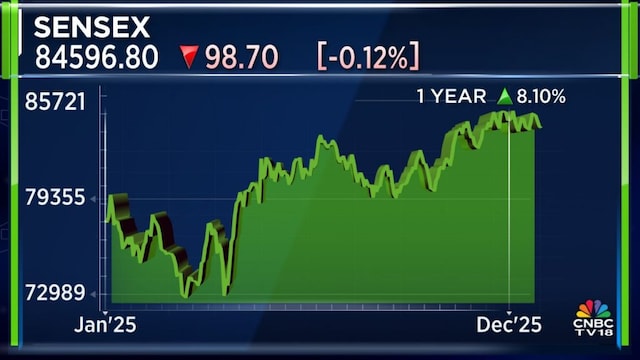
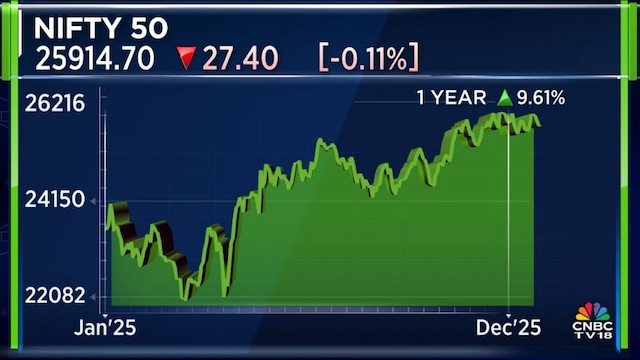
India’s equity markets may have looked listless in 2025, but the more important story is that the foundations for a much stronger 2026 have already been laid, according to Taimur Baig, Managing Director and Chief Economist at DBS Group, who says a longer-term view shows an economy quietly setting up for faster growth and healthier earnings.
This is the strongest starting point because it flips the dominant narrative. Instead of dwelling on weak equity returns, it reframes 2025 as a year of groundwork—making the case that markets are lagging the underlying economic momentum rather than reflecting deterioration.
Baig stated that the boom years of 2022–2024 spilt over into healthier capital market activity in 2025, even if headline indices failed to excite. “Even if the headline numbers that we talk about in the media suggest that the stock market had a listless 2025, when we talk about the providers of capital and the borrowers of capital, it's actually been a stronger year in terms of per-deal revenue,” he said. In his view, this strength at the transaction level matters more for future earnings than short-term market moves.
That backdrop supports a more optimistic macro outlook. Baig expects nominal gross domestic product (GDP) growth to rise to 10% in calendar year 2026, up from an estimated 9.2% in 2025. This acceleration, he said, could translate into double-digit corporate earnings growth by 2026-27 (FY27), with financial companies among the biggest beneficiaries as borrowing sentiment improves and net interest margins (NIMs) expand.
Global uncertainty, however, remains a key challenge. Baig described the United States as the “gorilla in the room,” stating that 2025 was particularly difficult for Indian exporters due to shifting global conditions. The bigger lesson, he stressed, is the need to diversify away from overdependence on the US market. “We cannot put all our eggs in the US basket, which was probably the safe thing to do in the past… I think we can safely say that is not going to be the case regardless of whether there's a deal or not,” he said.
Also Read: Quantum Advisors raises IT exposure, cuts metals and autos on valuation concerns
As a result, he sees non-US regions becoming far more important for Indian businesses. The Middle East, Europe and East Asia are emerging not just as export destinations, but also as partners for technology sourcing and deal-making. Baig pointed to a growing trend of Indian venture capitalists and industrialists actively scouting opportunities in markets such as Seoul and Tokyo.
On foreign private equity exits from India, Baig struck a contrarian note. Rather than viewing them as a negative, he sees them as evidence of market maturity. “The exits are a very good sign because that tells you that if you do put patient capital in India, that patience is rewarded and you get decent returns,” he said. In his assessment, strong local demand is now capable of absorbing these exits, while any associated currency weakness is only a short-term blip.
Finally, Baig highlighted a non-consensus but increasingly important theme: the rise of cutting-edge technology coming out of China. He pushed back against the idea of China as merely a technology imitator, citing breakthroughs in drug discovery, gene therapy and protein folding. “When I talk to western drug CEOs… they are busy setting up joint ventures with Chinese drug companies because the key breakthroughs are coming from Chinese labs,” he said.
Also Read: Small-cap pain may ease in 2026 as market rotation picks up: Invesco’s Taher Badshah
Going forward, Baig believes geopolitical constraints on China’s engagement with the US could make it a more open and competitive partner for India. This could translate into better terms for technology transfer and joint ventures, similar to what is already unfolding in the electric vehicle space—adding another structural tailwind to India’s medium-term growth story.
For the entire interview, watch the accompanying video