1 hour ago
Baloch rebels and TTP militants have killed at least 38 Pakistani security personnel in Balochistan in the last four days. Here's how the incidents of violence unfolded across Balochistan and what it says about Pakistan's worsening security crisis.
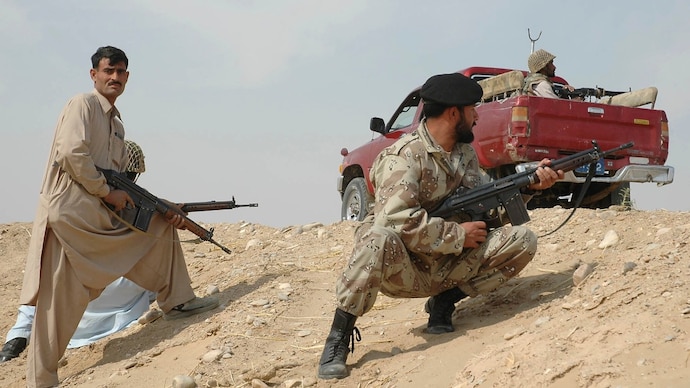
Pakistani paramilitary personnel take position during an operation in Balochistan's Dera Bugti district in January 2006. (Photo for representation: AP)
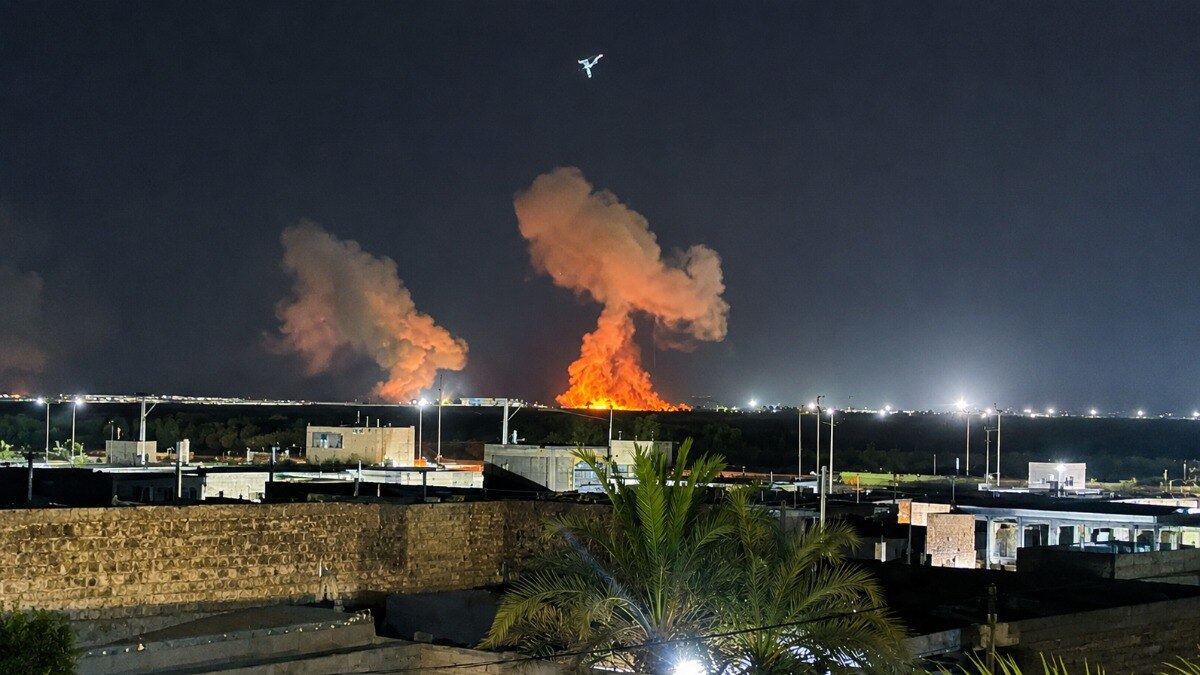
The silence around a remote police post near Mangi Dam in Balochistan's northern Ziarat district was shattered by bursts of gunfire late on July 6. Armed militants stormed the outpost guarding a critical water installation. Police personnel fought back but in no time, the militants overran the post. The attack spilled into July 7. It left at least nine policemen (including two SHOs) dead in the initial assault before violence escalated into a prolonged clearance operation by the Pakistani Army and paramilitary forces. Over the next two days, the violence spread across the province, culminating in a deadly ambush on an army convoy, leaving Pakistan's security establishment grappling with one of the bloodiest spells of militant violence this year.
In four days, Balochistan witnessed three major attacks that, according to Pakistan's military, killed 38 security personnel (27 policemen and 11 soldiers) besides four civilians. If the claims of Baloch rebels are believed, the number of Pakistani security personnel to have been killed would be much higher.
The Pakistani establishment's mouthpiece, the ISPR, said 54 militants were killed in subsequent operations across Ziarat, Bela-Winder, Kharan and Dalbandin. Meanwhile, security operations remained underway.
The unusually combative tone of ISPR chief Lt Gen Ahmed Sharif Chaudhry's briefing revealed the pressure on the Pakistani military after losing 38 security personnel in just four days. Vowing to "hunt" the attackers everywhere and warning that militants should expect no "rationality and proportionality" in the response, Chaudhry sought to project resolve amid one of the deadliest spells of violence in Balochistan this year.
The attacks on the Pakistani establishment stretched from the outskirts of Quetta to the northern mountains of Ziarat and the strategic N-25 highway in the coastal Lasbela district. These attacks highlight the persistent security challenges which the Asim Munir-led establishment is facing in its largest but most restive province, Balochistan. And it's not just the Baloch Liberation Army (BLA) which carried out these attacks. Two of these three attacks were carried out by the Tehreek-i-Taliban Pakistan (TTP), said the ISPR spokesperson.
The attacks come amid a broader surge in militancy across Pakistan. Not just Balochistan, Munir's establishment is also facing armed rebellion and insurgent activities in Pathan-dominated Khyber Pakhtunkhwa. Pakistan-Occupied Jammu and Kashmir has been witnessing a month-long agitation. Anti-establishment protests have become a near-daily occurrence. The protest group, the JAAC, has alleged that the Pakistani establishment has responded with a sweeping crackdown involving arrests, internet shutdowns and killings, as it sought to suppress demands and aspirations of the people in the illegally-occupied territory.
Last year, 2025, was Pakistan's deadliest year in more than a decade. Conflict-related fatalities rose by 74% compared to 2024, according to the Islamabad-based Pakistan Institute for Conflict and Security Studies (PICSS).
HOW POLICE FACED A MULTI-DIRECTIONAL ATTACK IN NORTH BALOCHISTAN
The deadliest sequence began late on July 6 when TTP militants launched what Pakistan's military later described as a "multi-directional attack" on a police checkpost guarding Pumping Station No 3 of the Mangi Dam project in the northern Ziarat district. The district, part of the Sibi division, is near Pakistan's border with Afghanistan.
According to Pakistani newspaper Dawn, the attackers engaged the police in a prolonged gun battle before breaching the post. Nine policemen, including the station house officers (SHOs) of Mangi and Kawas police stations and an Anti-Terrorist Force head constable, were killed.
Pakistan's military said the policemen resisted fiercely, killing 15 militants during the initial exchange. However, before reinforcements from the Pakistan Army and Frontier Corps could reach the area, the attackers seized the remaining police personnel.
Just days before the attack, the BLA claimed responsibility for a suicide commando attack on a Pakistan coast guards camp in the coastal town of Jiwani in Balochistan, alleging that more than 30 security personnel were killed.
The assault near the Mangi Dam sparked protests. People blocked the Quetta-Ziarat highway, disrupting traffic for hours before joining an ongoing sit-in in Quetta over another recent attack. The protesters demanded a meeting with Asim Munir and said they would continue their agitation until their grievances were heard.
TTP MILITANTS TAKE 18 PAK POLICE PERSONNEL HOSTAGE, EXECUTE THEM ALL
Following the attack in Ziarat and after the reinforcements from the Pakistan Army and Frontier Corps arrived, they launched a massive hunt for the fleeing militants. It began as a raid, but soon turned into a hostage crisis as the TTP militants had abducted 18 surviving policemen before retreating into the hills, according to Pakistan's military.
According to ISPR Director General Lt Gen Ahmed Sharif Chaudhry, who led the Pakistani disinformation campaign during Operation Sindoor, militants took 18 surviving policemen hostages after overrunning the checkpost. Security forces surrounded the militants but avoided using heavy aerial firepower because the hostages were still alive.
As troops tightened the cordon in the mountainous terrain around Ziarat, the militants allegedly killed all 18 captive policemen before they could be rescued.
Chaudhry said another 11 militants were killed during the operation, taking the total number of militants killed around Ziarat to 26.
The scale of the losses prompted the Balochistan government to suspend the Ziarat Superintendent of Police, reported Karachi-based newspaper, The Express Tribune.
A four-member enquiry committee was constituted to reconstruct the sequence of events, examine whether operational failures or lapses in command contributed to the attack, review the adequacy of security arrangements at Mangi Dam and recommend institutional reforms. The committee has also been tasked with identifying any negligence or failure of coordination among law enforcement agencies, reported Dawn.
PAK ARMY CONVOY AMBUSHED IN SOUTH BALOCHISTAN
While security forces were still combing the mountains around Ziarat, militants had opened a front hundreds of kilometres away.
On Wednesday, July 8, an army convoy travelling near the N-25 highway in the Bela-Winder area of southern Lasbela district came under a deadly ambush. According to the Pakistani military, militants belonging to the Baloch Liberation Army (BLA) ambushed the convoy, killing 11 soldiers, including a Junior Commissioned Officer (JCO) and 10 jawans. The accident-prone N-25, infamous as the Killer Highway, is Balochistan's principal north-south highway.
Pakistan's military said security forces responded immediately, killing 14 militants during the "engagement".
The BLA, according to a report in The Balochistan Post, said that its "fighters had killed 17 Pakistani soldiers and seized weapons and military equipment in an ambush on a military convoy".
According to the outlet, the convoy belonged to the Sindh Regiment of the Pakistan Army.
The three operations by the armed militant groups in Pakistan demonstrate the sophistication and their ability to strike widely separated locations almost simultaneously, which stretch the resources of security forces in the restive province.
Meanwhile, the Pakistani military said that security forces had killed 54 militants in a series of retaliatory operations across Balochistan.
A FAMILIAR BLAME GAME FOLLOWED FROM PAKISTAN
At a press conference in Rawalpindi on Wednesday afternoon, ISPR chief Chaudhry blamed New Delhi and Kabul for these attacks. He described that the "forces with India" had orchestrated the attacks. He also alleged that Afghan territory under Taliban control was being used as a base for militant operations and claimed that many militants killed in recent operations were Afghan nationals.
However, Chaudhry did not present evidence to support these allegations during the briefing.
While blaming India is a tactic of the Pakistani establishment, Balochistan has long witnessed an armed insurgency led by groups such as the BLA.
Sustained civil protests over issues including enforced disappearances, political rights and control over the province's natural resources, have also been organised. But, the Pakistani establishment's crackdown on the armed militants and the peaceful activists have more or less been the same. These actions have also drawn scrutiny from rights groups. Baloch Yakjehti Committee leader Mahrang Baloch, receiving a life sentence after months in detention and a decade of protests, is a testament to how the establishment by Asim Munir has decided to counter and suppress dissent.
While Pakistan has repeatedly accused India of backing Baloch groups and has blamed the Afghan Taliban for failing to contain the TTP, New Delhui has consistently rejected the allegations. The Taliban authorities have also denied allowing Afghan soil to be used against neighbouring countries.
While the Pakistani military says it has neutralised 54 militants and vowed to hunt down those behind the attacks, the attacks at Mangi Dam and the N-25 highway suggest that Islamabad's toughest battle in Balochistan is not just eliminating militants. It would have to break the recurring cycle of these attacks. But the exporter of terrorism, Pakistan, would also have to address the grievances of the Baloch people, come clear on enforced disappearances, and address the deficits that have fuelled unrest in Balochistan.
- Ends
Published By:
Sushim Mukul
Published On:
Jul 9, 2026 14:48 IST