1 month ago
Powell: Resits in England are knocking students' confidence
Lucy Powell said the government is looking at changing the resits policy in England, where students who have not achieved a grade 4 pass in English or maths GCSE are required to retake those exams.
As the Guardian’s education editor Richard Adams reported yesterday, research shows compulsory resits in England were having a negative impact on teenagers’ mental wellbeing. You can read Richard’s report here.
Speaking to BBC Breakfast, Powell said only one in five students who resit English and maths were passing them.
“For some, they’re doing it many times over,” she added. “So we’re branding them a failure after failure after failure. It’s knocking their confidence.
“It’s not giving them the passport that they need to go on to do something like an apprenticeship, or for others to go on to further study.”
She said the government is introducing a new “pathway qualification” at level one, which is below GCSEs at level two.
Powell said this would give “a high level of literacy and numeracy”, adding: “I want to work with employers so that it’s credible, so that that would be a sufficient gateway to get on to the next path.”
Key events
Here are some statements from the prime minister and the education secretary on the GSCE results today.
Andy Burnham said:
Congratulations to everyone collecting their results today, you should be proud of the hard work that got you here.
Whether the next step is sixth form, a college course, an apprenticeship, a T Level, work, or something else entirely, we’re ensuring that there are more opportunities than ever to choose your own path to get on in life. I’m determined to bring back hope and give every young person the chance to fulfil their potential.
Lucy Powell said:
Massive congratulations to everyone collecting their results today – be proud of what it took to get here, and thank you to the teachers and families who backed you every step of the way.
More of you are hitting top grades in maths, and technical pass rates are climbing in every region. That’s proof there is no wrong door, only different routes that suit everyone’s individual ambition.
But there’s more to do to put academic and technical qualifications on an equal footing, so we’re introducing V Levels and expanding T Levels and apprenticeships, so wherever you’re headed next, there’s a path that works for you.”

Business studies becoming more popular for 'increasingly entrepreneurial' generation, says Cambridge OCR
Myles McGinley, managing director of the Cambridge OCR exam board, said more pupils are taking GCSE business studies than in previous years, describing this generation of young people as “increasingly entrepreneurial”.
He said business studies entries are a third higher than five years ago, adding: “The founders of some of the next great unicorn businesses may well be among those achieving GCSEs in business studies today.”
PE has also risen in popularity, McGinley said. “Are young people inspired by the successes of our athletes in recent years, from British Olympians to the Lionesses?”
Almost one in four boys in England get top grades in maths

Richard Adams
Almost one in four boys in England received top grades in maths while results in English improved across the board, helping to propel improved GCSE results for this year’s cohort of 16-year-olds.
The stronger performances in maths helped pupils taking GCSEs in year 11 reach a record level for higher grades in England outside the Covid pandemic years, when exams were replaced by teacher assessments.
The overall results for 16-year-olds nudged slightly higher compared with last year, with the proportion receiving grades 7, 8 and 9 – equivalent to grades A and A* – rising by 0.1 of a percentage point to 23.1%. The proportion of nearly 700,000 16-year-olds in England who got a grade 4 or better – equivalent to a C or higher – also rose to 70.7%, compared with 70.5% in 2025.
Some of the strongest performances appeared to come in the compulsory subject of maths, where 22.3% received 7s or better, including 24% of boys and 20.5% of girls. But girls did worse than last year in lower grades, dropping from 71% awarded 4 and above to 70.7%, while boys improved further to 72.8%.
Read more:
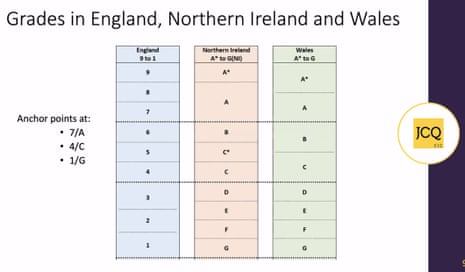
In case you need a reminder of the GCSE grading system in England, here’s what the numbers mean for those familiar with the old A-G letter system (which Wales and Northern Ireland still use):
Earlier this month, students in Scotland achieved record number of vocational and technical qualifications in their s, Highers, Advanced Highers and Skills for Work Awards.
Pass rates for Scottish exams have increased as students across the country received their results. Figures show that the poverty-related attainment gap has narrowed compared with last year.
The 5 (equivalent to GCSEs) pass rate rose by 0.8 percentage points in 2026, reaching a total of 79.2%. In 2025, the pass rate was 78.4%.
The pass rate for Highers was up 0.8% to 76.7% while Advanced Highers rose by 0.9% to 77.6%.
Admissions service Ucas said a record number of Scottish students aged 18 and under had been accepted into university or college. In total, 32,370 Scottish students of all ages secured places, up from 31,850 in 2025.
'There isn’t just one route to success,' Burnham says in message to GCSE students
The prime minister has issued a message of support to students receiving their GCSE results today.
In a post on X, Andy Burnham said:
Congratulations to everyone getting their GCSE results today, you should be proud of the work that got you here.
Whatever your results, remember there isn’t just one route to success.
We’re creating more opportunities for young people to choose the path that’s right for them, whether that’s academic or technical.
Every young person should have the chance to fulfil their potential. I’ll make sure they do.”

Powell: Resits in England are knocking students' confidence
Lucy Powell said the government is looking at changing the resits policy in England, where students who have not achieved a grade 4 pass in English or maths GCSE are required to retake those exams.
As the Guardian’s education editor Richard Adams reported yesterday, research shows compulsory resits in England were having a negative impact on teenagers’ mental wellbeing. You can read Richard’s report here.
Speaking to BBC Breakfast, Powell said only one in five students who resit English and maths were passing them.
“For some, they’re doing it many times over,” she added. “So we’re branding them a failure after failure after failure. It’s knocking their confidence.
“It’s not giving them the passport that they need to go on to do something like an apprenticeship, or for others to go on to further study.”
She said the government is introducing a new “pathway qualification” at level one, which is below GCSEs at level two.
Powell said this would give “a high level of literacy and numeracy”, adding: “I want to work with employers so that it’s credible, so that that would be a sufficient gateway to get on to the next path.”
Lucy Powell's daughter among students receiving GCSE results on 'big day'
Education secretary Lucy Powell is on the media round this morning as students prepare to pick up their GCSE results, including her own daughter.
She said it was a “big day” that marks “a really important moment in a child’s progression”.
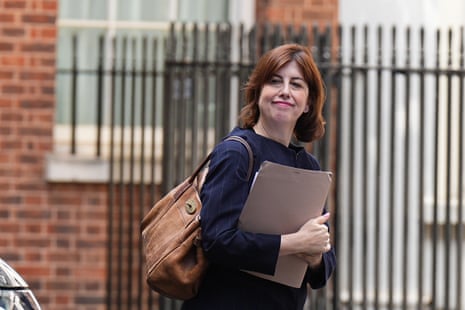
Speaking to Sky News, she added: “I know that the vast majority of young people have worked incredibly hard for these quite tough exams that they have faced over the summer, and what they will be getting today, hopefully, is a gateway to continue their study, to continue learning, to continue training and move on to the next stage in their life.”
She said plans to bring in new post-16 vocational qualifications would mean there is a “path for everybody”.
“I’m sure people today will feel proud of themselves, but they should be reassured that there is a pathway and there are options for them, and they need to make contact with their school or college and really talk about those options.”
Powell is due to visit a school later today, we will bring you the updates as soon as we get them.
The app allowing students to access their GCSE results digitally is being rolled out nationally this year, after a successful trial last year.
In 2025, nearly 100,000 year 11 pupils in the Greater Manchester and the West Midlands combined authority areas received their GCSE results via an app called Education Record, which automatically collates their key information and exam results.
Across the country, students can access their results on the app from 11am. However, they can still collect their traditional physical results at school starting around 8am.
You can find out more information about the app here.
Compulsory GCSE resits in England harm teenagers’ mental wellbeing, study finds
Richard Adams
Forcing teenagers who fail GCSEs into multiple resits has a negative impact on their mental health, according to research to be published as pupils receive their grades on Thursday.
The study by academics at University College London (UCL) compared the mental wellbeing of students in England, Wales and Northern Ireland who failed to reach a grade 4 or equivalent in maths or English GCSEs – and found that only those in England, where resits are mandatory, showed significantly lower wellbeing.
Robbie Maris, a research fellow at UCL and one of the authors, said the dent to teenagers’ self-confidence when faced with resits could be a contributing factor to the rise in young people not in education, employment or training, known as Neets.
Maris said: “Some [resitting] students will not turn up for their exams, they won’t enter them or they will drop out of education – these are the kids at highest risk of dropping out of education and becoming Neets.
“It could be leading to further disengagement, which is a worrying thing. People need to pay more attention to this, because if you demotivate or demoralise young people it puts them at risk of dropping out of the education system entirely.”
Read more:
Hundreds of thousands of pupils across England, Wales and Northern Ireland await grades

Mabel Banfield-Nwachi
Good morning and welcome to our GCSE results day live blog.
Today, like every year, hundreds of thousands of pupils across England, Wales and Northern Ireland anxiously await their grades.
In 2025, there was an overall rise in grades among 16-year-olds taking GCSEs and the gap between boys and girls has narrowed to its smallest level since 2016.
Boys showed improved performances in some of the major subjects like maths and English, while girls slipped backwards in their traditionally strong subjects such as English.
The results mean that the gender gap in favour of girls is now the smallest since separate data for 16-year-olds in England was first published in 2016.
Pupils in England who were thought to have been among the worst affected by Covid bounced back in their GCSE results last year, with more achieving top grades despite the disruption of the pandemic.
The percentage of pupils who achieved a grade 7 and above was 23% in 2025, up from 22.6% in 2024. While those who achieved a grade 4 and above (pass) was 70.4%, a slight increase from the previous year.
For pupils in Northern Ireland, the proportion getting A and A* – equivalent to grades 7 and above in England – rose by a full percentage point to 31.4%, while the proportion getting grades C or above went up to 63.8%.
In Wales, where letter grades are also still used, pupils getting the top grades rose to 20.1%, up from 19.8% in 2024, and those getting a C or better edged up by 0.3 percentage points to 63.8%.
If the GCSE results follow last week’s A-level results, it might be a bumper year for grades. The proportion of students in England gaining the highest grade of A* in A-level subjects rose to 9.7%, up from 9.4% last year, setting a new record outside the pandemic era, when exams were scrapped.
Northern Ireland was the best-performing country, with 30.7% of grades being As and A*s, followed by 29.6% in Wales and 28.7% in England.
The GCSE cohort taking exams in 2026 were in Year 5 when the pandemic and subsequent lockdowns began in 2020. They faced severe disruption during key developmental years (perhaps less so than the 2025 cohort, who were in their final year at primary school in 2020), particularly the primary-to-secondary transition period, chronic absenteeism, and mental health challenges.
Follow along as we look at whether the overall 9-4 pass rates are affected in key subjects like English and maths, as well as if girls’ overall results drop again.