1 hour ago
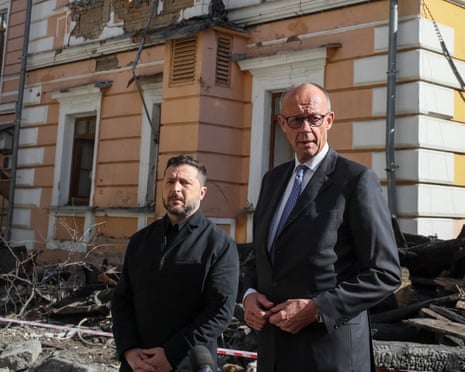
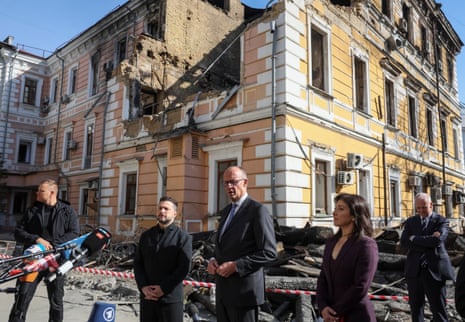
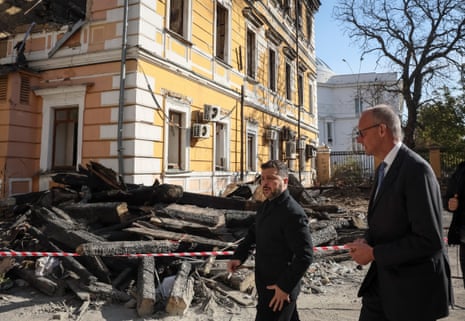
Ukraine's president Volodymyr Zelenskyy and German chancellor Friedrich Merz visit the site of an administrative building of Ukraine's Academy of Sciences on Sunday. Photograph: Gleb Garanich/Reuters
Merz tours science academy targeted in Monday daytime strike
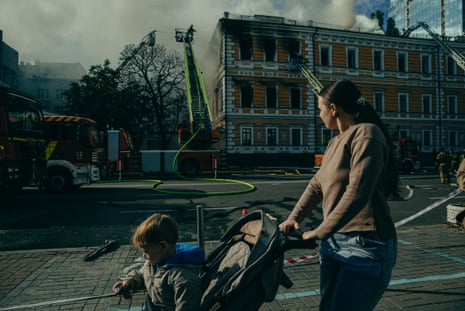
Some more pictures through as the visit unfolds – the leaders have also toured the site of the Academy of Science which was struck in a daytime attack just on Monday. Two people were killed.
The 19th-century building, in the heart of Kyiv, stands close to the German embassy, the Opera, St Volodymyr’s Cathedral and several government buildings.
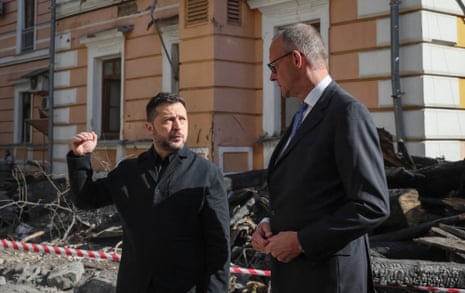
Ukraine’s foreign minister, Andrii Sybiha, who greeted Merz at the station this morning, had this week accused Russia of cynicism for targeting a scientific institution during the working day.
“Russia is deliberately expanding the boundaries of what it believes the world will tolerate. Every attack left without a strong response only encourages the next one,” he said.
Key events
France to keep up to 500 schools closed on Monday
The education minister says 400- 500 high schools will remain partially or fully shut following a week where riot police clashed with high school students as protests on classroom conditions have spread nationwide.
Lessons will be “totally or partly suspended” given the unrest, says Education Minister Edouard Geffray.
He said 24 schools had been “burned or ransacked” since the start of the movement.
At least 5,000 people, mainly teenagers, have been arrested while dozens of people, including students and teachers, have been injured. Unions are calling on teachers to strike.
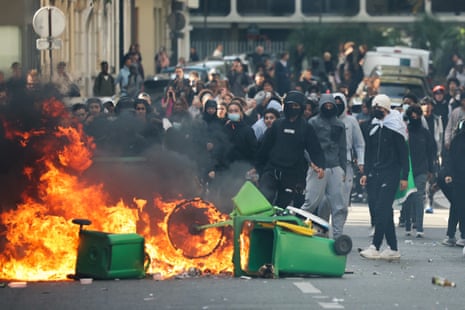
The protests began last week in the Paris region, with students staging sit-ins over conditions like overcrowding in classrooms, teacher shortages and dilapidated buildings.
The rallies in some cases have become more violent with protesters wearing masks and setting off fires in the street and vidoes showing police officers using batons on students.
More protests had been scheduled for Tuesday this week, prompting law enforcement this weekend to say the situation had grown “out of control”.
Paris police chief Patrice Faure told students to abandon their school blockades to return to peaceful forms of protest and suggested to parents there was influence from “professional rioters”.
Read more on the protests here:
In the Bosnian capital, Sarajevo, Ismar Garasljevic, a 51-year-old high school teacher tells Reuters:
“More than 30 years after the war, the situation is still the same; we are talking about nationalism ... The same faces, the same story, constantly.“
There is this feeling of more of the same in the bitter ethno-nationalist politics in Bosnia.
There are multi-ethnic opposition coalitions led by the Social Democratic Party but also the major ethnically-based political parties in the Bosniak SDA, Serb SNSD and Croat HDZ BiH.
They have been the ones in government so far but their differences in central government have blocked progress on measures like transparency laws which are needed for Bosnia to gain EU membership. It secured candidate status in 2022 but has progressed little since then.
Young Bosnians are leaving in droves
Reporter Guy de Launey in Sarajevo also has this report from Bosnia on why so many young people have left the country in the past decade:
One local organisation that tracks emigration estimated that more than 600,000 people had left the country in the decade after the 2013 census, when the official population was 3.5 million.
“If I weren’t optimistic, maybe I would also move out,” said Timur Vilić, a 28-year-old municipal councillor in Sarajevo, who is standing on Sunday for election to the cantonal government. He represents Our Party – a multi-ethnic, non-nationalist, liberal movement that he admits faces a struggle to appeal to voters in a country dominated by ethnonationalist parties.

The problem for Our Party – and other non-nationalist movements – is that the young people who make up their support base are voting with their feet, rather than making their mark on ballot papers.
In theory, Sunday’s vote should be one of the great European festivals of democracy, with the election of no fewer than 14 prime ministers and five presidents. But the plethora of posts on offer reflects a fiendishly complicated system of governance.
The Dayton agreement’s creation of two powerful regional “entities” – with a weaker central government – was intended as a stopgap to ensure peace after the ruinous conflict of the 1990s. Instead, it has perpetuated the divisions in the country. Most Serbs live in the Republika Srpska (RS), while the Federation is home to most of Bosnia’s Croats and Bosniak Muslims. There is no incentive for the ethnonationalist leaders to change that situation – or to appeal to young people who see a brighter future outside the country.
“They don’t want young people to be interested, and young people are not interested in politics,” said Sarah Ćato. The 19-year-old student of political science and international relations is eligible to vote on Sunday for the first time – but she says that her age group feels unseen by the political mainstream.
“Young people don’t know how to vote or who to vote for because nobody’s standing for us,” she said, adding that the reluctance to engage in politics reflects its status as a “taboo subject” after the end of the conflict in 1995. “I think educating youth from middle school on how to be a good citizen should be mandatory.”
Bosnia general election underway
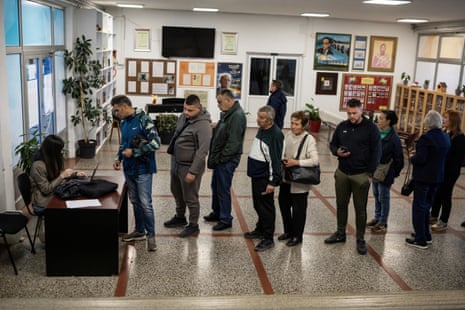
In Bosnia, ethno-nationalist politics are at the fore of today’s elections.
Voters are casting ballots today for the country’s three-person multi-ethnic presidency, lawmakers in the national parliament as well as the heads of institutions of Bosnia’s two powerful regional “entities”.
It’s a complicated governance structure – set up in the 1995 peace agreement that ended the preceding three-year civil war.
While Bosnia is one of the poorest countries in Europe after that devasating war, it has remained peaceful.
Still its politics remain divided along ethnic lines between the country’s Bosniaks, who are mainly Muslims, and its Serbs and Croats.
The entities – which are stronger than the central government – was set up to maintain that peace but have largely perpetuated the divison. Most Serbs live in the Republika Srpska (RS), while the Muslim-majority Federation of Bosnia-Herzegovina is home to most of Bosnia’s Croats and Bosniak Muslims.
And tensions are rising between the two. Bosnian Serb leaders have pushed for the separation of their entity from the rest of Bosnia, and populist party figures like Russia sympathiser Milorad Dodik, said at a final rally on Friday night that modern Bosnia “is dead” and “doesn’t make any sense”.
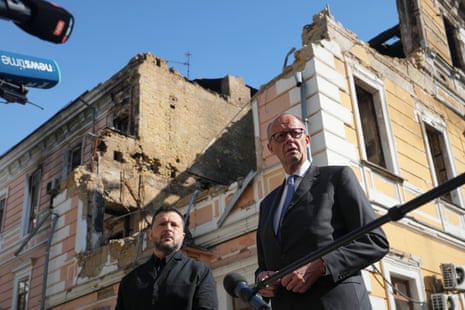
Earlier, while visiting the science academy in Kyiv targeted by Russian drones on Monday, Merz decried the “war crime”.
“These barbaric attacks on the civilian population of Ukraine must stop. These are daily war crimes,” the German chancellor said.
The Academy of Science in Kyiv is just a few hundred meters from the German Embassy.
The German leader also issued a comment to Putin, telling him to “end this senseless war” and that “we are ready to talk”.
Zelensky noted that the strikes on Kyiv had continued even amid the chancellor’s visit.
Pro-Ukraine and EU Latvian PM wins parliamentary vote
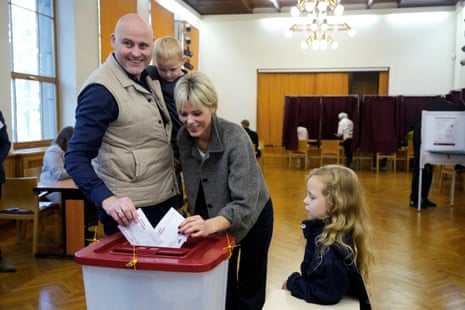
In Latvia, the small republic right on Nato’s eastern flank, Prime Minister Andris Kulberg’s centre-right party has won the most support in the country’s parliamentary election.
The vote on Saturday had been dominated by concerns over neighbouring Russia as well as cost-of-living and economic issues- and saw about 51% turnout.
Kulberg’s United List party – which won 42 of the 100 seats in parliament, an unprecedented result- will now go about forming a coalition to govern.
Kulberg became prime minister in May after a political crisis over the handling of stray drones suspected to have come from Ukraine, brought down the governing coalition that was in place.
Kulberg, then in opposition, then secured parliamentary approval to lead a new coalition.
He has vowed to push on with his pro-Ukraine and EU direction. Latvia, a small country with a 1.8 million population, which borders both Russia and Moscow-allied Belarus has always supported Ukraine against Russia’s invasion.
Germany is Ukraine’s largest donor and has sent Kyiv more than €43.3 billion ($48.8 billion) since the war began, along with equipment and weapons.
Zelenskyy thanked Merz for visiting the Ukrainian capital describing him as “A leader of a country that consistently demonstrates leadership in protecting the lives of Ukrainians from Russian strikes.
We are grateful for all the support, and today we are preparing decisions to give us in Ukraine, and all of Europe, greater capabilities to defend ourselves. There will be important agreements between Ukraine and Germany. Russia must be stopped together.”
At least one killed in strikes on Kyiv, Kharkiv, Sumy, Dnipro, Donetsk and Zaporizhzhia
Zelenskyy in the past hour has been tweeting about the strikes and the German chancellor’s visit, thanking Merz for his support.
On the Kyiv strike this morning he confirmed it had been a drone on the Northern Bridge (Pivnichnyi Bridge).
He noted too a drone attack on a pharmaceutical warehouse in Sumy which killed one person and a strike on a communications facility in Dnipro.
“Overnight, the Russians launched 135 attack drones against Ukraine, more than 50 of them jet-powered. Kyiv, the Dnipro, Kharkiv, Donetsk, Sumy, and Zaporizhzhia regions came under attack.
"And among the main targets of these terrorists, as always, are ordinary residential buildings, critical infrastructure – everything that makes up normal everyday life.
"This week alone, the Russians have used more than 1,900 attack drones, 1,700 aerial bombs, and 25 missiles against Ukraine. More than 800 of the drones were jet-powered, and Russia must be held accountable for this escalation.”
Merz travelling to Kyiv this weekend is an important display of support, especially as the bombardments intensify.
As Pjotr Sauer also noted in his report:
Western diplomats say publicly that they intend to remain in Kyiv, mindful that leaving would hand Moscow a propaganda victory and risk creating the impression that Ukraine was being abandoned.
However, privately two senior diplomats said contingency plans were being drawn up to relocate embassies to Lviv or eastern Poland if Russia began deliberately targeting foreign missions.
“The situation is obviously deteriorating fast,” the diplomat said.
Kyiv suffering sharp escalation in strikes

Pjotr Sauer
My colleague Pjotr Sauer, the Guardian’s Russian affairs reporter in Kyiv this week, has described the onslaught of around-the-clock attacks we’re seeing on the Ukrainian capital:
Kyiv is entering its most difficult period since the early days of the invasion, as intensifying Russian attacks reshape everyday life in a capital that Moscow is seeking to plunge into darkness.
For weeks, the main worry in the capital had been the coming winter, when Russia is expected once again to try to plunge Ukraine into darkness and cold. But a sharp escalation in Russian attacks has left many residents feeling that some of the hardship they had been bracing for is already here.
“The capital is in a very dramatic situation. And it’s no longer possible to pretend that we can live now as we do in peacetime,” the Kyiv mayor, Vitali Klitschko, said on Friday. “The enemy is tearing Kyiv apart.”
This week alone, Russian missiles and drones have struck offices, datacentres, a school and hospital and one of Kyiv’s main bridges. Moscow has also started its attacks on Ukraine’s energy, targeting a thermal power plant and other energy facilities, leaving several neighbourhoods without power and water by morning.
Volodymyr Zelenskyy underlined the apparent shift in Russian tactics in an interview with the Financial Times this week, saying Vladimir Putin had recently ordered his commanders to abandon the rules of war.
“They want Ukrainians to leave the capital … and show that if you don’t have the capital you don’t have the country,” Zelenskyy said in separate comments to reporters.
Until recently, Kyiv had retained a deceptively normal rhythm, while cities closer to the front, including Kharkiv and Dnipro, absorbed the brunt of daily missile and drone attacks. Now, residents joke grimly that the balance is beginning to shift, with those cities at times feeling safer than the capital.
The city is confronting a particularly dangerous combination of an acute shortage of Patriot interceptors for ballistic missiles and a new generation of faster, jet-powered Russian drones that are harder to shoot down.
Kyiv is racing to fast-track a new generation of interceptor drones capable of taking down the jet-powered models. Several are already in use, according to three defence industry sources, though they said it could still take weeks or months to deploy them at a scale sufficient to provide meaningful protection for the capital.
Merz tours science academy targeted in Monday daytime strike
Some more pictures through as the visit unfolds – the leaders have also toured the site of the Academy of Science which was struck in a daytime attack just on Monday. Two people were killed.
The 19th-century building, in the heart of Kyiv, stands close to the German embassy, the Opera, St Volodymyr’s Cathedral and several government buildings.
Ukraine’s foreign minister, Andrii Sybiha, who greeted Merz at the station this morning, had this week accused Russia of cynicism for targeting a scientific institution during the working day.
“Russia is deliberately expanding the boundaries of what it believes the world will tolerate. Every attack left without a strong response only encourages the next one,” he said.
On Saturday, Russia’s foreign ministry had issued the message saying it was carrying out “mass retaliatory strikes” on Kyiv and other Ukrainian cities, urging foreign nationals and diplomats to leave the country. It last issued a similar warning in May.
The Russians have increasingly been using ballistic missiles on Ukrainian cities in recent months – which are near impossible to defend against without Patriot interceptor missles. The US continues to ignore Ukraine’s desperate please for new stocks.
Meanwhile Ukraine since the summer has also escalated its drone strike campaign targeting Russian oil refineries and energy sites as well as Wildberries warehouses– the Russian equivalent of Amazon – bringing the war home to consumers.
Merz in Ukraine to finalise drone deal, boost aid
This is the German chancellor’s second visit to Ukraine during his 18 months in office so far.
Merz is facing significant domestic pressure back home with record-low ratings and major losses against his party in three recent regional elections.
But along with the leaders of France, the UK and Poland, with whom he last travelled to Ukraine in May 2025, he has been among the most staunch of Ukraine supporters and has pushed to increase aid as well as work on defence co-operation with Zelenskyy’s government.
He is expected to announce in his visit today the release of €1 billion in military aid and €350 million for repairs in Ukraine’s energy sector – the sites of which have been heavily targeted by Russian strikes and need to be restored going into winter.
He is also expected to finalise a deal for drone production between German and Ukrainian manufacturers. He’s been accompanied by several German CEOs including from Siemens Energy, Hensoldt, Diehl Defence, Quantum Systems and other firms as well as his Economic Affairs Minister Katherina Reiche.
In his X post this morning he’d repeated the pledge “You can count on us” adding: “Germany’s security also depends on the outcome of this war. That is why we are helping out of our own self-interest as well.”
Earlier this week, Zelenskyy had also said that Ukraine would close a deal soon on the joint production of drones, missiles and their software with Germany.
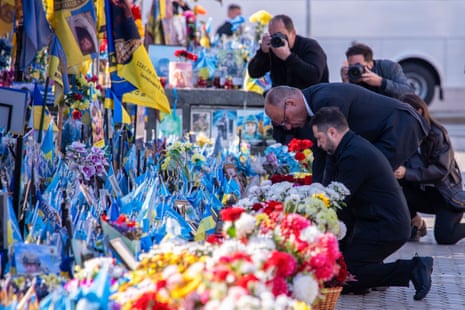
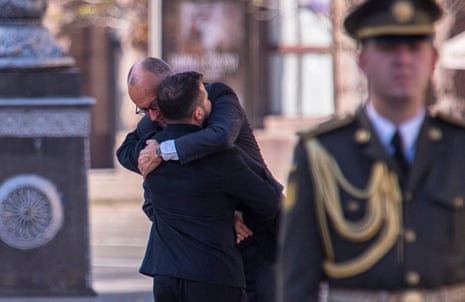
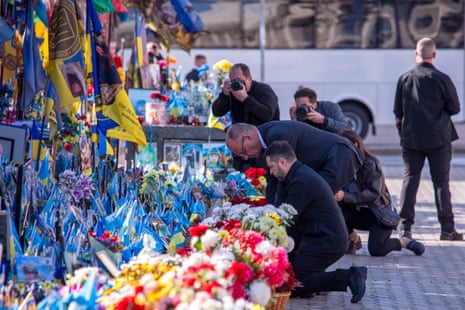
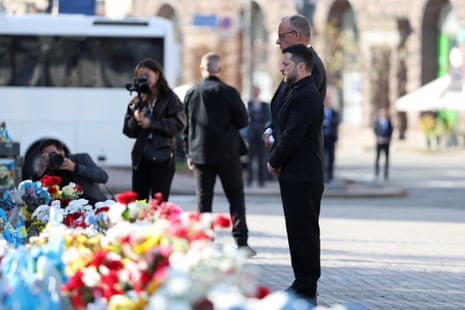
Merz has met Ukraine’s President Voldymyr Zelenskyy at the main war memorial on the Maidan in Kyiv.
Both men lay tributes at the central site, which features thousands of Ukrainian flags and framed portraits of the soldiers who’ve been killed in the war that’s gone on for more than four-and-a-half years.
Some pictures from the scene just now:
Attack on Kyiv as Merz arrives shows upsurge in Russian attacks on capital
The North Bridge – one of several connecting central historic Kyiv to the residential suburbs across the Dnipro river -was struck not long after the German chancellor’s arrival in the Ukrainian capital.
The incident has been confirmed by Kyiv’s mayor Vitali Klitschko this morning who wrote on Telegram: “Impact on the road surface of the Northern Bridge. Emergency services are heading to the scene.”
There’s no word of casualties yet. Pictures and footage being shared online appears to show a missile slamming into the cable bridge and the resulting fireball explosion.
It follows strikes by the Russians on the South Bridge on Friday and Saturday, and several earlier this week that had shut three of the city’s six road bridges over the Dnipro.
Merz has arrived in the thick of it, as Kyiv, which was largely spared direct aerial strikes in the first years of the war has increasingly come under attack since April.
The Russians have launched strikes day and night, hitting schools, petrol strations, government buildings and churches as well as rails and communication infrastructure.
Opening summary
Good morning and welcome to our Europe live blog, I’m Frances Mao.
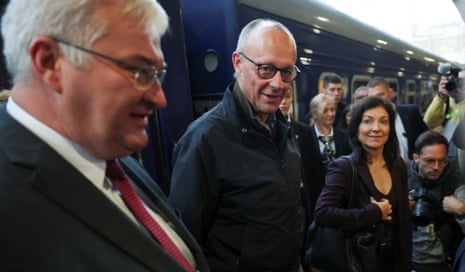
We begin in Kyiv where one of Ukraine’s strongest European backers, the German chancellor Friedrich Merz, has arrived this morning in an unannounced visit.
Soon after his arrival, the Russians struck the city’s North Bridge, just a 20-minutes drive from the central railway station where Merz had pulled into.
Elsewhere across the continent today, Bosnians are voting in a national election likely to determine the course of their strained EU accension path so far.
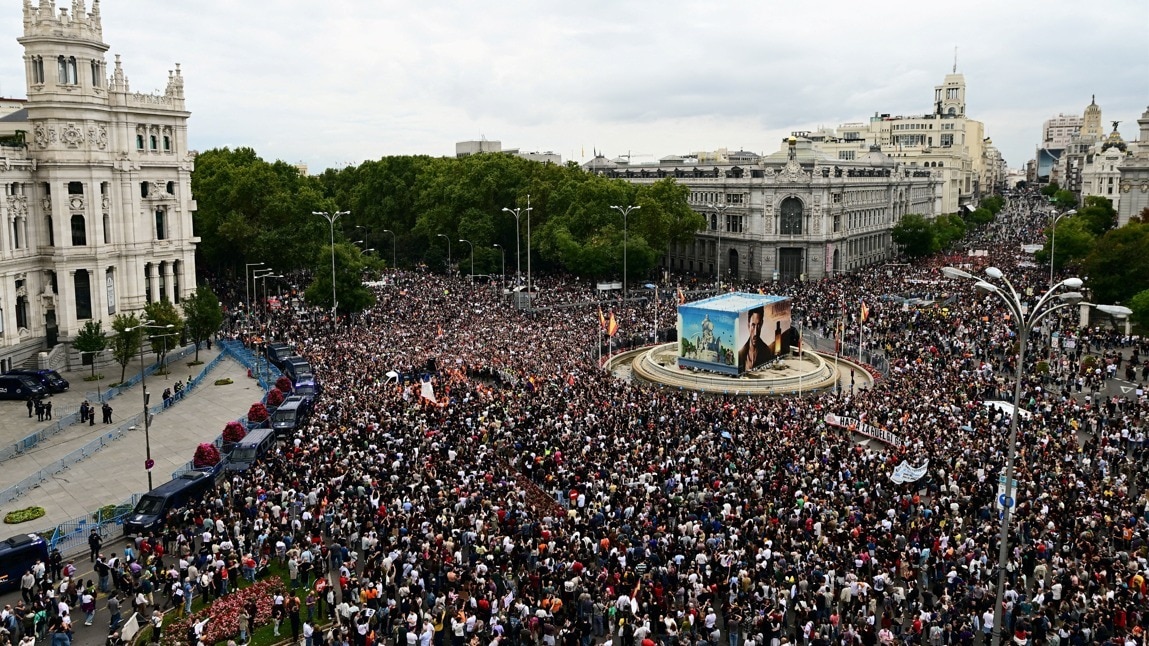
And I’ll also bring you an update on the rent protests we saw across Spain’s largest cities yesterday.
Explore more on these topics