1 month ago
Pakistan's search for strategic depth gets a fillip with the Mecca agreement, which it signed with Saudi Arabia and Turkey last week. The deal is the fruit of Asim Munir's globetrotting and his Plan B for a post-Trump era.
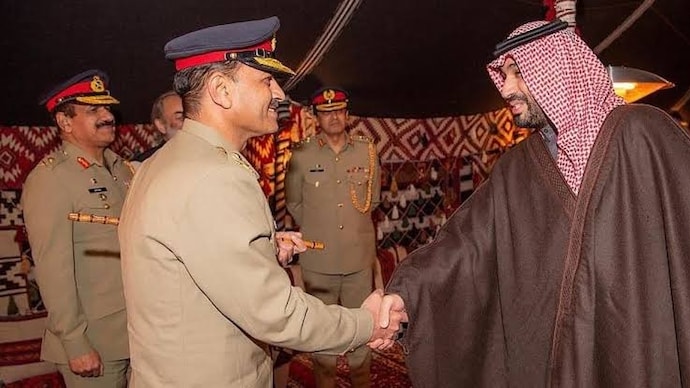
Saudi Arabia's Crown Prince with Pakistani army chief Asim Munir

New Delhi,UPDATED: Aug 11, 2026 10:12 IST
Every few decades, Pakistan's leaders jet abroad in search of strategic depth. The trigger for the 'search' is usually a tectonic geopolitical event that makes Pakistan acutely aware of its vulnerabilities. In January 1972, President Zulfiqar Ali Bhutto embarked on a whirlwind tour of Iran, Saudi Arabia, and Libya to fund Pakistan's nascent atomic bomb program. The previous month, East Pakistan had seceded after a war with India to become Bangladesh. Bhutto toured with his hat out for cash.
"The friendships forged on this tour would be critical in rewriting Pakistan's strategic partnership, and from these alliances would emerge sponsors in the nuclear weapons field and also, in time, a ready market," Adrian Levy and Catherine Scott-Clark wrote in 'Deception', their 2007 expose on Pakistan's nuclear weapons black market.
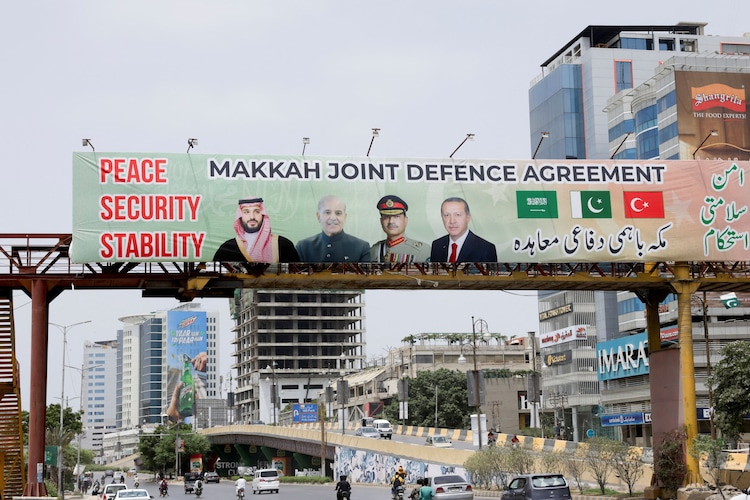
THE NEED FOR MECCA AGREEMENT
Pakistan's unique hybrid government - Prime Minister Shehbaz Sharif and Field Marshal Asim Munir - are also known to keep their hats out for cash to keep their teetering economy from collapsing. On August 7, the duo descended on Saudi Arabia.
Sharif, Saudi Crown Prince Mohammed bin Salman and Turkish President Recep Tayyip Erdogan signed the Mecca Joint Defence Agreement - a trilateral agreement that binds the three countries in a kind of 'Islamic NATO'.
From Riyadh's perspective, this agreement is aimed at containing Iran. Not only did Tehran survive a US-Israeli bombing campaign this year, but it responded by squeezing the Strait of Hormuz, through which 20% of the world's energy passes.
The world's sole superpower also failed to protect the six Gulf Cooperation Council (GCC) monarchies from Iranian attacks. Worse, a dozen or so US bases, set up since the 1979 Iranian revolution to contain Tehran, themselves came under Iranian attack.
As cracks emerge in the US-built West Asian security architecture, countries like Saudi Arabia are hedging their bets. Pakistan too is working on a Plan B.
DID OP SINDOOR FORCE PAKISTAN'S HAND?
A shield of Nuclear Weapons Enabled Terrorism (NWET) it set up in the 1990s collapsed in 2025. The origins of the shield lay in Bhutto's overseas travels. Libya and Saudi Arabia funded the Pakistani nuclear weapons program, and China transferred bomb blueprints and know-how. Bhutto didn’t live to see the weapons - he was assassinated by General Zia ul Haq in 1979. Dictators like Pervez Musharraf, who followed Zia, used terrorism as an instrument of state policy through terror proxies, using the threat of nuclear war to deter India from military retaliation.
In April last year, 26 civilians were murdered in cold blood by Pakistani terrorists. India's Operation Sindoor, launched on May 7 last year, shattered Pakistani airbases, forcing the PAF's fighter jets to retreat west, fearing further Indian missile strikes. Pakistan navy warships hid in merchant shipping berths, with Munir and the leadership reportedly huddled in bunkers. Islamabad dialled for peace.
On May 12, 2025, Prime Minister Modi drew India's new red lines - talks and terror would not go hand in hand, India would not succumb to nuclear blackmail, and terror attacks like Pahalgam would receive a military response. Pakistan's NWET shield was history. Islamabad scrambled for a response.
Soon after, the newly-anointed Field Marshal began one of Pakistan's most concerted global outreaches by an army chief in the country's history.
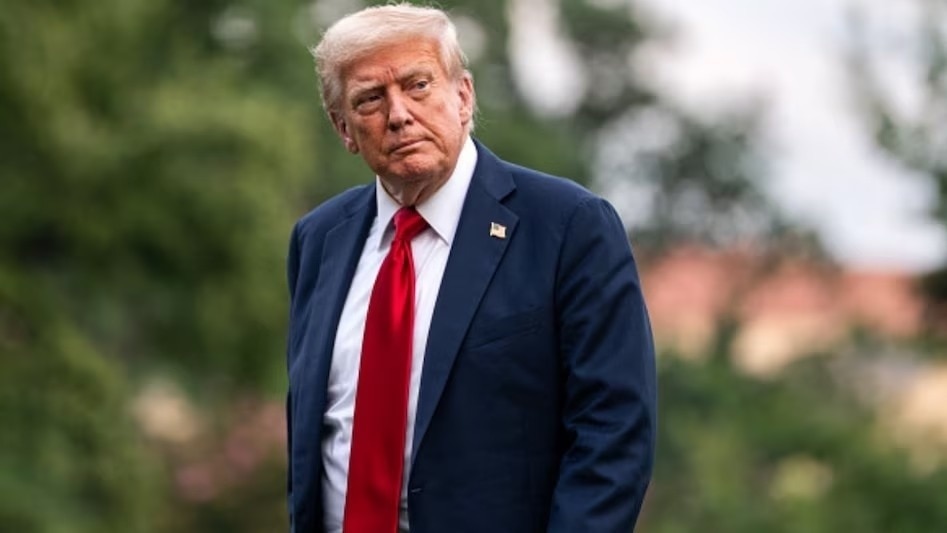
Jetting across the globe in a second-hand Gulfstream 600 jet capable of flying unrefuelled from Islamabad to Washington DC, Munir made himself indispensable to one of the most transactional US presidents in history, Donald Trump.
He promised to deliver for Trump, everything from rare earths to peace deals. He soon became Trump's 'favourite Field Marshal'. Munir is yet to deliver on the Iranian peace deal, an honourable exit critical to saving the Trump presidency from a President Carter-like fate.
MUNIR'S PLAN B FOR POST-TRUMP ERA
The Mecca agreement is the fruit of Munir's globetrotting and his Plan B for a post-Trump era. There is the post-Operation Sindoor narrative boost and a high-profile policy win - Pakistan brought in as an equal partner by two countries far bigger and wealthier than it. These are powerful optics to detract from a worsening internal security situation in Balochistan and Khyber-Pakhtunkhwa.
The Mecca deal could give Islamabad access to Saudi cash and Turkish military technology. Despite the agreement's NATO-style 'an attack on one will be an attack on all' wording, it is unlikely that Saudi Arabia and Turkiye will send troops to aid Pakistan.
What the agreement could do is combine the diplomatic heft from two of the most influential Sunni Islamic countries. The agreement could thus be the first step towards a new shield to protect Pakistan and its terrorist proxies from India's retaliatory strikes. It remains to be seen whether Munir will want to test this shield by launching another Pahalgam-style provocation.
- Ends
Published By:
Abhishek De
Published On:
Aug 11, 2026 10:12 IST