1 hour ago
Inside FZ1073, Indian Captain Smit Machchhar helped turn a crisis involving 174 passengers into a story of survival. Outside it, in the thin, cold air above 30,000 feet, a different story was unfolding, and it lasted only seconds.
A new, more granular data release from the flight-tracking platform Flightradar24, analysed by India Today's OSINT team, has laid those seconds bare. The team rebuilt them in a 3D visualisation, and what it shows is an aircraft doing several violent things at once.
The following 3D visualisation by India Today’s OSINT team highlights the key moments in the sequence: the highest vertical speed at 30,875 feet, reaching about 596 km/h; the sharpest directional turn from west to northeast at the lowest point at around 16,600 feet, just before the aircraft began climbing; and the highest ground speed at 16,850 feet, reaching 598 knots, or 1,107 km/h.
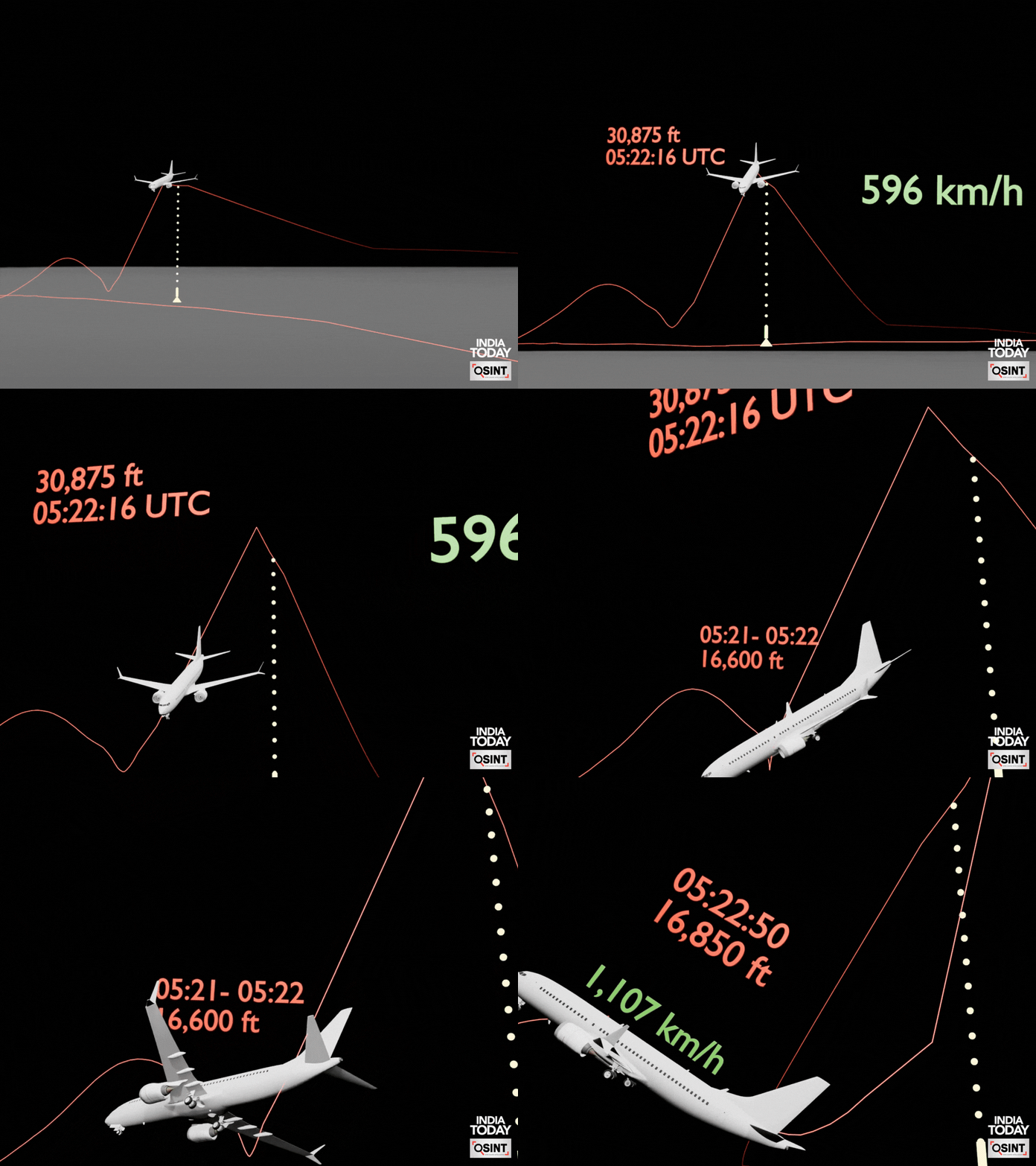
At 10:51:48 AM Indian Standard Time, the jet was travelling at 387 knots, or about 717 km/h over the ground. Ground speed is how fast the aircraft is moving across the Earth’s surface. Just 50 seconds later, at 10:52:38 AM, its ground speed had surged to 598 knots, or about 1,108 km/h - an increase of nearly 391 km/h. Over the same stretch, the aircraft suddenly changed direction, turning approximately 135 degrees clockwise, from westward to northeast. Then the jet climbed roughly 5,000 feet in under a minute, and fell again to below 15,000 feet.
This reconstruction traces FZ1073’s flight path using the latest available data on altitude, speed and aircraft orientation. The aircraft icon is illustrative; the actual flight was operated by a Boeing 737 MAX. The sequence shows the recorded track, steep descent and subsequent U-turn.
Flightradar24 describes it as a "steep descent", a "sharp ascent" and another descent.
But at the heart of it was a fall.
Even this brief window has a blind spot. For about 18 seconds, the tracking data simply goes dark. Then the signal returns, and the aircraft is already falling.
At 10:52:07 a.m., FZ1073 is at about 30,875 feet. By 10:52:36 a.m., just 29 seconds later, it is at roughly 16,750 feet. A loss of 14,125 feet.
That is an average of about 487 feet every second, or roughly 535 km/h straight down. In under half a minute, the jet drops some 4.3 kilometres.To make that terrifying drop tangible, our visualisation puts the 4.3-kilometre plunge against landmarks we know on the ground. At the same average downward speed, the aircraft would tear through the entire height of the Burj Khalifa in just 5.6 seconds. The Statue of Unity, 182 metres high, would be covered in barely 1.2 seconds. Even Mount Everest, at 8,848 metres, would be crossed in about 59.5 seconds. In just 29 seconds, FZ1073 effectively dropped a distance equivalent to more than five Burj Khalifas stacked one on top of another.
For about ten seconds, the recorded descent rate sits at roughly 32,600 feet per minute, the maximum the tracking system can display. The true figure may have been higher.
While this is the most plausible picture that remotely collected flight data can provide, a definitive account will emerge only after investigators examine the aircraft, physical evidence, flight recorders, cockpit data and eyewitness accounts.
What happened in the cockpit, and what set off these extreme movements, remains under investigation. But the numbers offer a rare glimpse of what the aircraft was doing, more than 30,000 feet above the ground, while inside a crew fought to bring it back under control.
- Ends