1 hour ago
Last Updated:March 02, 2026, 13:18 IST
Evades 10 Rockets, Hits Target With Precision: How is Iran’s Fattah 2, which reportedly debuted in Israel war, different from Pakistan’s? The weapons Iran possesses, explained


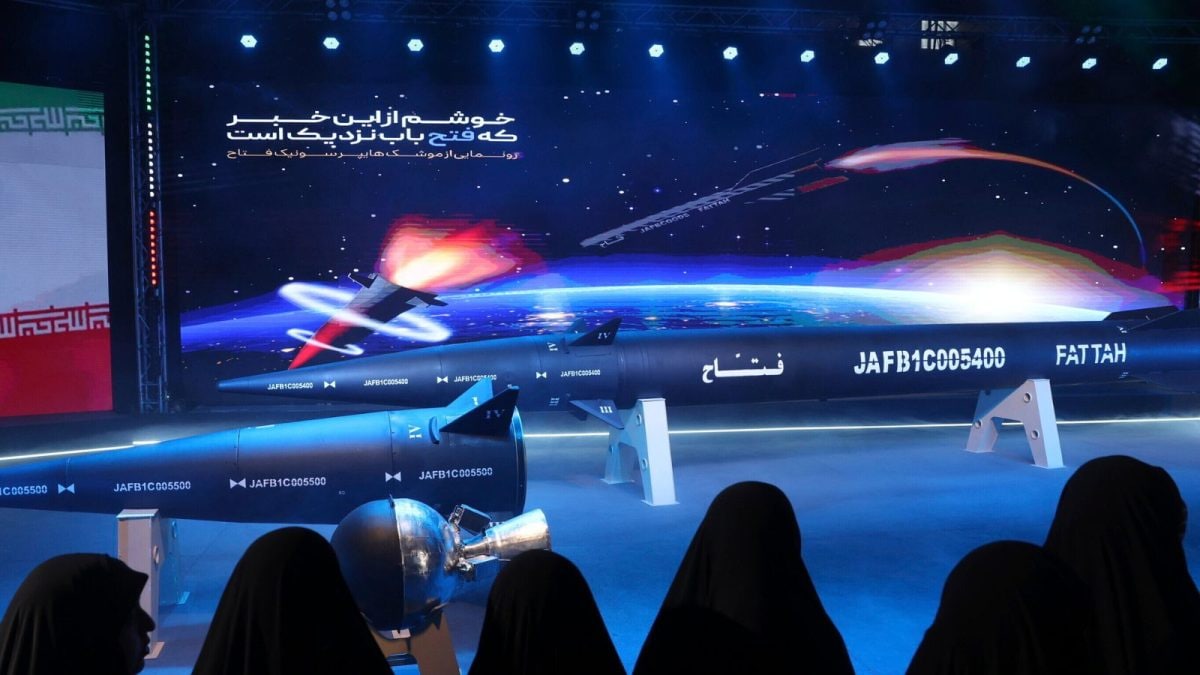
Women look at Fattah missile in a ceremony in Tehran, Iran, in 2023. (AP File)
Iran’s most advanced hypersonic missile Fattah-2 made its debut in the ongoing war against Israel, claimed reports.
The missile is a better version of the original Fattah-1, featuring a Hypersonic Glide Vehicle (HGV) warhead designed to evade modern air defence systems through high-speed manoeuvrability.
Reports indicate it was deployed against U.S. forces and Israeli interests during a major escalation of hostilities. A viral video from March 1, 2026, purportedly shows an Iranian missile, suspected to be a Fattah series, evading more than 10 interceptor rockets before successfully hitting its target. News18 has not independently verified the authenticity of the video or claims.
💥IRANIAN HYPERSONIC MISSILE EVADES MORE THAN 10 INTERCEPT ROCKETS TO HIT TARGETthe camera man just calmly records like it’s a firework display. 🫤 pic.twitter.com/PfQzcJR3ar
— Radar ???? Archie🚨 (@RadarHits) March 1, 2026
Fatah 2: Its features
Speed: Capable of reaching terminal velocities between Mach 13 and Mach 15 (approximately 15,000–18,500 km/h).
Range: Approximately 1,400 to 1,500 kilometres, placing targets across the Middle East, including Israel and U.S. regional bases, within its reach.
ALSO READ | Iran To Israel In 12 Minutes? The Trajectory And Power Of Ballistic Missiles Explained
Engine: Utilises a liquid-fuel rocket engine with adjustable thrust, allowing for trajectory changes mid-flight.
Payload: Carries an explosive warhead of roughly 200 kilograms.
How is Iran’s Fatah different from Pakistan’s?
Iran’s Fattah-2: A strategic hypersonic missile designed for long-range, high-speed strikes against hardened air defences.
Pakistan’s Fatah-II: A tactical Guided Multiple Launch Rocket System (GMLRS) with a much shorter range of approximately 400 km, primarily intended for precision strikes against land-based targets like S-400 batteries.
How India shot down Pakistan’s Fatah-II
India’s air defense systems successfully intercepted and shot down a Pakistani Fatah-II ballistic missile. The missile was intercepted over the skies of Sirsa, Haryana, approximately 220 km west of New Delhi, during Operation Sindoor in May 2025.
Iran’s weapon inventory
Aside from the Fattah-2 hypersonic missile, Iran possesses one of the largest and most diverse weapon inventories in the Middle East, primarily focused on asymmetric warfare to compensate for its aging conventional air force.
1. BALLISTIC AND CRUISE MISSILES: Iran’s missile program is the “backbone of its deterrence," capable of reaching targets up to 2,000–2,500 km away.
Medium-Range (MRBM): Khorramshahr-4 (Kheibar), Sejjil (solid-fuel for rapid launch), Shahab-3, and the high-precision Kheibar Shekan.
Short-Range (SRBM): Zolfaghar, Fateh-110, and the Qiam-1, used for rapid regional strikes.
Cruise Missiles: Low-flying systems like the Soumar (2,500 km range), Paveh, and Hoveyzeh designed to hug terrain and evade radar.
2. UNMANNED AERIAL VEHICLES OR DRONES: Iran uses a “saturation strategy," launching waves of cheap drones to overwhelm air defenses.
Kamikaze/Suicide Drones: The Shahed-136 and Shahed-131 series, famously exported and used in regional conflicts.
Combat/Reconnaissance: Shahed-129 (similar to the Predator), Mohajer-6, and the wide-body Kaman-22, which has a 24-hour flight endurance.
3. AIR DEFENCE SYSTEMS: Iran utilises a multi-layered, tiered defense architecture.
Long-Range: Bavar-373 (indigenous competitor to the S-400) using Sayyad-4B missiles to hit targets at 300 km. It is supported by Russian S-300 and Chinese HQ-9B systems.
Medium-Range: Khordad-15 and Sevom Khordad (famed for downing a US Global Hawk drone in 2019).
Short-Range: Tor-M2, Pantsir-S1, and the 9 of Dey system for intercepting cruise missiles and drones.
4. NAVAL AND UNDERWATER WEAPONS: Iran’s naval strategy focuses on “swarming" tactics and closing the Strait of Hormuz.
Submarines: Kilo-class (heavy attack), indigenous Fateh-class, and over 20 Ghadir-class midget submarines designed for shallow-water ambushes.
Anti-Ship Missiles: Abu Mahdi (long-range), Noor, and Khalij Fars (ballistic anti-ship).
New Tech: The Sayyad-3G naval air defense system, recently unveiled in February 2026 for shipborne protection.
5. CONVENTIONAL AND IMPORTED GEAR
Aircraft: Largely aging F-14 Tomcats, F-4 Phantoms, and Su-24s. Newer additions include Russian Yak-130 trainers and recently delivered Mi-28 attack helicopters.
Ground Force: Karrar and Zulfiqar main battle tanks, alongside Russian-supplied Spartak MRAPs.
First Published:
March 02, 2026, 13:02 IST
News explainers Explainer: Iran’s Fattah-2 Not The Same As Pakistan’s That India Shot Down During Op Sindoor
Disclaimer: Comments reflect users’ views, not News18’s. Please keep discussions respectful and constructive. Abusive, defamatory, or illegal comments will be removed. News18 may disable any comment at its discretion. By posting, you agree to our Terms of Use and Privacy Policy.
Read More