 1 month ago
Moshe Katri, Managing Director–Investment Banking at Wedbush Securities, believes that as GenAI adoption accelerates, large IT services companies that already dominate integration-heavy work are likely to be the biggest beneficiaries.
By Alpha Desk December 29, 2025, 1:47:41 PM IST (Published)

In the generative artificial intelligence (GenAI) era, the real competitive edge will come not from simply adding AI capabilities, but from changing the IT services business model itself. That shift will involve decoupling revenue growth from headcount and moving toward performance-based contracts, according to Moshe Katri, Managing Director of Investment Banking at Wedbush Securities.
This is why, even as Katri calls Coforge’s $2.35 billion acquisition of Encora a “decent deal,” he remains more convinced by the artificial intelligence strategies of large, tier-1 Indian IT firms, which he believes are structurally better positioned to benefit as GenAI scales.
Coforge has described the acquisition of US-based Encora as a defining moment, with the combined entity expected to generate $2.5 billion in revenue and see a meaningful contribution from AI. Management highlighted Encora’s Silicon Valley origins and its “AI native DNA,” stating that the firm operates at the intersection of AI, cloud and data. Financially, Encora is estimated to generate about $600 million in revenue with a 19% adjusted EBITDA margin in 2025-26 (FY26), and Coforge has said the deal will not be earnings-per-share dilutive due to strong margins and expected synergies.
Katri acknowledged that such positioning comes at a cost, pointing out that premium valuations are typical in high-growth areas. “You will see premium multiples for companies that are operating in high growth areas… you're paying here for growth, north of 20%. You're paying here for high teens EBITDA margins,” he said, referring to the more than 20 times Enterprise Value to Earnings Before Interest, Taxes, Depreciation, and Amortisation (EV/EBITDA) multiple implied in the transaction.

However, he questioned whether Encora should be viewed as a pure-play GenAI company. “The true GenAI model is going to be reflected in companies such as Fractal, Trident… I think Encora has AI expertise or GenAI expertise, but that's probably among other things that they do. It's not exactly a pure GenAI business, the way I see it,” Katri said. He added that, judged against the price paid, Coforge still secured a “pretty decent deal,” as a genuine pure-play GenAI firm would likely command a far higher valuation.
Also Read: Coforge’s growth story intact as big deal wins drive order book higher
Katri also contrasted two distinct AI strategies emerging in the Indian IT services sector. Large-cap firms such as TCS and Infosys are embedding AI across their existing service lines, while mid-cap players like Coforge are opting to acquire tier-two or tier-three “AI-derivative” companies to build scale more quickly.

He expressed a clear preference for the tier-1 approach, arguing that deep expertise in systems integration and data management forms the critical infrastructure for GenAI adoption. Drawing a parallel with cloud computing, he stated that early fears of disruption ultimately gave way to a large integration cycle. “Cloud ultimately created a very large integration cycle for the space. And the way we see it, GenAI is going to do the same thing for the space,” he said.
Also Read: Titan’s lab-grown diamond entry cuts uncertainty; Coforge AI deal a long-term bet: PL Capital
As GenAI adoption accelerates, Katri believes the biggest beneficiaries will be the large IT services companies that already dominate integration-heavy work. “The tier ones are in great shape to benefit from that cycle once it starts really scaling,” he said, naming Infosys, TCS and Cognizant, along with digital-focused firms such as Globant and EPAM.
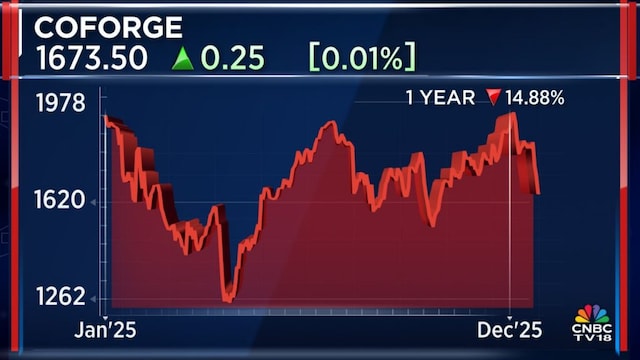
For the entire interview, watch the accompanying video