1 hour ago
Burnham says Hillsborough law being debated today can change UK by shifting power and dismantling unaccountability culture
Andy Burnham describes the Hillsborough tragedy, the police cover-up and smear campaign against fans that happened afterwards, and the long campaign by survivors, relatives and Liverpudlians for justice that has been running ever since as the story that has done most to shape his political outlook. As a young culture secretary, he gave a speech at the Hillsborough 20th anniversary memorial in 2009 which was instrumental in persuading him that the government had to redouble its efforts to ensure the full truth came out.
Today he is expected to give his first speech in the Commons since his election as MP for Makerfield in the debate on the Hillsborough law bill.
In an article for the Liverpool Echo, he says the Hillsborough law is about more than just a single football disaster; it is about changing the way power is distributed in Britain, and dismantling its unaccountability culture.
He explains:
The truth on its own is not enough. Without accountability, there can be no justice. That is why I introduced the first Hillsborough Law almost ten years ago, supported by Keir Starmer, as one of my final acts in parliament. Its return this week is another major step towards ensuring no family has to endure what the Hillsborough families have endured.
Yet this is about more than Hillsborough alone.
The infected blood scandal. The nuclear test veterans. Grenfell. The Post Office scandal. Different tragedies, but too often the same pattern: institutions protecting themselves instead of the people they exist to serve.
Bishop James Jones described it perfectly as “the patronising disposition of unaccountable power”.
Those words have stayed with me ever since. The Hillsborough Law is our chance to begin dismantling that culture once and for all.
The lesson of Hillsborough goes beyond introducing a duty of candour. It asks us what kind of country we want to be. One where power is concentrated in distant institutions, or one where it is shared more fairly with the people and places those institutions are meant to serve. If an entire city could be ignored for two decades while telling the truth about the deaths of its own people, what other communities have gone unheard? Which voices have been overlooked simply because they lacked power?
For me, this has always been about changing that. It is why I believe we must continue to redistribute power, strengthen our towns and cities, and build a Britain where every community is treated with equal respect and where, in the face of injustice, nobody walks alone.
In the article, Burnham also recalls the impact of his speech at the 20th anniversary memorial.
On 15 April 2009, I stood on the Kop before the memorial service. One word echoed around Anfield: “Justice.”
That moment changed me. It forced me to confront uncomfortable questions about how power operates in our country, and why an entire city could spend twenty years telling the truth only to be ignored.
How could Liverpool be right all along, yet dismissed for so long? How could so many voices be raised, and so few people in authority be prepared to listen?
Key events
Neil Shastri-Hurst (Con) told Campbell he was undermining his new argument. If the situation in the Middle East was really as serious as Campbell claimed, that was all the more reason why it would be wrong to go into the summer with a PM who had not faced parliament.
In response, Campbell said that, if the situation in the Middle East deteriorated during the summer, parliament could be recalled.
John Cooper (Con) said that, if Manchester is really as fantastic as Andy Burnham says it is, he should come to the Commons next week and explain why.
Campbell said that on Monday next week, when the Tories want Burnham to address parliament, Burnham will be appointing ministers and forming a government.
Commons leader Alan Campbell accuses Tories of preferring 'weird political game' to debating crisis in Middle East
Katie Lam (Con) said the Tories only wanted to delay the Commons recess by one day. She said Campbell should consider what voters would think of Andy Burnham avoiding parliamentary scrutiny having become PM.
In response, Campbell accused the Tories of playing games. He said:
People listening to this … will do so with a degree of incredulity that [the Conservative party] was preferring to go down a route of playing some weird political game while the Middle East is on the brink of conflagration.
In response to a question from Alec Shelbrooke (Con), Campbell said he was “totally unaware” not just of the wording of the Tory opposition day motion planned for tomorrow (see 1.04pm), but of the topic that it was going to cover. In a bid to convince MPs that this was not a lie, he said that he was standing at the despatch box and that MPs knew the importance of a minister “telling the absolute truth when they stand here”.
Tories accuse Burnham of 'running scared of scrutiny', claiming he blocked vote on delaying recess until he has become PM
In the Commons, Alan Campbell, the leader of the house, has just announced there will be a change in parliamentary business tomorrow. Wednesday was set aside for an opposition day debate – a debate on a motion tabled by the Tories. Instead, there will be a general debate on the situation in Iran. There will also be a vote on the regulations banning support for Iran’s Islamic Revolutionary Guard Corps.
In response, Jesse Norman, his Tory shadow, claimed that the government was only doing this because Labour whips knew that the Tories were going to table a motion saying the Commons should delay the recess so that Andy Burnham can address MPs after he becomes PM on Monday next week.
Norman went on:
The government has a majority of more than 150 and it could not trust its MPs to vote the right way on that motion [delaying the recess], and it could not bear the idea of a new prime minister facing any scrutiny before September.
A prime minister, let me remind us all, who has been chosen by a coronation not a contest, with no known platform, almost no known policies, and no idea of his priorities or indeed his cabinet team.
Norman said people would conclude Burnham was “running scared of public scrutiny before he can even take office”.
Campbell, in his reply to Norman, did not accept that this was the reason for the timetable change. He said it was important for MPs to have a chance to debate what was happening in Iran. He said, until Norman read them out, he had not heard the words of the motion that Norman said the Tories were planning to table tomorrow.
Green candidate for Greater Manchester mayor criticises Burnham for voting for immigration bill
Last night Andy Burnham voted for the government’s immigration and asylum bill. Sundus Abdi and Jessica Elgot have the story.
There were 14 Labour MPs who voted against.
The Green party has criticised Burnham for his vote. This is from Geraldine Coggins, the Green candidate in the byelection to replace Burnham as mayor of Greater Manchester.
It is shameful that Andy Burnham voted in favour of Shabana Mahmood’s cruel immigration and asylum bill which will undermine the rights of refugees.
As a key Burnham ally I am calling on Bev Craig [Labour’s candidate for Greater Manchester mayor] to disown this act of performative cruelty and to stand up for what is right, to celebrate immigration - which has hugely benefitted Greater Manchester both socially and economically - and treat some of the most vulnerable people in our communities with dignity and humanity. We are so much better than this in Manchester.
Burnham says Hillsborough law being debated today can change UK by shifting power and dismantling unaccountability culture
Andy Burnham describes the Hillsborough tragedy, the police cover-up and smear campaign against fans that happened afterwards, and the long campaign by survivors, relatives and Liverpudlians for justice that has been running ever since as the story that has done most to shape his political outlook. As a young culture secretary, he gave a speech at the Hillsborough 20th anniversary memorial in 2009 which was instrumental in persuading him that the government had to redouble its efforts to ensure the full truth came out.
Today he is expected to give his first speech in the Commons since his election as MP for Makerfield in the debate on the Hillsborough law bill.
In an article for the Liverpool Echo, he says the Hillsborough law is about more than just a single football disaster; it is about changing the way power is distributed in Britain, and dismantling its unaccountability culture.
He explains:
The truth on its own is not enough. Without accountability, there can be no justice. That is why I introduced the first Hillsborough Law almost ten years ago, supported by Keir Starmer, as one of my final acts in parliament. Its return this week is another major step towards ensuring no family has to endure what the Hillsborough families have endured.
Yet this is about more than Hillsborough alone.
The infected blood scandal. The nuclear test veterans. Grenfell. The Post Office scandal. Different tragedies, but too often the same pattern: institutions protecting themselves instead of the people they exist to serve.
Bishop James Jones described it perfectly as “the patronising disposition of unaccountable power”.
Those words have stayed with me ever since. The Hillsborough Law is our chance to begin dismantling that culture once and for all.
The lesson of Hillsborough goes beyond introducing a duty of candour. It asks us what kind of country we want to be. One where power is concentrated in distant institutions, or one where it is shared more fairly with the people and places those institutions are meant to serve. If an entire city could be ignored for two decades while telling the truth about the deaths of its own people, what other communities have gone unheard? Which voices have been overlooked simply because they lacked power?
For me, this has always been about changing that. It is why I believe we must continue to redistribute power, strengthen our towns and cities, and build a Britain where every community is treated with equal respect and where, in the face of injustice, nobody walks alone.
In the article, Burnham also recalls the impact of his speech at the 20th anniversary memorial.
On 15 April 2009, I stood on the Kop before the memorial service. One word echoed around Anfield: “Justice.”
That moment changed me. It forced me to confront uncomfortable questions about how power operates in our country, and why an entire city could spend twenty years telling the truth only to be ignored.
How could Liverpool be right all along, yet dismissed for so long? How could so many voices be raised, and so few people in authority be prepared to listen?
MPs set to pass Hillsborough law bill today after government drops opt-out for spies
Today MPs are expected to pass the so-called Hillsborough law bill – which is officially known as the public office (accountability) bill – after the government dropped its insistence on provisions that would in practice have given the security services an opt-out. Before it becomes law, the bill will still have to go through the Lords.
Libby Brooks has a good account of what led up to this in her First Edition briefing.
Hillsborough law campaigners, including those whose family members were killed in the 1989 disaster, have welcomed the concession.
In a statement, Charlotte Hennessy, Sue Roberts, Steve Kelly and Margaret Aspinall said:
We have shown that true power belongs to ordinary people.
We did not stay silent, we were not ground down, we were not afraid to speak truth to power.
This is not just about legislation, but about changing the way the bereaved and survivors are treated and a change in culture and it is deeply empowering knowing that this protect others, forever.
Reeves to say UK has 'beaten the odds' during last 2 years, in probable last big speech as chancellor
Rachel Reeves will say Britain’s economy has “beaten the odds” during her time as chancellor, in a speech defending her record before her expected sacking or demotion next week when Andy Burnham becomes PM.
She is giving her Mansion House speech tonight, and according to extracts released in advance she will say:
Because of the choices I have made, I’m proud to report that the British economy is strong.
At the start of this year Britain had the fastest economic growth in the G7. Last year, borrowing fell from 5.2% to 4.3%, its lowest level in six years.
Investment is up, productivity is up, and wages are up too.
Waiting lists are falling faster than at any time in the last 17 years and half a million children will be lifted out of poverty by the end of this parliament.
She will also urge her successor to continue with her approach.
This government has made huge strides in delivering on the promise of change,” she is expected to say.
Fixing the foundations, restoring economic stability, and proving our capacity to deliver radical change.
That change is only possible if we maintain the credibility that we have earned, and the stability that we have built, with growth and opportunity in every town, city and region of the UK.
Ed Davey urges Burnham to 'be bold, be brave' and introduce PR now
Andy Burnham wants to introduce proportional representation (PR). But he accepts that Labour does not have a mandate to introduce PR now, because it was not in the party’s election manifesto, and he says as leader he would develop a PR plan for the party to include in its next manifesto.
In a speech today, Ed Davey, the Lib Dem leader, will urge Burnham to be bolder, and do it now. According to extracts released in advance, he will say:
So my challenge to Andy Burnham – as he makes the critical decision about what kind of prime minister he wants to be – is this:
Be bold. Be brave.
Fix the broken electoral system by introducing proportional representation. To give everyone an equal vote and an equal voice in our democracy, and make sure no politician or political party can afford to take them for granted.
And do it now. Don’t wait until it is too late. Don’t wait until after the next election – when you might be powerless to do anything about it.
Starmer attends Bastille Day parade in Paris, after coalition of willing allies pay lavish tribute to him
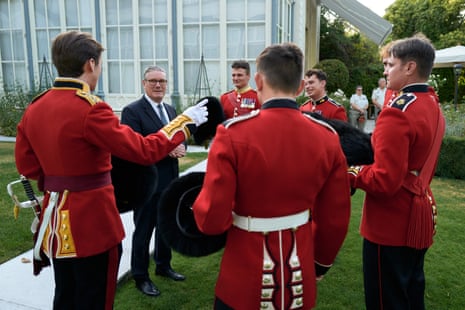
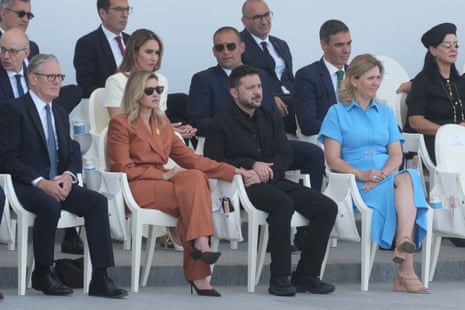
Keir Starmer attended Bastille Day celebrations in Paris today as one of his final engagements on the international stage. The Press Association reports:
The prime minister met British troops involved in the ceremonial events in the French capital before watching the parade alongside Emmanuel Macron and other leaders including Ukraine’s Volodymyr Zelenskyy.
Starmer will be succeeded as prime minister by Andy Burnham on Monday after the former Greater Manchester mayor secured enough support to make it mathematically impossible for anyone to stand against him for the Labour leadership.
The prime minister and other European leaders watched a military parade and flypast in Paris.
Troops from the Grenadier Guards marched alongside the French Garde Republicaine.
The celebrations follow Starmer’s final “coalition of the willing” summit on Monday, at which fellow leaders Macron, Zelensky and Germany’s Friedrich Merz paid tribute to his impact on the world stage.
Macron, the French president, told Starmer that “we owe you a lot, Prime Minister”, while Merz, the German chancellor, said he would “phone you occasionally to get your opinion on this or that”.
Zelenskyy, the Ukrainian president, thanked Sir Keir for his “constant, steadfast support”, which the prime minister said would continue under his successor.
Andrew McDonald and Megan McElroy have a more colourful account of Starmer’s reception at the summit yesterday in their London Playbook briefing for Politico.
The PM wakes up in a very hot French capital this morning to celebrate Bastille Day alongside Emmanuel Macron … and their farewell could get emotional. Playbook hears Macron introduced a football match-style minute’s applause at the top of the Coalition of the Willing meeting on Monday after thanking Starmer for what he’s done for Ukraine. Macron said the PM has played a “historic role” in setting up the CoW, before Ukraine’s Volodymyr Zelenskyy described him as a “friend” and a “great PM and great man.”
Here is Kevin Schofield from Huffpost UK on Robert Jenrick boasting about his anti-establishment credentials on the Today programme. (See 9.41am.)
Reform MP Robert Jenrick, a former Exchequer Secretary to the Treasury, Housing Secretary, health minister and immigration minister, tells @BBCr4today: “We are not mainstream politicians, we are politicians who are fighting the establishment every single day.”
Robert Jenrick accuses Labour of 'playing politics' with safety of Reform UK politicians like Nigel Farage
Good morning. It didn’t last long. Yesterday afternoon in the House of Commons, as John Crace reports, there was a rare outburst of reasonableness as MPs debated the death of Ann Widdecombe. Earlier in the day Richard Tice, the Reform UK deputy leader, had been on social media claiming that the establishment wanted Nigel Farage dead and, after the police revealed counter-terrorism officers were now in charge of the murder investigation, demanding apologies all round from anyone who accused Reform UK of politicising the tragedy. But in the Commons Tice dropped these arguments, and instead focused mostly on a warm and funny tribute to Widdecombe. And Shabana Mahmood, the home secretary, avoided the temptation to criticise Reform UK, and instead made a point of saying how much she understood Farage’s concerns.
It was an almost cordial end to a day that had started with social media reaction at its most unpleasant. There is more coverage on Today in Focus here, or in our overnight splash story here.
This morning it was back to normal. Robert Jenrick, the Reform UK Treasury spokesperson, was on the Today programme and he revived all the Farage security grievances from the weekend. Here are the key quotes.
Jenrick accused Labour of “playing politics” with the safety of Reform UK politicians like Farage. He said:
The government chose not to give Nigel the security that he needed. They now have, as a result of Ann Widdecombe’s appalling murder, offered him a meeting.
The home secretary could have offered that meeting a year ago, two years ago. She chose not to.
That, I’m afraid, is playing politics with the safety of politicians.
And I suspect that’s because they don’t like the views the Reform politicians take forward.
Because we are not mainstream politicians. We are politicians who are fighting the establishment every single day. We are not backing down.
Jenrick accepted that Farage had turned down a significant offer of government-funded security last year. He was asked about a report in the i saying Farage “turned down taxpayer-funded security including a bodyguard, car and trained driver last year”. In their story, Arj Singh, Caroline Wheeler and Kitty Donaldson say:
The Reform UK leader was offered the protection following police advice on the threats he faced.
He had already been receiving publicly funded security prior to this, and felt that his package had been downgraded.
It would have given Farage a similar level of security to Conservative leader Kemi Badenoch and some high-profile Cabinet ministers.
Farage declined the offer because he considered the protection to be inadequate.
Asked about the story, Jenrick did not contest the details and accepted that Farage had turned down the security he had been offered because he did not view it as adequate.
Jenrick dismissed claims that politics was not involved in the decision about what security Farage should be offered. Decisions about what security gets offered to politicians like Farage are taken by the Royal and VIP Executive Committee (Ravec), the body in charge of VIP protection. In the Commons yesterday, Mahmood said this body, which is run by officials, was, and should be, “fiercely independent”. But, when this argument was put to Jenrick, he did not accept it. He said:
That’s a choice. The home secretary is not powerless … I think it’s within her power to overrule it if she wished to.
Jenrick brushed off claims that Farage is deliberately talking up the security threats he faces because he wants to distract public attention from the controversy about his failure to register donations from the cryptocurrency billionaire Christopher Harborne and from the convicted fraudster George Cottrell. When this was put to Jenrick, he repeated his point about the security threats to Farage being genuine, and his claim that they weren’t being taken seriously by the government.
But Jenrick did not go as far as endorsing a claim made by his Reform UK colleague Zia Yusuf, who yesterday said: “None of the government, the Speaker nor the police care at all about the security of Reform MPs.”. Jenrick just argued instead that the security concerns of Reform UK MPs were not being taken seriously because of their political views.
Jenrick also argued Reform UK politicians were more at risk than people from other parties. He said:
Reform MPs are not asking for special treatment.
What Reform MPs want is to be able to go home to their family at the end of the day in safety, and to know that their homes and their loved ones are protected.
There is a legitimate concern that Reform MPs are more endangered than many others, because we raise issues that many mainstream politicians shy away from.
If you talk about Islamist extremism, as I do, and Nigel Farage has done for many years, you are likely to be in considerably more danger than those who don’t.
Nick Robinson, the presenter, pointed out that this was not a view that the family of Jo Cox, the Labour MP murdered 10 years ago by a rightwing extremist, would endorse, or Diane Abbott, the suspended Labour MP who receives a record amount of online abuse.
Jenrick said Farage had been “vindicated” by the decision of the police to treat the murder of Widdecombe as politically motivated. He said:
I do think it was wrong that parts of the media claimed that Nigel was politicising the death of Ann Widdecombe, an appalling claim when he was about mourning the death of a loved colleague.
And he has been vindicated now because the police have admitted that the murderer may well have had a terrorist or political motivation.
Here is the agenda for the day.
9.45am: Andrew Bailey, the governor of the Bank of England, gives evidence to the Commons Treasury committee.
Morning: Keir Starmer attends the Bastille Day parade in Paris.
11.30am: James Murray, the health secretary, takes questions in the Commons.
Noon: Downing Street holds a lobby briefing.
After 12.30pm: MPs start their debate on the remaining stages of the public office (accountability) bill, aka the Hillsborough law bill. Keir Starmer is expected to lead for the government at third reading, which may not start until 6pm. First MPs will debate amendments at the report stage.
1.30pm: Ed Davey, the Lib Dem leader, gives a speech at the Institute for Government.
2pm: Yvette Cooper, the foreign secretary, gives evidence to the Commons foreign affairs committee.
If you want to contact me, please post a message below the line when comments are open (between 10am and 3pm), or message me on social media. I can’t read all the messages BTL, but if you put “Andrew” in a message aimed at me, I am more likely to see it because I search for posts containing that word.
If you want to flag something up urgently, it is best to use social media. You can reach me on Bluesky at @andrewsparrowgdn.bsky.social. The Guardian has given up posting from its official accounts on X, but individual Guardian journalists are there, I still have my account, and if you message me there at @AndrewSparrow, I will see it and respond if necessary.
I find it very helpful when readers point out mistakes, even minor typos. No error is too small to correct. And I find your questions very interesting too. I can’t promise to reply to them all, but I will try to reply to as many as I can, either BTL or sometimes in the blog.