1 month ago
Tankers are repositioning and limited crossings have resumed, but hundreds of vessels remain stalled as operators await formal clearance and security guarantees.


New Delhi,UPDATED: Jun 17, 2026 18:41 IST
The first signs of a relaxation in the maritime blockade around Iran are beginning to emerge from the Strait of Hormuz, even as commercial traffic through the critical waterway remains sparse.
For India, the reopening of the Strait of Hormuz would ease mounting concerns over crude supplies, freight charges and inflation. But days after President Donald Trump announced a framework agreement intended to restore passage through the waterway, commercial traffic remains a trickle rather than a return to normal.

Still, the signs of a broader de-escalation are beginning to appear.
Maritime data tracked and analysed by India Today points to three developments that suggest a gradual easing of tensions: Iranian oil tankers have crossed the American naval blockade in the Gulf of Oman; dozens of large tankers are positioning near ports on the eastern side of the Strait of Hormuz; and several India-linked vessels have moved closer to the passage before settling into holding patterns.
Together, these movements suggest that shipowners are preparing for a reopening, even as they wait for the agreement to be formally signed and for clearer assurances that the route is safe.
An analysis of Automatic Identification System (AIS) tracks and other maritime indicators by India Today’s OSINT team shows that several India-linked vessels — including some that initially showed signs of movement after the announcement — have since entered a holding pattern off Sharjah. Their movements suggest they may be awaiting formal transit clearance before attempting to cross the strait.
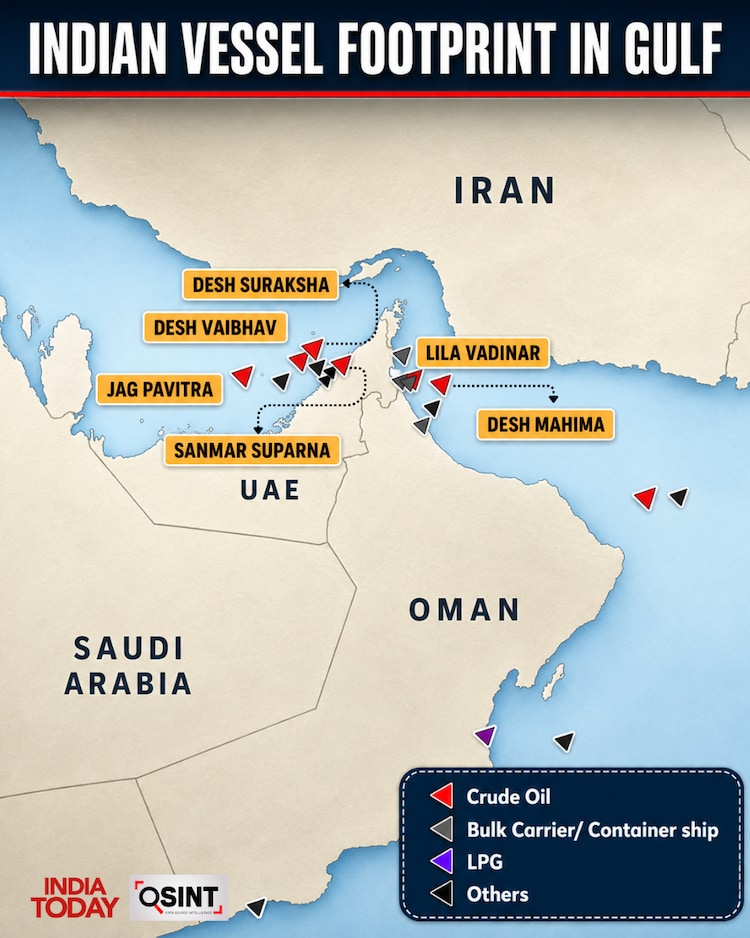
India Today’s OSINT team tracked 23 Indian-flagged vessels across the wider Gulf region. Nine were positioned inside the Persian Gulf, west of the Strait of Hormuz, while eight were clustered around the Fujairah–Khor Fakkan approaches on the eastern side.
Among those remaining inside the Gulf were the tankers Desh Vaibhav, Desh Suraksha, Sanmar Suparna and Jag Pavitra. Their presence shows that a significant part of the Indian-flagged fleet remains behind the chokepoint, despite tentative signs that limited movement has resumed.
The data identified seven India-linked oil tankers across the region. An earlier working estimate suggested that together these vessels have a capacity of roughly 15 million barrels of oil.
The wider backlog is far larger.
Ship-tracking data from MarineTraffic showed more than 580 commercial vessels inside the Persian Gulf on Tuesday, including over 250 tankers and 330 cargo ships. About three-quarters of the tankers, nearly 190 vessels, appeared stationary.
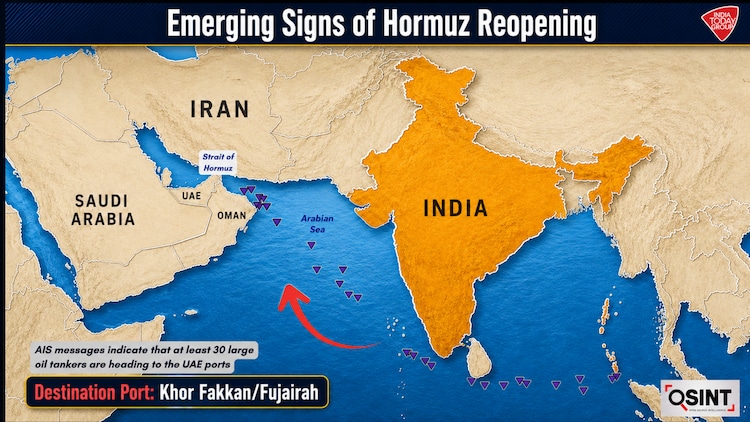
On the other side of the strait, a second buildup is taking shape.
Windward, the maritime intelligence company, said at least 23 very large crude carriers were sailing toward the UAE ports of Khor Fakkan or Fujairah based on their declared AIS destinations. At least 30 more were already anchored there. India Today independently tracked at least 30 oil tankers sailing toward ports in the UAE.
The inbound tankers have been tracked from as far away as the South China Sea and across the Indian Ocean. Their movement suggests that commercial operators are preparing to load Gulf oil as soon as the strait reopens, even before the hundreds of vessels stranded inside begin to leave.
According to Lloyd’s List Intelligence, some shipowners are moving quickly to reposition vessels as market sentiment improves. Insurers, however, continue to maintain elevated war-risk premiums, saying they need clear evidence of sustained security before lowering rates.
The resulting picture is one of preparation rather than normalization: vessels are assembling at both ends of the chokepoint, but most are still waiting.
Several factors may explain the continued lull. Reports suggest that a broader reopening may depend on the formal signing of the interim peace agreement between Washington and Tehran. Operators must also account for the possible presence of naval mines near established shipping lanes, raising questions over whether the passage is safe for routine commercial transit.
For now, no attack on a commercial vessel has been publicly reported since the framework agreement was announced. That relative calm is one of the clearest indications that the immediate maritime threat may be receding.
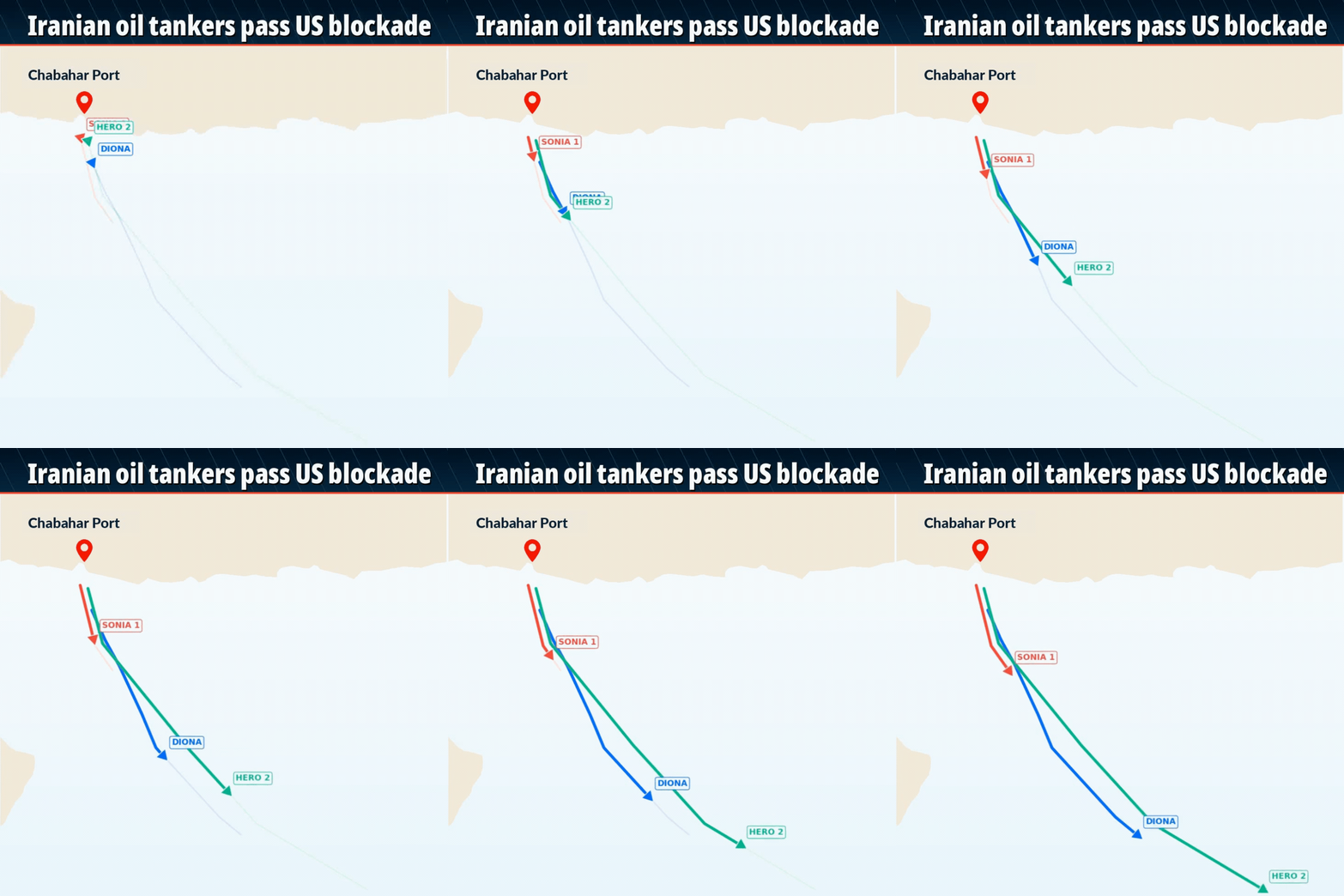
It has coincided with the first confirmed movement of loaded Iranian crude tankers across the American blockade perimeter in roughly two months. TankerTrackers, which monitors oil shipments through AIS data and satellite imagery, said the Iranian Tanker Company vessels Diona and Hero 2 crossed the blockade perimeter carrying a combined 3.8 million barrels of crude.
A third Iranian tanker, Sonia I, carrying about one million barrels, also crossed the blockade line and was tracked heading toward Singapore. An empty Iranian-linked VLCC, Stream, was meanwhile moving toward the Gulf of Oman and the blockade zone.
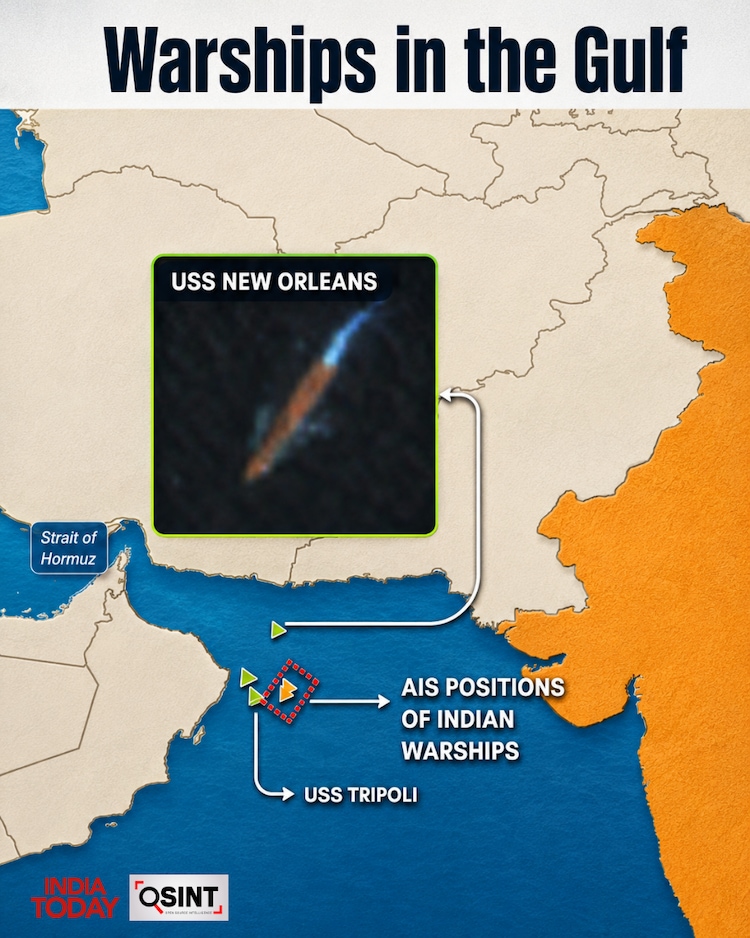
The lifting of the American blockade, alongside the restoration of unrestricted passage through the Strait of Hormuz, is a central part of the framework announced on June 15 and expected to be formalized on June 19.
- Ends
Published By:
bidisha saha
Published On:
Jun 17, 2026 18:41 IST