1 month ago
Balen Shah was sworn in as Nepal Prime Minister on Friday. The story isn't just who he is. It's how he got there.
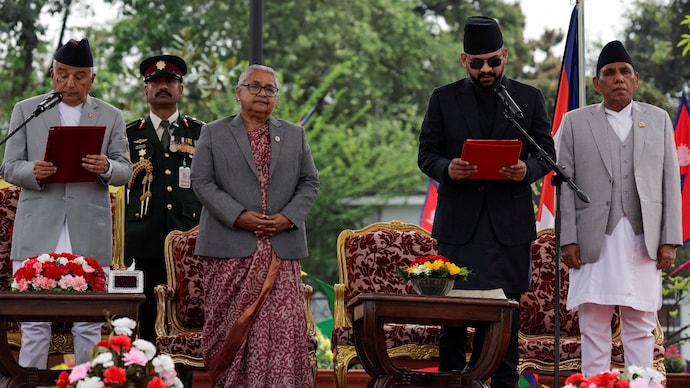
Newly appointed Prime Minister Balendra Shah of Nepal takes oath in the presence of Outgoing interim Prime Minister Sushila Karki and Chairperson of Assembly Narayan Prasad Dahal in Kathmandu on March 27, 2026. (Photo: Reuters)
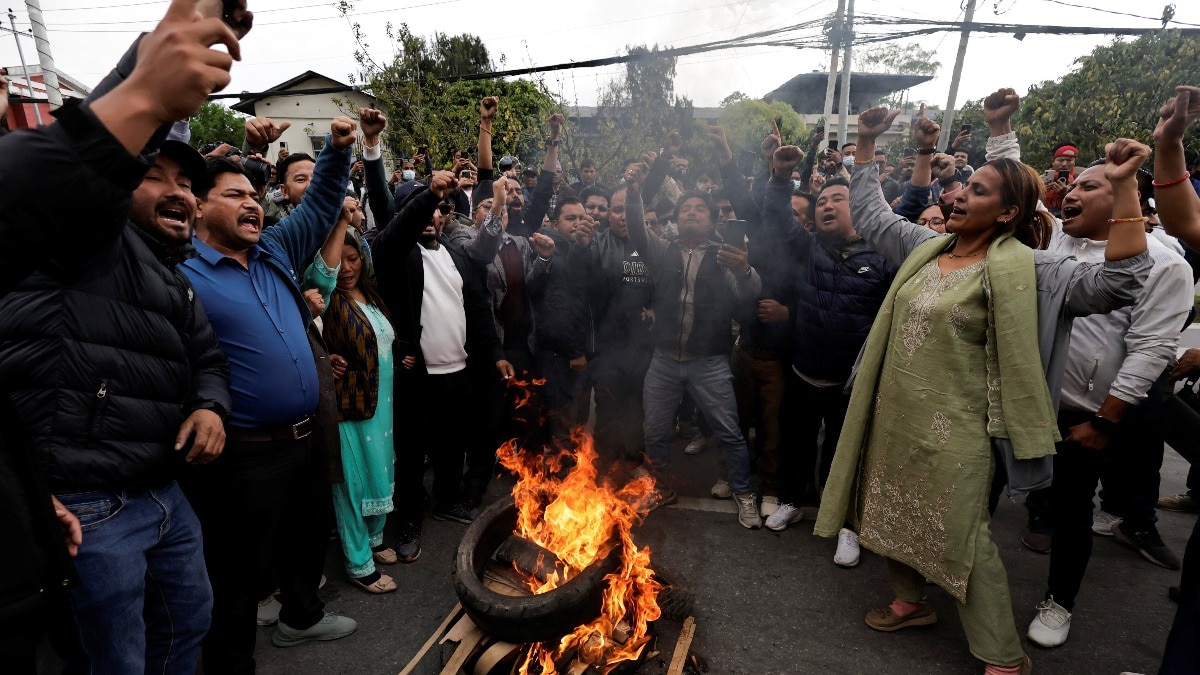
There's a scene that keeps repeating itself in the theatre of modern history. A city burns. Young people fill the streets. A government falls. And then — almost always — comes the betrayal. The generals step in, as they did in Egypt, Myanmar, Sudan. The old guard regroups, as it did in Algeria and Belarus. Or the movement breaks everything and discovers it cannot build anything in the rubble — as we saw in Libya and Yemen.
Nepal just refused that script.
Today, in the marble halls of Sheetal Niwas — the Presidential Palace in Kathmandu — Balendra Shah, a 35-year-old rapper and politician known simply as Balen, was sworn in as Nepal's Prime Minister. He is the youngest elected head of government in Nepal's history, and the first leader from the Madhes region to hold the country's highest executive post.
But strip away the biographical fireworks, and what you're actually watching is something rarer and more important: a country that bled in the streets for change, and then — constitutionally, peacefully, by the book — got it.
Think of where this has gone wrong before.
When Corazon Aquino rode the Philippine People Power Revolution to the presidency in 1986, she inherited a country that had endured 21 years of Marcos's kleptocracy. She was a housewife with no government experience, swept in on a tide of grief and rage after her husband's assassination. The world was moved. The generals were not. Aquino survived seven coup attempts in six years. Democracy held, but barely — and only because she had the United States quietly leaning over her shoulder.
When Vclav Havel — playwright, dissident, moral conscience of a nation — became Czechoslovakia's president after the Velvet Revolution of 1989, he called his election "a fairy tale." He was right, but fairy tales have endings. Within three years, the country he'd helped liberate had peacefully split in two.
Lech Walesa, the electrician who became the soul of Poland's Solidarity movement, won the Nobel Prize and then the presidency. But then he spent much of his term feuding with his own Parliament, his charisma curdling into authoritarianism.
Even Zelenskyy — the comedian who swept into the Ukrainian presidency in 2019 on a platform of anti-corruption and national renewal — found that governing is a different art than performing. He found himself dragged into a war that he has failed to win or lose.
The lesson history keeps teaching: protest is not a governance manual. What Nepal has done, then, is extraordinary precisely because of how ordinary it looks.
The interim government — led by Sushila Karki, the former Chief Justice who had never sought political office — held the country together, organised elections, and, in her final address to the nation, expressed confidence that the new youth-led administration would deliver on the core demands of the generation that brought her there.
The Rastriya Swatantra Party secured 182 out of 275 seats in the House of Representatives. The RSP is four years old. Political analyst after political analyst has called it a harsh rebuke of Nepal's political elite.
That's technically accurate. But it undersells the thing. What Nepal's voters did on March 5 was something much more deliberate: they chose a future over a grudge.
THE MAN BEHIND THE SUNGLASSES
So who is Balen Shah, the face of that future, really — beyond the black rectangular glasses and the rap verses?
Before entering politics, Shah was widely known in Nepal as a rapper whose music addressed corruption, inequality, and government dysfunction. His debut song, "Sadak Balak" — "Street Child" — was released in 2012, and he gained visibility in 2013 after winning Raw Barz, a YouTube rap-battle series that helped popularise underground hip-hop in Nepal. He drew from Tupac Shakur and 50 Cent. He also has a master's degree in structural engineering from a college in Karnataka.
Then — in 2022 — he ran for mayor of Kathmandu as an independent, without party machinery, without inherited cadres, without a family name in the ledger of Nepali politics.
As mayor, Shah introduced reforms to improve efficiency and transparency — digital building permits, live broadcasting of council meetings.
His administration invested in infrastructure, waste management, and accessibility while supporting cultural heritage preservation efforts. He was also combative, controversial, and occasionally legally contested. Some rights groups alleged human rights violations in his administration's bid to reclaim Kathmandu's roads.
That complexity is important. The hagiography his supporters are tempted to write would leave it out. The cynicism his critics reach for would make it the whole story. Neither is honest.
DOUBLING INCOME & OTHER PROMISES
Now comes the hardest part: governing.
The RSP's economic manifesto is either visionary or delusional, depending on which Kathmandu coffee house you're sitting in. The targets are ambitious enough to raise eyebrows: seven percent average annual growth over five to seven years, per capita income above USD 3,000 — up from about USD 1,447 today — and an economy that roughly doubles in size to USD 100 billion.
A central pillar of the plan is building India's IT sector into Nepal's second major economic engine. The RSP wants to increase software and IT service exports from the current USD 1.5 billion to USD 30 billion within a decade, backed by an autonomous IT Promotion Board, a global technology hub, and digital parks across provinces targeting 500,000 direct jobs.
The party has also vowed to create 1.2 million jobs specifically to reduce forced labour migration — the quiet haemorrhage of young Nepalis to Gulf construction sites and Malaysian factories that has become, grotesquely, the country's most reliable economic engine. Remittances exceed 25 percent of Nepal's GDP.
In energy, the RSP has pledged to raise Nepal's installed hydropower capacity to 30,000 megawatts over the next decade, with long-term energy trade agreements with India and Bangladesh.
And then, most intriguingly, comes cryptocurrency. The RSP proposes studying global regulations, crafting a national policy, and launching pilot projects for mining within a year.
Nepal has abundant hydropower and cool climates — two inputs for the vast computing farms that generate bitcoin. The party imagines exporting "green computing power" to Asia, turning electrons into digital assets before they leave the grid.
The fiscal math receives less attention than it deserves. The RSP promises tax cuts while maintaining revenue. Nepal's tax-to-GDP ratio, at about 17 percent, is already low by regional standards.
So: ambitious, internally contradictory in places, and brimming with the confidence of people who have never had to negotiate a parliamentary budget with a hostile opposition. Because, for now, they don't have one.
WALKING THE INDIA-CHINA TIGHTROPE
The world Balen Shah inherits is not kind to new beginnings.
Nepal sits between India and China — two civilisational powers whose rivalry has only intensified, and neither of whom will allow their Himalayan neighbour to drift fully into the other's orbit.
The RSP manifesto speaks of transforming Nepal from a "buffer state" into a "vibrant bridge" — a formulation that sounds elegant in a manifesto and will require extraordinary diplomatic dexterity to survive contact with Delhi and Beijing.
The ghost of the Maoist insurgency has never fully been laid to rest. Two bodies — a truth and reconciliation commission and another on abducted persons — have only collected complaints for years without delivering accountability.
That history demands justice, not just memory. Whether a 35-year-old who grew up after the insurgency can find the courage and the coalition to confront it remains to be seen.
And the 76 people who died in the streets last year — their families are watching. The commission's report naming Oli is only the beginning of what will be a long, politically explosive accountability process.
THE GUARANTEE OF HOPE
History is rarely made on the day that looks like history.
It's made in the months after: in the budget sessions and the bureaucratic standoffs, in the moment when the civil service refuses to reform itself, in the night a young minister realises that campaigning and governing are different planets.
But today matters. Today, a country that has known almost nothing but political recycling chose something genuinely new. Today, the transfer happened — clean, constitutional, watched by the world — because an interim Chief Justice did her job, because the army stayed in its barracks, because three million young voters turned grief into a ballot.
Nepal has had more than a dozen governments since 2008. The nation has known Maoists and monarchists, communists and congressmen — a carousel of failure dressed in the language of transformation.
This time, the person taking the oath wrote verses about broken roads before he tried to fix them.
That's not a guarantee. But in a world where protest movements routinely get swallowed by the machinery they challenge, it is — at the very minimum — a different kind of beginning.
- Ends
Published On:
Mar 27, 2026 16:29 IST
Tune In