 1 hour ago
The revised proposal no longer promises large-scale reconstruction across Gaza. Instead, it focuses on creating a temporary settlement for only a small portion of the enclave's more than two million displaced residents.
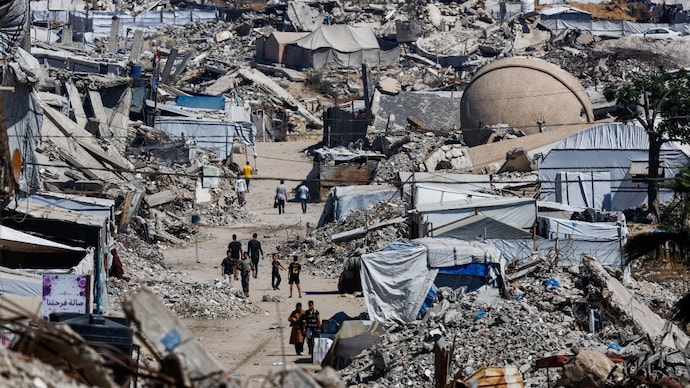
Palestinians walk past the rubble of residential buildings destroyed during the war. (Photo: Reuters)
US President Donald Trump's ambitious plan to rebuild Gaza appears to have been scaled back dramatically. What was once presented as a sweeping roadmap to rebuild the entire war-ravaged territory has now been reduced to a much smaller pilot project near Rafah in southern Gaza, according to a report by The Guardian.
The revised proposal no longer promises large-scale reconstruction across Gaza. Instead, it focuses on creating a temporary settlement for only a small portion of the enclave's more than two million displaced residents.
Even that limited plan is moving slowly. Officials familiar with the project believe it may not be ready before the end of this year, highlighting just how difficult post-war planning has become amid continued fighting and political uncertainty.
When Trump's Board of Peace (BoP) unveiled its vision earlier this year, expectations were high.
The proposal spoke about reopening aid corridors, restoring hospitals, rebuilding water and electricity systems, repairing sewage networks and reviving everyday life across Gaza within 100 days.
Months later, that vision looks very different.
According to The Guardian, the focus has shifted almost entirely to a single pilot camp near Rafah. The camp would house only tens of thousands of displaced Palestinians in portable housing units rather than serve as the foundation for rebuilding the whole territory.
The project would also include a Palestinian civil administration, a specially vetted police force and an Stabilization Force (ISF) responsible for security.
WHY HAS THE PLAN SLOWED DOWN?
The biggest obstacle remains the war itself.
Although a ceasefire brokered by Trump came into effect last October, Israel has repeatedly carried out military operations inside Gaza. Reconstruction work has largely remained frozen while humanitarian aid continues to face restrictions.
Western diplomats quoted in the report believe meaningful reconstruction is unlikely unless there is a political change in Israel following elections scheduled for October 27.
Until then, officials expect only limited progress.
"The aim is just to keep something going, keep the ball in play, because if you stop there are others with a more extreme agenda just waiting to jump in and take over, and they are talking about wholesale population transfer and colonisation," one diplomat told The Guardian.
SECURITY FORCE STILL ONLY ON PAPER
Some early steps have been taken.
A small number of officers from Morocco and Kosovo have arrived in Israel. They are expected to become the first members of the planned Stabilization Force.
A logistics base near the Kerem Shalom crossing is also nearing completion.
However, according to The Guardian, construction of the actual pilot camp has not yet begun. Satellite imagery reportedly shows disturbed ground but no permanent structures.
Training for the proposed Palestinian police force has also not started.
Officials hope the ISF will eventually include around 5,000 personnel from countries including Morocco, Kosovo, Albania and Kazakhstan. That is only about a quarter of the force originally envisioned.
One official familiar with the planning acknowledged the slow pace.
"I think you're looking at late 2026. If we got this done, in place, by December, I'd be very happy."
CONTINUED FIGHTING CASTS A SHADOW
The future of the project also depends heavily on developments on the battlefield.
Israeli officials have repeatedly argued that military operations cannot end unless Hamas disarms.
Hamas has indicated it could consider giving up its weapons under certain conditions and recently participated in discussions in Cairo about possible disarmament mechanisms.
But Palestinian sources quoted by The Guardian said progress remains unlikely while Israeli military operations continue.
"As long as Israel doesn't commit to a gradual withdrawal from the Gaza Strip and to changing the reality there, there's no basis for talks," a Palestinian source told Haaretz, as cited by The Guardian.
Many diplomats fear that if fighting escalates again before Israel's elections, even the scaled-down pilot project could collapse.
CRITICISM CONTINUES TO GROW
The revised proposal has also attracted criticism from multiple sides.
Former Israeli Prime Minister Ehud Olmert has reportedly described the proposed Rafah camp as a "concentration camp" in the making.
Board of Peace officials reject that characterisation. They insist residents would be free to move in and out of the pilot area.
Others question whether focusing resources on one small area risks creating unequal access to aid.
The Palestinian Authority has also objected to discussions about using billions of dollars in Palestinian tax revenues currently withheld by Israel to finance parts of the project.
"These are not Israeli funds to withhold or bargain with," Palestinian Foreign Minister Varsen Aghabekian said.
"These funds must be released immediately and unconditionally."
She also warned against allowing temporary arrangements to replace a broader political solution.
"The humanitarian catastrophe cannot be managed through fragmented or partial measures. At the same time, every effort that genuinely saves Palestinian lives deserves careful consideration. Our concern, however, is that temporary arrangements must never become a substitute for a comprehensive solution or serve to normalise an unacceptable reality."
For now, the future of Gaza's recovery remains tied not just to funding and planning, but to whether the fighting eases enough to allow reconstruction to begin at all.
- Ends
Published By:
Satyam Singh
Published On:
Jul 17, 2026 01:25 IST