22 hours ago
Last Updated:January 04, 2026, 16:33 IST
With the Congress divided over succession, Siddaramaiah turns to Urs’ legacy to strengthen his political base and counter growing organisational pressure from rival leaders.

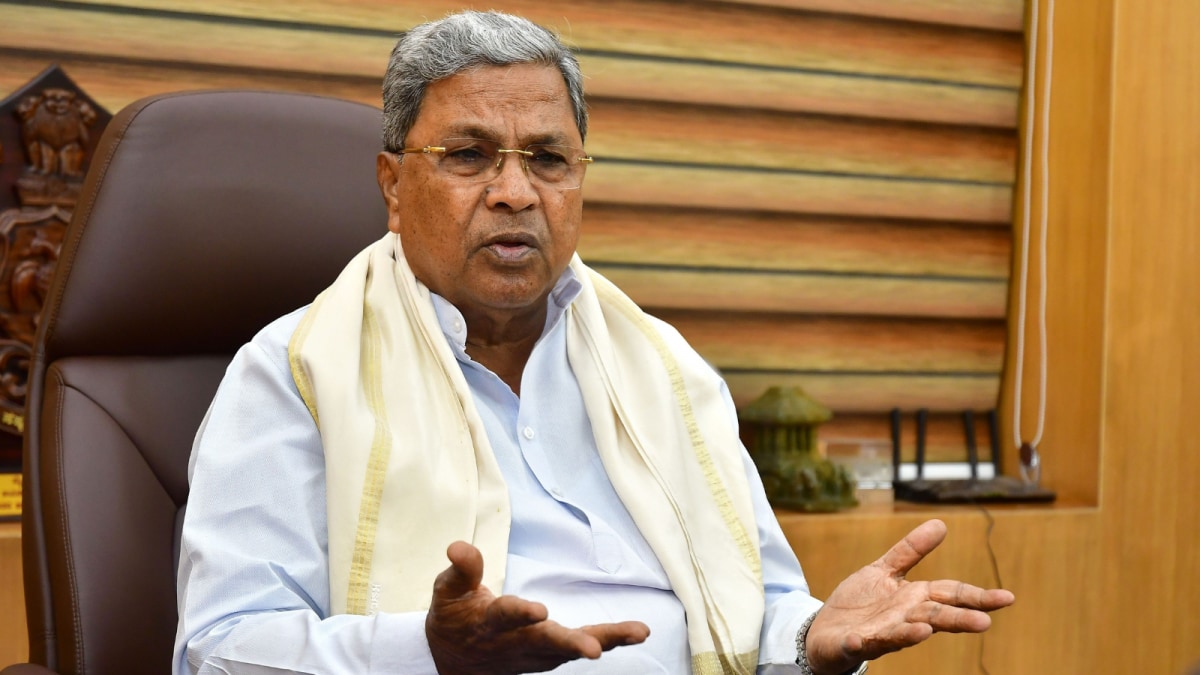
Karnataka Chief Minister Siddaramaiah (File Photo)

Devaraj Urs was the first Congress chief minister to decisively break the hold of dominant castes in Karnataka politics. Through land reforms, the expansion of reservations and the reorganisation of local power, Urs shifted political and economic influence towards backward classes, Dalits and minorities. His politics was not symbolic; it was structural, altering who owned land, who accessed education and who exercised authority.
Siddaramaiah has long projected himself as Devaraj Urs’ political inheritor. The comparison is not new, but the timing is deliberate. As questions swirl around the chief minister’s chair, January 6 allows Siddaramaiah to foreground ideology and legacy rather than rely solely on administrative authority.
The parallels Siddaramaiah draws are intentional. Urs used the state machinery to address entrenched social imbalance. Siddaramaiah positions his government’s welfare guarantees — free bus travel for women, income-support schemes, food security measures and the push for a caste census — as contemporary tools aimed at the same objective. Where Urs redistributed land, Siddaramaiah is redistributing state resources.
There are also contrasts Siddaramaiah appears keen to underline. Urs governed during a period of one-party dominance, with far greater political room to manoeuvre. Siddaramaiah governs amid coalition-like pressures within his own party, sustained opposition scrutiny and fiscal constraints. By invoking Urs, he frames these limitations as part of the challenge of reform, not as reasons to step back from social-justice politics.
January 6 also serves a strategic purpose. Devaraj Urs remains the most unifying icon for Karnataka’s AHINDA coalition. Siddaramaiah, now widely regarded as the tallest AHINDA leader in the state and an influential OBC voice nationally, uses the moment to reinforce that social base — a reminder to the Congress that this coalition, rather than organisational arithmetic alone, delivered its return to power in 2023.
On January 6, Mysuru will also witness a nati koli oota — a luncheon featuring Siddaramaiah’s favourite dish — as the chief minister becomes Karnataka’s longest-serving holder of the post, surpassing Devaraj Urs’ record.
You may recall that months ago, Siddaramaiah shared a nati koli meal with his deputy D.K. Shivakumar amid reports of a power tussle. Shivakumar later said the meal was specially prepared for him as it was his favourite. Siddaramaiah joked that he wanted Shivakumar to source good local chicken from villages, as city chicken lacked flavour.
Shivakumar, breakfasts and nati koli saaru aside, continues to press his advantage as KPCC president and the party’s chief organiser. His camp argues that the Congress would not be in power without his groundwork, fundraising and control over the organisation. For his supporters, the question is not whether he becomes chief minister, but when.
The comparison also sharpens internal contrasts within the Congress. While D.K. Shivakumar’s claim rests on organisational strength and electoral management, Siddaramaiah’s rests on ideological continuity. Parameshwara and Satish Jarkiholi, too, draw legitimacy from social representation, but neither is seen as carrying the Urs legacy in the same way.
For Siddaramaiah, January 6 is therefore not merely commemorative but political. It reinforces the argument that in Karnataka, Congress governments have survived and thrived when anchored in social reform rather than factional balance. By invoking Urs, Siddaramaiah positions his leadership within that tradition.
That argument plays out against a wider power struggle within the Karnataka Congress.
The party has no shortage of chief ministerial contenders — Siddaramaiah, Deputy Chief Minister D.K. Shivakumar, Home Minister G. Parameshwara and PWD Minister Satish Jarkiholi — but only one chair. That reality has turned the Congress’ internal balance into a slow-burn contest for power.
At the centre of it all is the uneasy coexistence between Siddaramaiah and Shivakumar. While both insist publicly that the government is stable, the contest for control is increasingly visible, marked by parallel power centres, competing loyalties and constant signalling.
Siddaramaiah continues to project himself as the party’s mass leader, anchoring his claim in the 2023 mandate and the AHINDA coalition that powered the Congress back to office. He has rejected speculation of a mid-term change and maintains that the chief minister’s post is not open for negotiation.
Shivakumar, meanwhile, is consolidating his position as KPCC president and organisational backbone. His supporters argue that the Congress would not be in power without his groundwork, fundraising and command over the party structure.
Hovering in the background are two other names that complicate the equation. Parameshwara, a senior Dalit leader, is viewed as an acceptable consensus option should the high command look beyond the Sidda–Shivakumar rivalry. Satish Jarkiholi, a powerful backwards-class leader with influence in north Karnataka, is considered a potential dark horse if caste arithmetic begins to drive the decision.
The Congress high command has so far refused to be drawn into the contest, aware that taking sides too early could fracture the government. That reluctance has encouraged quiet lobbying and factional mobilisation.
The BJP, meanwhile, has seized on the churn to question the government’s stability, arguing that the Congress is too consumed by internal rivalry to govern effectively.
For now, Siddaramaiah controls the government and the ideological narrative, Shivakumar controls the organisation, and Parameshwara and Jarkiholi remain part of an unspoken Plan B. How long the Congress can manage four ambitions and one chief minister’s chair without a rupture remains the central political question in Karnataka.
First Published:
January 04, 2026, 16:33 IST
News politics Why Jan 6 Matters In Karnataka: Devaraj Urs, Siddaramaiah And CM Power Struggle | Southern Slice
Disclaimer: Comments reflect users’ views, not News18’s. Please keep discussions respectful and constructive. Abusive, defamatory, or illegal comments will be removed. News18 may disable any comment at its discretion. By posting, you agree to our Terms of Use and Privacy Policy.
Read More