1 hour ago
CIA Director John Ratcliffe's unannounced trip to Moscow has sparked speculation over the reasons behind the visit. The secrecy surrounding the trip has prompted geopolitical voices to float theories. While some link it to concerns over a possible Russian nuclear strike on Ukraine, others see an Iran sanctions angle.
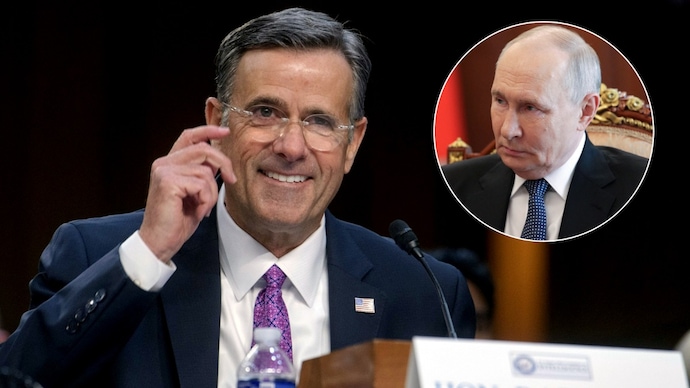
CIA chief John Ratcliffe's trip to Vladimir Putin-led (inset) Russia on Tuesday appears to be his first known official visit to the country since taking charge of the agency. (Image: AP and Reuters)
The secretive Moscow trip by US Central Intelligence Agency (CIA) Director John Ratcliffe has triggered a wave of speculation, with geopolitical voices suggesting that his visit could be linked to anything from concerns over a possible Russian nuclear strike on Ukraine to the ongoing Iran conflict, raising questions over what prompted the CIA chief to travel to Russia at such a sensitive moment in the Russia-Ukraine war and amid escalating US pressure on Tehran.
Ratcliffe travelled to Moscow on Tuesday (August 25) for undisclosed meetings with Russian officials, according to US media reports citing people familiar with his movements. Neither the CIA nor the Kremlin has publicly disclosed the purpose of the visit or confirmed who Ratcliffe met. It appears to be Ratcliffe's first known trip to Russia since becoming CIA director under US President Donald Trump.
The secrecy surrounding the trip has only added to the intrigue. Hours before reports of Ratcliffe's presence emerged, a US Air Force Boeing C-17A Globemaster III was tracked arriving at Moscow's Vnukovo Airport. The US aircraft had travelled from Riga, Latvia, after originating from Joint Base Andrews in Maryland. A US diplomatic motorcade was also seen in Moscow.
The circumstances were unusual enough to draw immediate attention.
CIA CHIEF'S VISIT TO RUSSIA TO WARN PUTIN ADMINISTRATION?
One possible explanation is the increasingly tense situation surrounding the Russia-Ukraine war. US intelligence assessments have reportedly raised concerns that Russian President Vladimir Putin's calculations might be shifting, with Moscow potentially becoming more willing to undertake provocative actions against Nato countries, including hybrid or deniable operations designed to test the alliance's resolve.
The US-based Wall Street Journal (WSJ) newspaper on Tuesday reported that Ratcliffe's visit came as US intelligence obtained information suggesting Russia could be preparing for another mobilisation and considering actions aimed at testing Nato's resilience. Against that backdrop, former US deputy director of national intelligence Beth Sanner offered one possible interpretation of Ratcliffe's mission.
Explaining what she believed could be the purpose of such a visit, Sanner told the WSJ that Ratcliffe might have gone to Moscow to deliver a blunt warning: "We know what you're thinking about doing, and you better not."
That interpretation would place the CIA chief's trip in the context of preventing a possible escalation rather than negotiating the details of an existing peace agreement.
The timing is significant because US-brokered efforts to end the Russia-Ukraine war have stalled, while Ukrainian forces have continued striking targets deep inside Russian territory. US officials reportedly asked Ukraine to temporarily halt strikes around Moscow and other Russian cities during Ratcliffe's visit, further suggesting that Washington considered the trip sensitive.
IS RUSSIA PLANNING A NUCLEAR STRIKE ON UKRAINE?
The most alarming speculation came from US political analyst and columnist Gordon G Chang. He suggested that the possibility of a major Russian escalation should not be dismissed.
Questioning whether the Moscow mission could be connected to concerns over Russia's nuclear posture, Chang wrote on X saying, "Did John Ratcliffe [CIA chief] go to Russia because Putin is planning to use nuclear weapons against Ukraine?"
He followed it with an even more stark assessment: "War is coming," the US-based political analyst said in a separate post on X.
Chang also argued that the Trump administration should explain the situation to the American public. "The administration should tell the American people what is happening. And if the situation is as serious as it appears, President Trump should be getting the American people ready," Chang wrote, calling for greater transparency.
These are, however, speculations rather than confirmed information about Ratcliffe's mission. There is no public evidence establishing that a Russian nuclear strike on Ukraine was the reason for his visit.
SANCTIONS ON IRAN LINKED TO CIA CHIEF'S RUSSIA VISIT?
Another theory points away from Ukraine and towards Tehran.
The Trump administration has stepped up economic pressure on Iran, announcing a strategy aimed at isolating Tehran and warning countries and entities against continuing significant economic ties with the country. Russia remains an important strategic partner of Iran.
Tom Cotterill, defence editor at the Telegraph newspaper, cited former senior British military planner Air Marshal Andrew Turner as suggesting that Iran could be one of the central issues behind Ratcliffe's Moscow trip.
Explaining the theory, Turner reportedly said the visit could be connected to Washington's attempt to persuade Moscow to reduce its support for Tehran. Calling Ratcliffe's trip "extraordinarily unusual". "I would think it has a lot to do with Iran and the strategy of pressure that the president is looking to impose on Tehran," Turner was quoted by Cotterill's post on X.
The former British military planner further said that Washington could be seeking Russian cooperation in its campaign against Iran. "I believe he is requesting or trying to induce Russia to cease support and break off relations with Tehran," Turner added.
WHAT DOES CIA CHIEF'S SECRETIVE MOSCOW TRIP MEAN?
For now, the central mystery remains unresolved around the unannounced visit.
Ratcliffe's visit is confirmed by multiple US media reports, but the agenda is not. The trip comes at the intersection of three major geopolitical crises: the stalled Russia-Ukraine negotiations, concerns over possible Russian escalation against Nato and the Trump administration's intensifying campaign against Iran.
That is why the speculation has ranged from a warning to Putin over Ukraine and nuclear weapons to a diplomatic effort over Iran or even an attempt to test the possibility of a larger US-Russia bargain.
The significance of the visit might therefore lie not only in what Ratcliffe discussed in Moscow, but in why Washington chose its top intelligence official, rather than a conventional diplomat, to carry the message.
- Ends
Published By:
Avinash Kateel
Published On:
Aug 26, 2026 12:26 IST