 1 hour ago
Imagine a friend showing you a message about someone planning a shooting. Do you report it, or brush it off as angry talk? What if you get it wrong either way?
In Illinois, a co-worker alerted police to concerning messages linked to 19-year-old Alexandros Paporakis, arrested over an alleged mass shooting plot that may have targeted a Hindu place of worship. It was busted because someone spoke up.
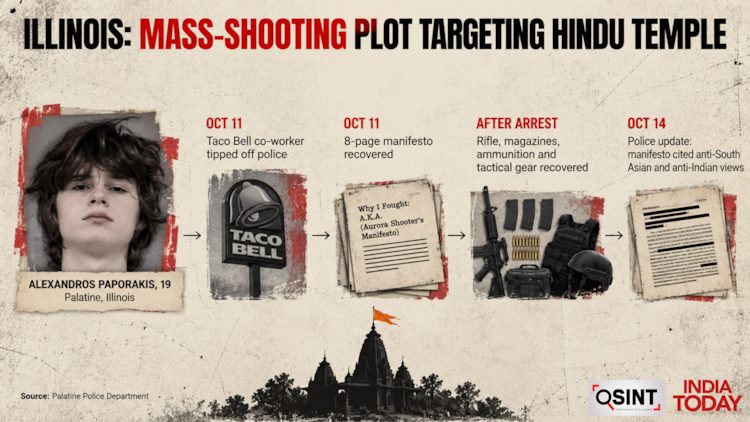
But in a country infamous for its gun culture, speaking up is not always that simple. People may hesitate, unsure whether a threat is serious enough to report. Others may fear the consequences of getting involved.
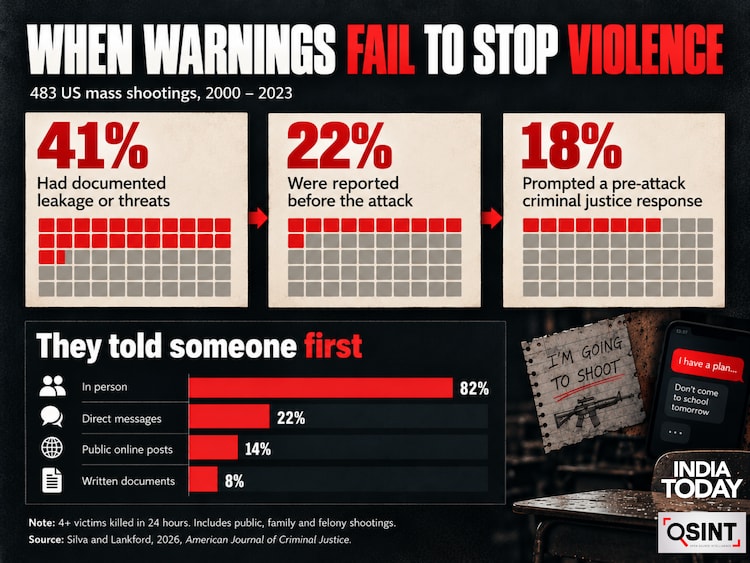
In nearly half of US mass shootings, the attacker had given warning signs before the violence. In 82% of these cases, they had spoken about their intentions to someone in person. The findings come from a 2026 study by Jason R. Silva of William Paterson University and Adam Lankford of the University of Alabama, published in the American Journal of Criminal Justice.
India Today’s OSINT team mapped US mass shooting patterns and examined what research reveals about the warnings that often precede violence.
SOMEONE USUALLY HEARS SOMETHING FIRST
Before a shooting, someone may have heard a threat, received a message or seen a disturbing post. But did they recognise it as a warning?
The American Journal of Criminal Justice examined 483 US mass shootings between 2000 and 2023 in which at least four victims were killed.
In 197 cases (41%), perpetrators had signalled violent intent beforehand. Yet only 54% of those warnings were reported before the attack. Across all 483 cases, just 22% were reported in advance.
Most warnings were communicated in person (82%), while 22% involved direct messages, 14% public online posts and 8% written documents. These categories overlap.
The researchers identify “public uncertainty about individuals’ dangerousness” as a key barrier. Someone may hear a threat and still wonder: is this just talk, or should I be worried enough to report it?
GUN VIOLENCE: FROM SCHOOLS TO WORKPLACES
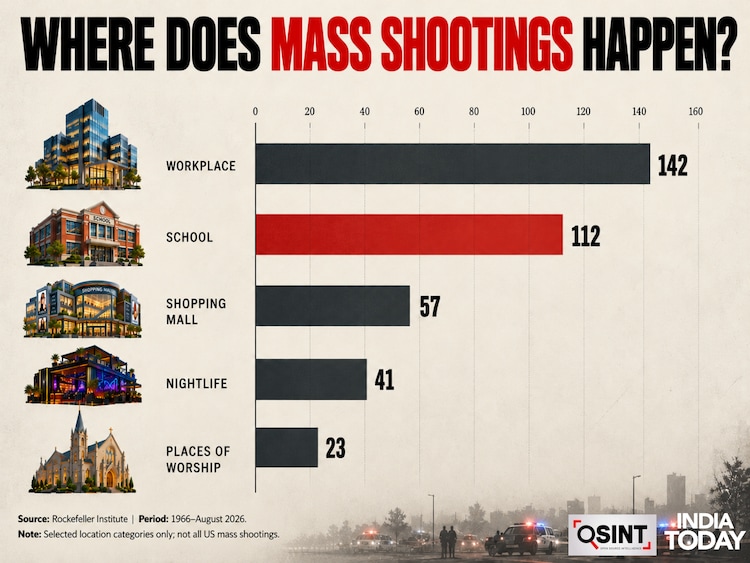
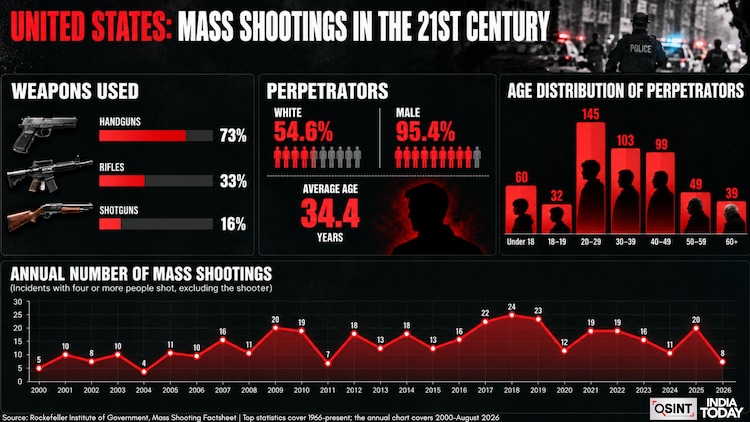
A separate Rockefeller Institute of Government dataset focuses on public mass shootings, excluding incidents linked to gang violence and targeted militant or terrorist activity. It recorded 517 attacks since 1966, leaving 1,741 people dead and 4,480 victims in total.
Workplaces accounted for 142 incidents, followed by schools with 112, making them among the most frequently recorded settings for these attacks.
The perpetrators were overwhelmingly men (95.4%), while white perpetrators accounted for 54.6%. The average age was 34.4, but 60 perpetrators were under 18, and another 32 were aged 18 or 19. Together, 92 were teenagers or younger.
FBI data offers a more recent snapshot: the bureau counted three active shooters aged 18 or younger in 2023, six in 2024 and three in 2025. The figures fluctuate, rather than establish a rising trend. The FBI's active shooter figures use a different definition from the Rockefeller Institute's public mass shooting dataset.
The Illinois case brings these patterns closer to the present. Paporakis, 19, allegedly told Taco Bell co-workers that Sunday would be “a special day”. Investigators say they recovered his eight-page manifesto, titled Why I Fought: A.K.A. (Aurora Shooter’s Manifesto), along with a rifle, loaded magazines, and ammunition. Prosecutors say the alleged plot may have targeted a Hindu place of worship. The allegations have yet to be tested in court. A co-worker's decision to alert police may have helped authorities intervene before the alleged plot unfolded.
THE MAP REVEALS THE SCALE OF GUN VIOLENCE
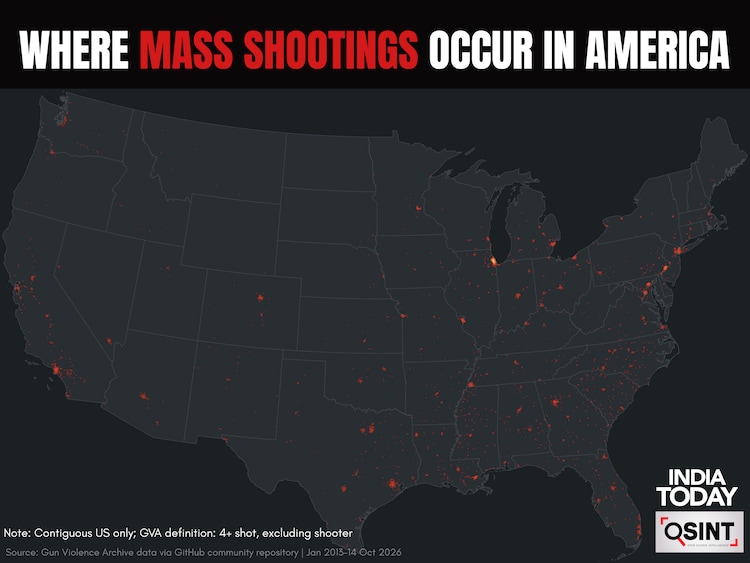
Zoom out from Illinois, and the scale of America’s gun violence becomes clearer. India Today’s OSINT team mapped 6,226 shooting incidents across the contiguous United States between January 2013 and October 14, 2026, using a community-maintained dataset derived from Gun Violence Archive records.
Illinois recorded the most incidents, at 574, followed by California with 550 and Texas with 451. Chicago alone accounted for 423 records, more than any other city in the dataset.
But these were not all deadly attacks. The Gun Violence Archive counts incidents in which four or more people were shot, excluding the shooter, whether or not anyone died. Nearly 47% of the mapped incidents recorded no victim fatalities.
And in Illinois, a recent alleged plot raises a question that goes beyond the numbers: when someone sees a warning sign, will they speak up?
- Ends