1 month ago
Typhoon Bavi battered Japan's southern islands before moving towards Taiwan. The storm disrupted travel, cut power and prompted evacuations as China prepared for landfall.
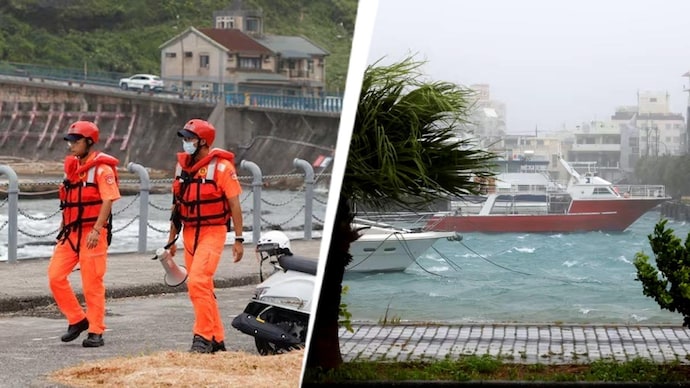
Typhoon Bavi is forecast to make landfall near the eastern Chinese city of Wenzhou. (Images: Reuters)

New Delhi,UPDATED: Jul 11, 2026 11:19 IST
Typhoon Bavi battered Japan's southern Sakishima island chain with torrential rain and powerful winds on Saturday before advancing towards Taiwan, triggering widespread travel disruptions, power outages and mass evacuations across the region. Authorities in Japan, Taiwan and China warned of flooding, landslides and damaging winds as one of the largest storms in decades swept across East Asia.
The storm lashed Okinawa prefecture's Ishigaki Island, where deserted streets were strewn with debris carried by fierce winds. Boats at local harbours were tossed by rough seas as Bavi packed maximum sustained winds of 144 kmph (90 mph) near its centre. Officials warned that wind gusts could reach up to 198 kmph.
Siu bo Bavi bt u cn qut vo t lin i Loan, Phc kin - tq sc gió 280-300km/h
D bo ko b trc tip vo nc ta nhng hon lu vn có th gy gió mnh v bin ng mt s khu vc gip tq pic.twitter.com/Fl5YOAiIjK— Callavibes (@Thaouyentt) July 11, 2026
The severe weather brought transport to a standstill across the island. All flights and ferry services to and from Ishigaki remained suspended throughout Saturday. Airlines cancelled 345 flights, while more than 24,000 households across Okinawa were left without electricity.
Residents of Japan's remote Sakishima Islands spent Friday preparing for the typhoon by reinforcing windows and securing homes and businesses against the approaching storm. Japan Airlines cancelled more than 100 flights on Friday and Saturday, disrupting travel for nearly 20,000 passengers, while All Nippon Airways grounded more than 160 flights through Sunday, affecting another 20,000 passengers, according to news agency Reuters.
After crossing Japan's southern islands, Bavi moved towards Taiwan, where authorities evacuated more than 14,000 people, primarily from mountainous regions in the north and east of the island.
Although the storm is forecast to weaken gradually and is not expected to make landfall in Taiwan, officials ordered precautionary evacuations amid forecasts of nearly one metre (three feet) of rainfall in some areas.
Taiwan suspended most public activities as almost every city and county declared a typhoon holiday, shutting schools and government offices that would otherwise have been open over the weekend. While the island's main north-south high-speed rail line continued operating with reduced services, aviation was severely affected, with 920 international and all 280 domestic flights cancelled, Reuters reported.
Taiwan's defence ministry said nearly 29,000 soldiers had been placed on standby to assist with emergency response operations. The Central Weather Administration described Bavi as the largest storm by size expected to affect the island since 1987.
In Taipei, strong winds and intermittent rain swept through the city, though some residents continued with their daily routines.
Conditions were harsher in Taipei's Beitou district, located near the surrounding mountains, where gusts of around 100 kmph (60 mph) toppled trees and caused rivers to swell.
Typhoon Bavi reaches Japan's Ryukyu Islands, bringing impacts to them and Taiwan.
Bavi is forecast to make landfall on the coast of China within the next 24 hours. pic.twitter.com/von0tUVBHc— CIRA (@CIRA_CSU) July 11, 2026
Ahead of the storm, supermarkets across Taiwan saw panic buying as residents stocked up on essentials. Farmers rushed to harvest or protect crops before the weather deteriorated, fishermen secured their boats, and authorities distributed thousands of sandbags in flood-prone areas.
Bavi, spanning nearly 1,000 km (620 miles) at its widest point, is forecast to make landfall near the eastern Chinese city of Wenzhou, home to around 10 million people, early on Sunday. Chinese authorities warned the typhoon could have a "significant impact" after striking the southeastern coast and cautioned northern provinces, which have less experience dealing with tropical cyclones, to strengthen preparedness.
Some forecasts indicated that the storm could make landfall twice in China.
The storm's impact has already been felt elsewhere in the region. In the southern Philippines, landslides triggered by heavy rains linked to one of the strongest storms in decades have killed at least 15 people, while rescue teams continue searching for those missing. Officials warned that moderate to heavy rainfall would continue across parts of the country through the weekend.
Typhoon Bavi (Inday) left 15 dead in the Philippines, mostly due to landslides in Mindanao, and put Taiwan on maximum alert. #IndayPH
Moving northward, the storm canceled flights in Japan and forced China to evacuate more than 17,000 residents. pic.twitter.com/p5WOVOEW3W— GeoTechWar (@geotechwar) July 10, 2026
The approaching typhoon also disrupted international air travel, with Thai Airways and Malaysia Airlines suspending flights to and from Taipei as East Asia braced for the storm's continued advance.
- Ends
Published By:
Sahil Sinha
Published On:
Jul 11, 2026 11:19 IST