1 hour ago
Turkey is assessing how it can help Saudi Arabia counter Houthi attacks under the Mecca Joint Defence Agreement. The move highlights the pact's defensive focus as Ankara readies it for parliamentary ratification.
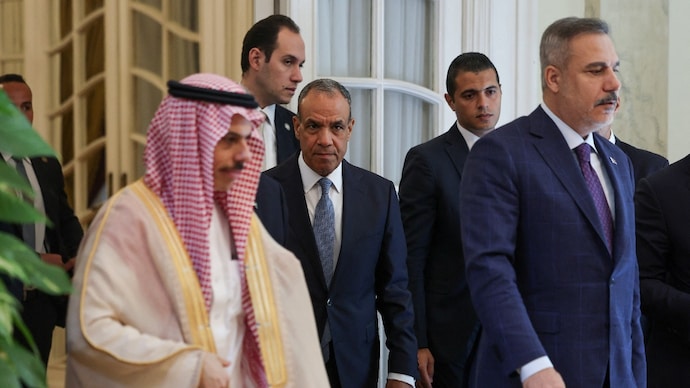
He also added that the work to send the text of the Mecca Pact to the Turkish parliament to be ratified was finalised. (Credits: Reuters)
Turkey is assessing how it can help Saudi Arabia counter attacks from Yemen's Iran-aligned Houthi militias as part of the Mecca Joint Defence Agreement signed between the two countries and Pakistan, Turkish Foreign Minister Hakan Fidan said on Thursday.
In his remarks, Fidan described the pact as a defensive agreement and not an offensive one.
Officials were working on what kind of contributions could be made particularly on air defenses, Fidan said, speaking at a joint news conference with his Hungarian counterpart in Ankara.
He also added that the work to send the text of the Mecca Pact to the Turkish parliament to be ratified was finalised.
TURKEY'S INCLUSION IN THE MECCA JOINT DEFENCE AGREEMENT
On August 7, 2026, Saudi Crown Prince Mohammed bin Salman, Turkish President Recep Tayyip Erdoan and Pakistani Prime Minister Shehbaz Sharif signed the Mecca Joint Defence Agreement, bringing Turkey into the collective defence framework established by Saudi Arabia and Pakistan in September 2025.
The agreement commits the three countries to treating an armed attack against any one of them as an attack against all three. It also calls for closer defence cooperation among the signatories.
The agreement’s practical military implications remain uncertain.
The full text has not been made public, while the pact does not appear to establish a joint military command, permanent forces or a clearly defined mechanism for responding to an attack.
This has led some analysts to view the mutual-defence commitment as primarily political rather than an immediately operational military arrangement.
The broader defence cooperation component could prove more significant over time.
Greater collaboration in defence production, joint military exercises and intelligence sharing could strengthen coordination among Saudi Arabia, Turkey and Pakistan and potentially create deeper institutional links between their armed forces.
The agreement also does not replace the US security relationship with Saudi Arabia. Riyadh’s new partners are themselves US allies rather than strategic adversaries of Washington. The United States has therefore not opposed the arrangement.
US President Donald Trump welcomed the agreement, saying the countries would “finally be able to defend themselves in a more meaningful way”.
For Saudi Arabia, the pact could consequently offer greater defence-industrial and diplomatic capabilities, even if its immediate value as a collective military-security guarantee remains limited.
- Ends