1 hour ago
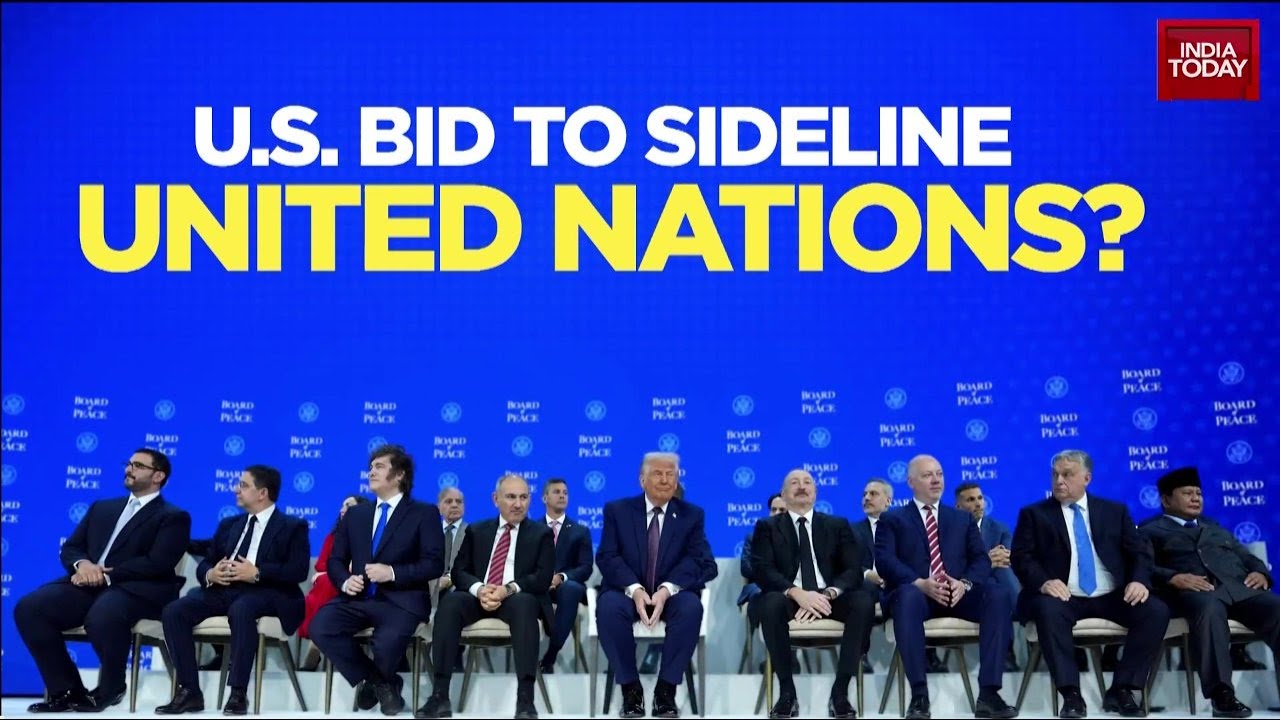
Amid the hullabaloo and self-congratulation of Donald Trump’s “board of peace” launch in Davos, his administration laid out specific plans for the short- and long-term future of Gaza, aimed at a lasting peace.
The blueprint set out on Thursday was extremely ambitious. It envisages a unified Palestinian-run Gaza, which represents a rebuff to the aims of Israeli extremists, including some in the governing coalition, who have sought the deportation of Gaza’s population and the building of Israeli settlements in its place.
The plan’s success will depend largely on whether Trump and his board of peace has the determination to implement the plan, overcoming Israeli objections and obstruction – and whether a mechanism can be created inside Gaza to oversee the disarming of Hamas.
A slideshow presented in Davos by Trump’s son-in-law, Jared Kushner, imagined a futuristic dreamscape of gleaming apartment blocks and office towers, with neat industrial parks and residential districts – and even an airport. The territory had a slice taken off it to create a buffer zone along the Israeli border, and was treated as blank slate, ignoring the property rights of generations of Palestinians, but it was a move away from a partition between Hamas and Israeli-run halves.
The plan also spelled out more achievable promises for the next 100 days, including the restoration of basic infrastructure – including water, sewage and electric systems, hospitals and bakeries – together with a significant increase in the flow of goods entering Gaza. The critical Rafah crossing between Gaza and Egypt is due to open for traffic next week, for the first time since Israeli troops seized control of it in May 2024.
Kushner committed the US administration to achieving those short-term goals.
“The next 100 days we’re going to continue to just be heads down and focused on making sure this is implemented,” he said. “We continue to be focused on humanitarian aid, humanitarian shelter, but then creating the conditions to move forward.”
The board of peace will be represented in Gaza by a “high representative”, a veteran Bulgarian and UN diplomat, Nickolay Mladenov. But the plan, as spent out in Davos, puts much of the onus for implementation on the newly formed Committee for the Administration of Gaza (NCAG), a panel of Palestinian non-partisan technocrats who are supposed to run Gaza for a transition period.
Its chair, the “chief commissioner” Ali Shaath, addressed the assembled world leaders in Davos by video link from Cairo, but also spoke directly to the people of Gaza, largely ignored so far in the Trump peace plan.
“Step by step, with discipline and determination, we will rebuild a capable Gaza, capable of self-reliance, and we will build it into a centre for freedom, opportunity and peace,” Shaath told his fellow Palestinians.
Shaath, an engineer and a former deputy transport minister in the Palestinian Authority, said the NCAG’s mission was “to restore order, to rebuild institutions and to recreate a future for the people of Gaza defined by opportunity and dignity under the principle of one authority, one law and one weapon”.
According to documents supplied by the administration, “one weapon” means that all weapon possession in the future Gaza can be “authorized by one authority only (NCAG)”.
The clause addressed a major and immediate hurdle to turning a semi-observed ceasefire into a real and lasting truce. US and Israeli officials agree there will not be further withdrawals by the Israeli army (still occupying more than half of Gaza) until Hamas disarms.
Hamas has reportedly agreed in principle to hand over its heavy weapons, such as rockets and artillery, to a Palestinian administration, and is said to be prepared to accept the NCAG.
To put that to the test, Shaath and the NCAG would have to be allowed to enter Gaza with a Palestinian police force that has been trained in Jordan and Egypt over past months.
The plan presented in Davos notably made no mention of the Stabilisation Force (ISF), which was a key part of Trump’s peace proposals last year, endorsed in November by a UN security council resolution.
Creating the ISF has been fraught with problems. None of the countries in the Arab and Islamic world that provisionally agreed to provide troops wanted their soldiers to confront Hamas over its weaponry. Israel declared it would not accept Turkish or Qatari forces, while other potential troop contributors insisted that Turkey and Qatar were involved.
The US blueprint mentions only the new Palestinian police force. Heavy weapons would be “decommissioned immediately”, it said.
“Personal arms [will be] registered and decommissioned by sector as NCAG police becomes capable of guaranteeing personal security,” the blueprint said. The end state would be a situation in which “only NCAG-sanctioned personnel may carry weapons”.
The immediate test of the blueprint will come next week, when the Rafah crossing is due to open. “Opening Rafah signals Gaza is no longer closed to the future or to the world. This is a real step and it marks a new direction,” Shaath said in his video presentation.
However, Benjamin Netanyahu’s cabinet is due to discuss the opening of Rafah next week. There is considerable opposition inside the coalition to reopening the crossing, at least until the remains of the last unaccounted-for Israeli hostage, Ran Gvili, are returned.
There will be considerably more internal opposition to the establishment of a Palestinian interim government in territory, which the far right is bent on emptying and annexing. The plan does not say a future Gaza would be part of a sovereign Palestinian state. But it does not exclude a unified Palestine, and it is unlikely the NCAG would be able to recruit credible Palestinian members if it did.
Under the plan, the Israeli army would withdraw progressively from all Gazan territory in phases from the current truce line agreed as part of phase one of the plan. That further withdrawal would be “based on agreed-upon standards”, the Kushner blueprint said, but it gave no details, raising questions over whether Israel would comply.
For the population of Gaza, most still living in tents and under regular Israeli fire, perhaps the most encouraging aspect of Thursday’s presentation in Davos was that Trump clearly still sees his prestige and that of his “board of peace” as being wrapped up in the ceasefire he brokered last year.
In other words, the ceasefire plan is still harnessed to the bulldozer of the president’s self-esteem, which at least has the potential to break through the substantial hurdles to a free and peaceful Gaza.