1 hour ago
The QUAD is often seen as a counterweight to China in the Indo-Pacific. But can it avoid the fate of past minilaterals? History offers a warning, and perhaps a roadmap.
US Secretary of State Marco Rubio will land in India on Saturday amid growing attention on India-US ties, which have shown visible friction since Donald Trump’s return to the Oval Office. But beyond bilateral optics lies a bigger question: what happens to the QUAD, a minilateral grouping of India, the United States, Japan and Australia, often seen as a potential countermeasure to China’s growing influence in the Indo-Pacific, especially at a moment when questions around its momentum are quietly resurfacing?
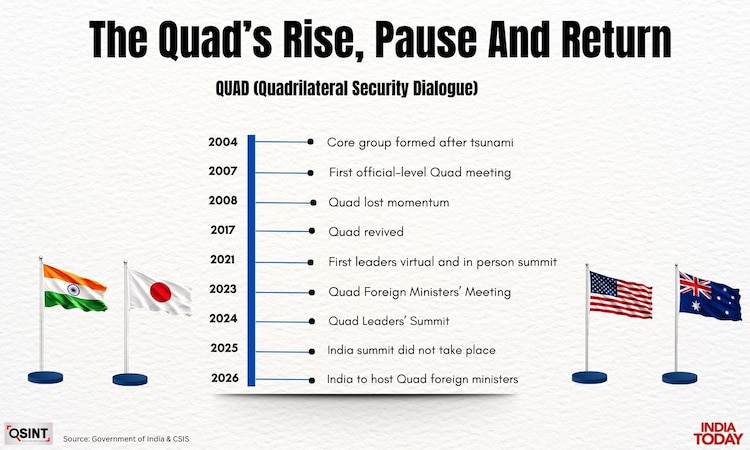
Minilaterals are smaller, issue-specific coalitions of countries built for pragmatic problem solving. As larger multilateral institutions, such as the G20, G7 or BRICS, often struggled to address regional governance challenges swiftly or build consensus, these smaller coalitions became an increasingly important feature of international politics.
QUAD, founded in 2007, revived in 2017, and elevated to the leaders’ level in 2021, the QUAD steadily expanded from security consultations into vaccines, critical technologies, maritime coordination, and supply chain resilience, all under the banner of a “free and open Indo-Pacific”. Yet the expected QUAD Leaders’ Summit last year never materialised, quietly fuelling questions over political bandwidth, competing priorities, and whether the grouping is beginning to lose momentum.
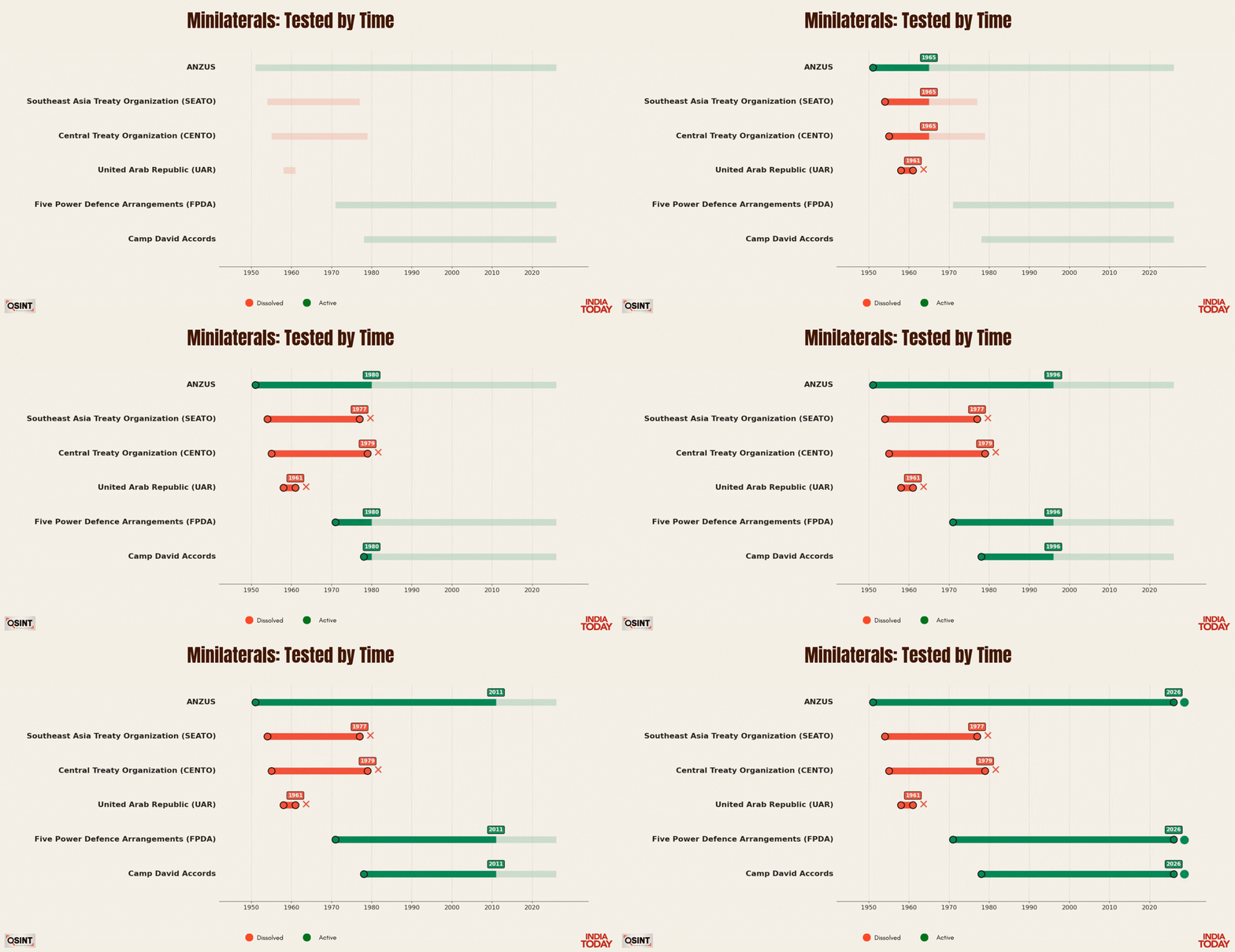
However, these questions are hardly unique to the QUAD. Alliances are often easy to announce, but hard to sustain, and history shows what rhetoric often hides. To understand what separates enduring minilaterals from those that faded, India Today’s Open Source Intelligence (OSINT) team traces six historical examples: the Five Power Defence Arrangements, Camp David Accords, ANZUS, Southeast Asia Treaty Organisation, Central Treaty Organisation, and the United Arab Republic.
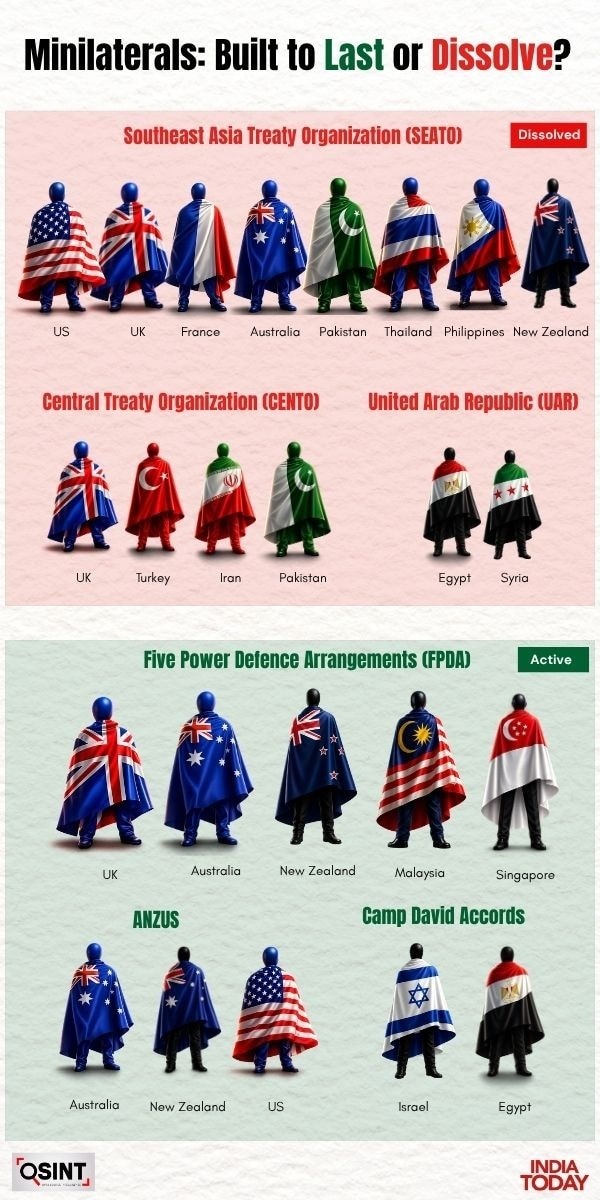
So what does this mean for the QUAD? History offers no easy prediction, but it does offer clues. The minilaterals that endured: FPDA, ANZUS, Camp David - remained narrowly focused, operationally active and politically flexible. The ones that faded: SEATO, CENTO, the UAR - struggled with vague commitments, uneven ownership or competing priorities. The QUAD sits somewhere in between: more institutionalised than its critics suggest, yet still far from a treaty alliance. With foreign ministers meeting again this month, on May 26, the question may not be whether the QUAD survives, but whether it evolves fast enough to remain strategically relevant.
FIVE POWER DEFENCE AGREEMENTS (FPDA)
When Britain announced its “East of Suez” military withdrawal in the late 1960s, ending more than a century of colonial and military presence across the Malay Peninsula and Singapore, Kuala Lumpur and Singapore faced an urgent question: who fills the security vacuum? As scholars Allan Chong Guan and Ralf Emmers note in their work on FPDA, the threat was far from theoretical. Malaysia had only recently emerged from the Indonesia-Malaysia Confrontation, or Konfrontasi (1963 to 1966), marked by cross-border infiltrations and sabotage against the newly formed federation, while communist insurgencies and wider regional instability continued to shape Southeast Asia’s security landscape.
In response, the Anglo-Malayan Defence Agreement (AMDA) was replaced by the Five Power Defence Arrangements (FPDA) on 1 November 1971, bringing together Malaysia, Singapore, the United Kingdom, Australia and New Zealand under a consultative defence framework rather than a treaty-bound military alliance. The wording mattered. The 1971 Joint Communiqu stated that in the event of an “externally organised or supported” armed attack, or even its threat, members would “immediately consult together” on measures to take, stopping short of a NATO-style automatic response.
More than five decades later, FPDA still functions, and that survival itself is evidence. FPDA’s success lies less in wars fought and more in crises avoided. Deterrence is often measured by what did not happen, and in that sense, the arrangement quietly delivered.
As documented in FPDA studies and Malaysia’s 50-year security review, the arrangement institutionalised regular military exercises, intelligence exchanges and operational coordination, evolving from Cold War air defence into maritime security, counterterrorism and humanitarian assistance. That endurance is why security scholar Carlyle A Thayer described FPDA as the “quiet achiever” of regional security, a low-profile pact sustained by deterrence, continuity and trust rather than warfighting.
CAMP DAVID ACCORDS
The Camp David Accords succeeded not because they solved the Middle East conflict, but because they achieved something narrower and far more durable: continuity. Signed in 1978 after 13 days of negotiations hosted by US President Jimmy Carter between Egyptian President Anwar Sadat and Israeli Prime Minister Menachem Begin, the accords emerged after decades of Arab-Israeli wars, including the 1967 Six-Day War and the 1973 Yom Kippur War.
As documented by the US State Department’s Office of the Historian, the agreement pursued a realistic objective: peace between Egypt and Israel, rather than an ambitious settlement of every regional dispute. That focus proved decisive. Under the 1979 Egypt–Israel Peace Treaty, Israel withdrew from the Sinai Peninsula, occupied since 1967, while Egypt became the first Arab state to formally recognise Israel.
More than four decades later, despite wars in Gaza, regional uprisings and repeated diplomatic crises, the treaty has endured. This endurance is precisely why William B. Quandt, a former US Security Council official who participated in the Camp David negotiations, later argued in his book Camp David: Peacemaking and Politics that the accords worked because they focused on “achievable objectives” and built mechanisms for sustained diplomacy rather than idealistic promises.
AUSTRALIA, NEW ZEALAND, UNITED STATES SECURITY TREATY (ANZUS)
ANZUS emerged from a crisis of confidence in old security guarantees. As an Australian Parliamentary Library foundation paper notes, until the fall of Singapore, Australia’s maritime security could largely be summed up in three words: “The Royal Navy”. For decades, Australia and New Zealand depended on Britain and imperial strategy as their primary security anchor.
But World War II shattered that assumption. After the fall of Singapore in 1942 and Japan’s rapid expansion across the Pacific, Canberra and Wellington grew increasingly reluctant to leave their defence to chance and hence, both countries sought stronger security guarantees from the United States.
The result was ANZUS, signed in 1951 by Australia, New Zealand, and the United States. Yet unlike NATO, the treaty avoided an automatic military commitment. Article IV required members to “act to meet the common danger in accordance with constitutional processes” if attacked in the Pacific, leaving room for political flexibility rather than binding intervention.
That ambiguity may explain ANZUS’s endurance. Even after New Zealand’s anti-nuclear dispute with Washington in 1986 effectively reduced the pact to a de facto US-Australia security partnership, ANZUS adapted rather than collapsed.
SOUTHEAST ASIA TREATY ORGANISATION, THE "ASIAN NATO”
SEATO was born out of Cold War fears but struggled to become the “Asian NATO” it aspired to be. Formed in 1954 through the Manila Pact after France’s defeat by the communist Viet Minh at Dien Bien Phu, a turning point that ended France’s war in Vietnam and alarmed Western powers about the spread of communism in Asia, the alliance brought together the United States, Britain, France, Australia, New Zealand, Pakistan, Thailand, and the Philippines to contain communist expansion.
Washington saw SEATO as a way to “block further communist gains in Southeast Asia”, according to the US State Department’s historical account. Yet unlike NATO, the alliance was built on strategic ambiguity. Article IV of the Manila Pact required members only to “act to meet the common danger in accordance with their constitutional processes”, stopping short of any automatic military response.
That flexibility soon became a weakness. Major regional powers such as Indonesia and Malaya stayed out, while the Vietnam War exposed deep divisions, with members unwilling to act collectively. As security analyst Ju Hyung Kim writes, SEATO lacked an integrated command mechanism or automatic defence obligation like NATO’s Article 5, and ultimately failed to halt communist advances in Indochina and hence by 1977, the alliance had dissolved.
CENTRAL TREATY ORGANISATION (CENTO)
Created in 1955 as the Baghdad Pact, the alliance brought together Iran, Iraq, Pakistan, Turkey and the United Kingdom to contain Soviet influence across the region’s “northern tier”, with strong backing from Britain and the United States. As documented by the US State Department, the objective was to build a chain of allied states to “prevent communist penetration” and block Soviet expansion into the Middle East. However, CENTO never developed a credible collective defence system. The United States supported the alliance but never formally joined, while the pact lacked an integrated military command or binding mutual defence guarantees.
That weakness soon became structural. As historian Behet Kemal Yeilbursa argues in his study, The Baghdad Pact: Anglo American Defence Policies in the Middle East, 1950–1959, CENTO struggled to reconcile the competing priorities of its members, weakening cohesion almost from the outset.
The cracks soon became visible. Iraq withdrew after the 1958 revolution toppled its “pro-Western monarchy”, forcing the alliance to relocate from Baghdad to Ankara and rebrand as CENTO. Pakistan later grew frustrated after receiving little meaningful support during its wars with India, while the 1979 Iranian Revolution removed another key pillar. By then, even US assessments acknowledged the organisation had become more relevant for “economic and technical cooperation” than military deterrence. CENTO dissolved in 1979, failing less from lack of power than lack of political cohesion and regional buy-in.
UNITED ARAB REPUBLIC (UAR)
The United Arab Republic began as one of the Arab world’s boldest political experiments and ended as one of its shortest-lived unions. Formed in 1958, Egypt and Syria came together under Egyptian President Gamal Abdel Nasser amid soaring pan Arab enthusiasm and fears of regional fragmentation. As Middle East scholar Alan W. Horton noted in his 1962 paper “A Note on Syria and the United Arab Republic,” the union emerged from a mix of idealism and insecurity, writing that “the union had had an illogic that was bridged only by faith and fear.”
But unity proved harder to govern than to imagine. Horton further observed that “a competing faith, Syria for the Syrians, gained strength,” as frustrations with Egyptian dominance deepened inside Syria and regional interests overtook pan Arab idealism.
By 1961, a military coup in Damascus ended the experiment after barely three and a half years. The UAR collapsed not because Arab unity lacked appeal, but because political symbolism proved easier to sustain than shared sovereignty.
- Ends
Published By:
bidisha saha
Published On:
May 22, 2026 16:12 IST