6 hours ago
India Today simplifies the first 48 hours of the US blockade as a calibrated, selective operation, where some vessels were turned back or stalled while others passed, reflecting controlled enforcement as the conflict's trajectory remains fluid amid whispers of backchannel efforts and possible talks ahead.
There are many theories on the termination of wars taught under the broader subject of war studies, but one that explains the Iran conflict quite well comes from Geoffrey Blainey. In his book The Causes of Wars, he argues that wars begin when countries disagree about their relative strength and end when they come to agree on it.
Before February 28, the United States would have had its own assessment of the damage it could inflict on Iran and the retaliation it could withstand. Iran, too, would have had its own understanding of the scale and speed at which the US and its allies could strike, along with its own capacity to respond.
The forty days of conflict showed that both sides got some of these calculations wrong. Iran clearly underestimated how quickly the US and Israel could neutralise its top leadership, air defence systems, and even its navy. At the same time, it seems to have overestimated the effectiveness of its ballistic missile programme in carrying out precise strikes on high-value targets in Israel and against US carrier strike groups.
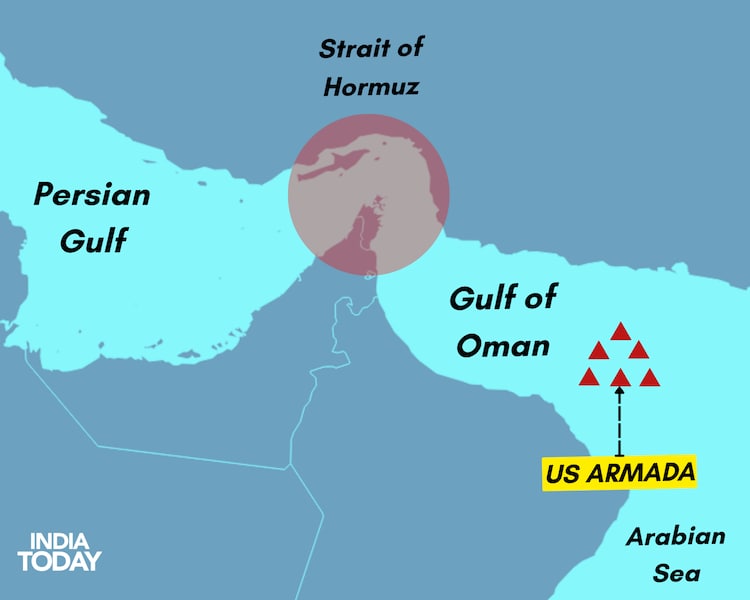
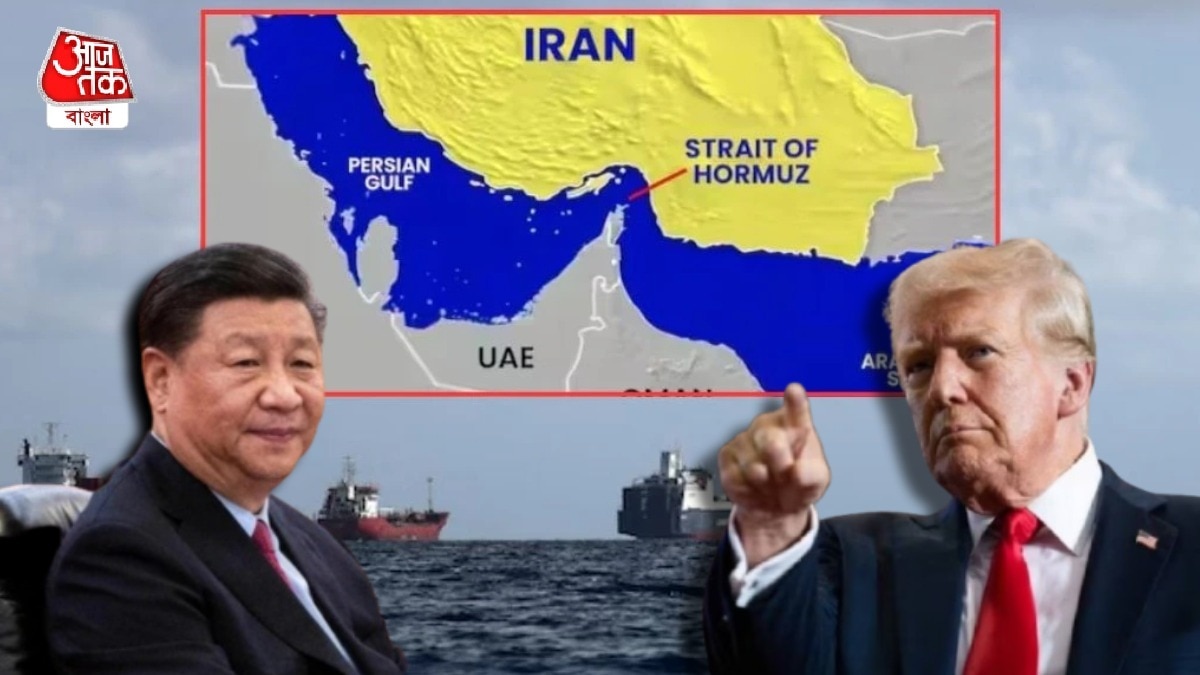
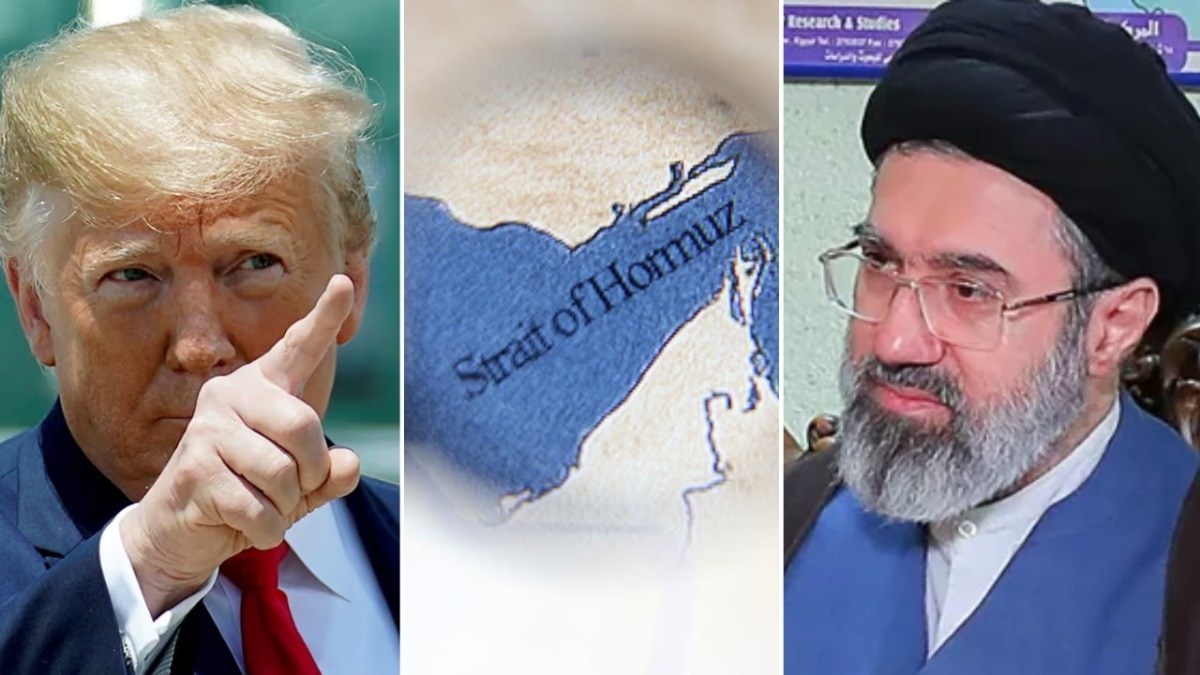
On the other side, the US underestimated Iran’s resilience. Its bureaucracy and leadership structure held together despite sustained losses. Iranian drones performed better than expected, but the biggest miss for the US and Israel was Iran’s ability to disrupt the global energy supply chain by threatening and restricting movement through the Strait of Hormuz.
The US decision to push for a blockade targeting Iran-linked maritime movement appears to be an effort to correct this imbalance in perceived strength before both sides return to the negotiating table.
Understanding the blockade
As of today, there are effectively two overlapping blockades shaping traffic between the Arabian Sea and the Persian Gulf.
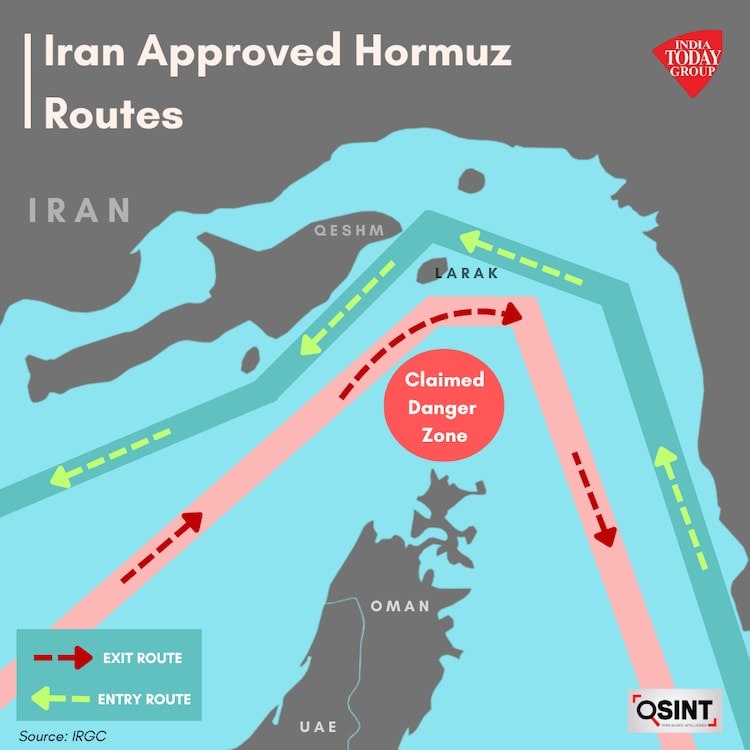
The first is imposed by Iran. It allows only a limited number of vessels from what it considers “friendly” countries to pass, and even those are required to deviate from the usual shipping lanes. These ships are routed closer to Iranian islands such as Larak and Qeshm, often under the guidance of Iranian naval forces. According to Lloyd’s List Intelligence, more than 322 vessels crossed the Strait between March 2 and April 12, most of them linked to Iran. A smaller number of ships from countries like China, India, Pakistan, Oman, and France were also allowed through, typically with government-level coordination.
The second blockade is enforced by the US military. Its stated objective is to restrict the movement of vessels coming from or going to Iranian ports. Statements from US CENTCOM suggest that the US Navy is not trying to stop all traffic, only ships linked to Iran, either through ownership or cargo. Vessels connected to other countries and ports are, in principle, not the target.
In the first 24 hours, there have been conflicting reports about how effective the US blockade really is. Many analysts have pointed to commercial ship tracking data showing the movement of sanctioned vessels through the Strait of Hormuz. But a lot of this confusion comes from how people expect a naval blockade to work.
India Today Open Source Intelligence (OSINT) team tracked vessel movements using MarineTraffic and other commercial tracking platforms in the first 36 to 48 hours of the US blockade, identifying patterns across categories.
3 vessels were confirmed to have taken a U-turn, while 2 vessels were observed stalled in the Gulf of Oman with no clear forward movement. In contrast, 9 vessels were tracked transiting the route under varying conditions, including sanctioned ships, Iran-linked vessels, and others employing evasive routing tactics.
Broader reporting suggests that up to eight vessels were forced to reverse course, while over 20 vessels transited the Strait of Hormuz within the first 48 hours of the US blockade. However, these figures remain limited, reflecting movements mainly around Larak Island and in the core of the Strait. Crucially, they do not necessarily account for Iranian goods and crude shipments moving to and from Iranian ports, which remain the central focus of the US blockade.
Every vessel transiting, or attempting to transit, the perilous waters carries its own operational story. India Today OSINT team makes an effort to draw a clear distinction between why some vessels are stopped, and others are not, and why even certain Iranian-linked ships appear to have moved “through” the US blockade.
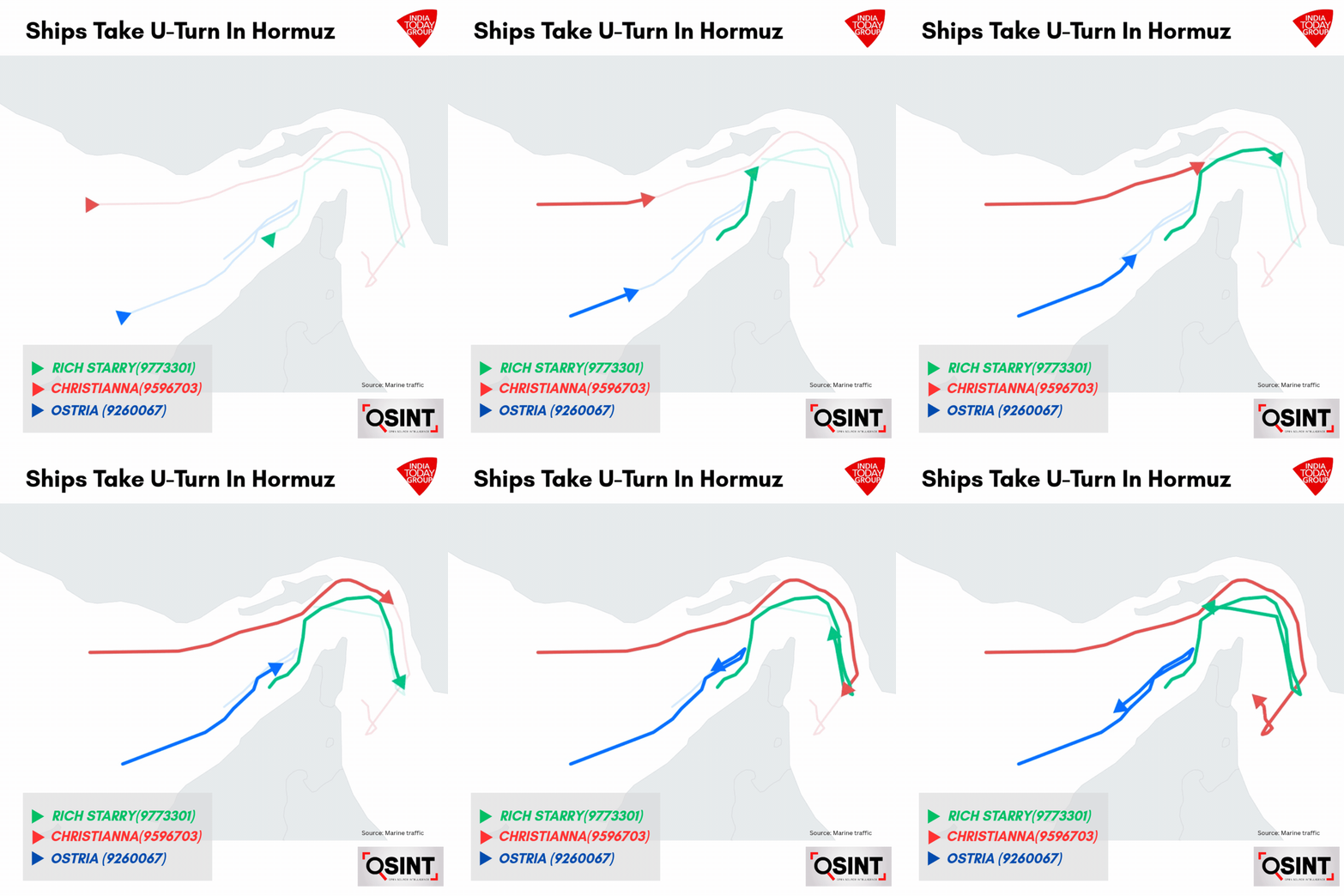
Vessels that made a U-turn
Rich Starry (IMO 9773301), a chemical and oil tanker, is a known shadow fleet asset. Lloyd’s List reporting notes that the vessel is sanctioned by the United States and has been falsely indicating a Malawian flag, placing it in a near stateless category. AIS manipulation between April 3 and April 14 points to covert loading, likely involving Iranian cargo. After transiting the Strait of Hormuz, the vessel reversed course in the Gulf of Oman, a move consistent with pressure from US enforcement.
Christianna (IMO 9596703), a Greek-owned bulker, departed Bandar Imam Khomeini before and transited the Strait. It later appeared off Shinas, Oman, signalling Fujairah as its destination. Soon after, the vessel reversed course, aligning with the enforcement posture of the US blockade.
Ostria (IMO 9260067) presents a similar trajectory. Following the blockade announcement, the vessel turned around and proceeded toward Sharjah. It subsequently switched off its AIS, obscuring further movement, and is currently assessed to be at anchor in the Persian Gulf. Commercial tracking databases have repeatedly linked the vessel to sanctioned or restricted activity, with frequent association with shadow fleet operations.
Vessels stalled by the US blockade
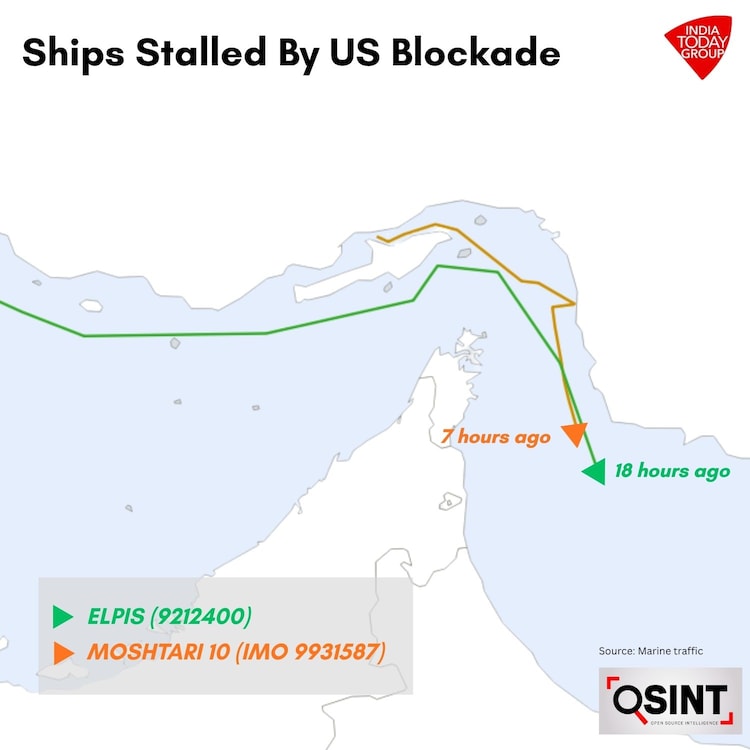
Shadow fleet tanker, Elpis (IMO 9212400), exited the Strait of Hormuz after the US blockade came into force. As per Lloyd’s List, the vessel had departed Bushehr and is under US sanctions.
However, the vessel has remained stationary in the Gulf of Oman for nearly 18 hours, without turning back or proceeding further, indicating possible disruption linked to US enforcement.
Moshtari 10 (IMO 9931587), an Iran-flagged general cargo ship, shows a similar pattern. It has been stalled in the Gulf of Oman for around 7 hours, with no forward movement and no course reversal, for reasons that remain unclear.
Vessels that went “through”
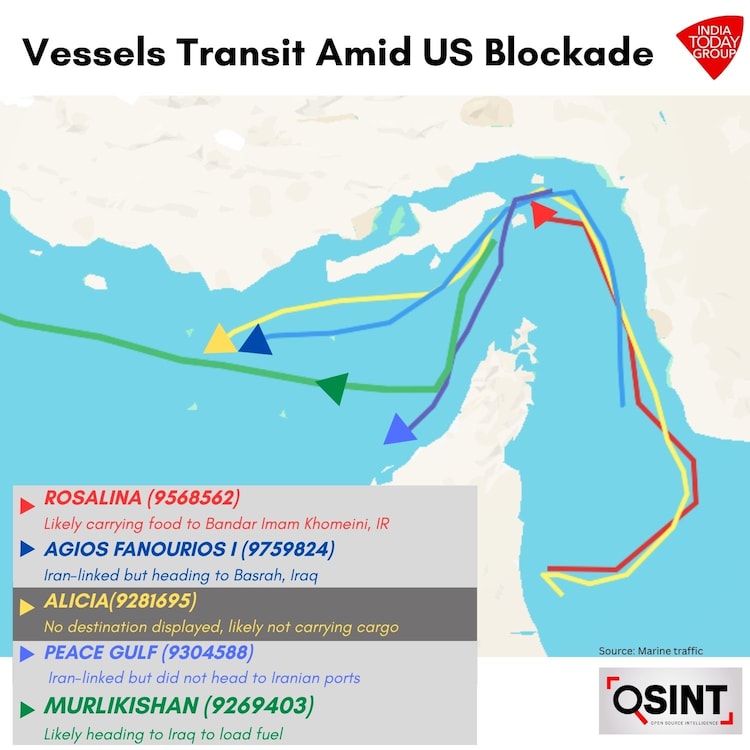
Vessel tracking data, as tracked by India Today using MarineTraffic, shows multiple ships navigating complex routes amid the US blockade in the region.
These vessels are among those that have transited the route after the blockade came into effect. While the exact reasons behind their passage remain unclear, their movements point to selective enforcement, operational gaps, or deliberate routing strategies that allow certain ships to pass despite restrictions.
It might also be the case that empty Iranian tankers returning to their ports are exempted by the US, as stopping them serves no real purpose.
Two Iran-flagged boxships, Rayen (IMO 9820245) and Daisy (IMO 9270684), both sanctioned as per Lloyd’s List, had been waiting off the Iranian coast in the Gulf of Oman since the conflict began.
According to Lloyd’s List reporting, both vessels transited the Strait on Tuesday and proceeded toward Bandar Abbas, altering their stated destinations shortly before entry. The move appears designed to complicate tracking and enforcement targeting, a familiar tactic, with shadow fleet tankers often broadcasting false AIS positions to obscure their movements.
Rosalina (IMO 9568562) appears to be heading toward Bandar Imam Khomeini, likely carrying food supplies.
Agios Fanourios I (IMO 9759824), the Malta-flagged VLCC, entered the Gulf via the Strait on Wednesday in a second attempt to transit, after being among several vessels that had tried to enter during the US-Iran ceasefire window on Sunday. It is now heading to Iraq to load Basra crude for Vietnam’s Nghi Son refinery, Reuters reports, citing trade sources.
Other vessels like Alicia (IMO 9281695), which is not displaying a destination, are likely sailing without cargo. Peace Gulf (IMO 9304588), also Iran-linked, did not proceed toward Iranian ports. Meanwhile, Murlikishan (IMO 9269403) is likely heading toward Iraq, possibly to load fuel.
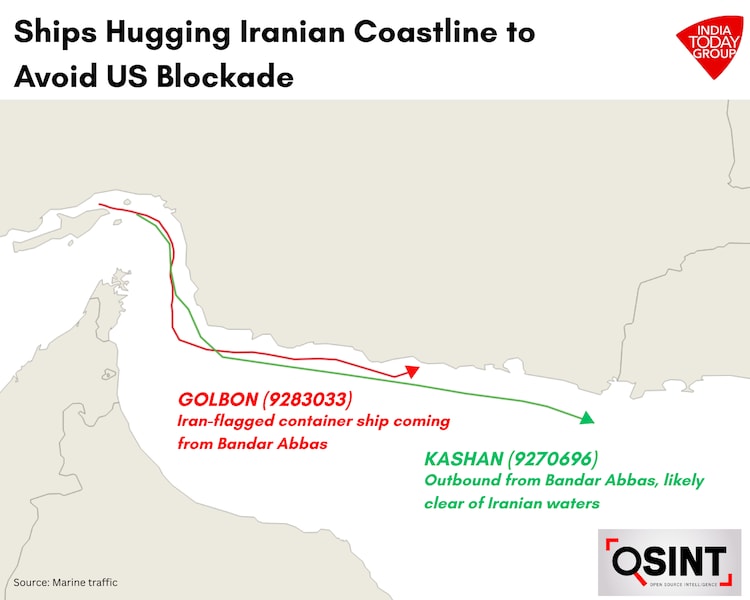
Vessel tracking data also shows multiple ships hugging the Iranian coastline to bypass the US blockade.
Two of these are sanctioned container ships, Kashan (IMO 9270696) and Golbon (IMO 9283033), both heading outbound.
Martin Kelly, Head of Advisory at EOS Risk Group, notes that Golbon was used to transport sodium perchlorate, a key component in solid rocket propellants, from China to Iran in February 2025. He adds, “The blockade is having a limited effect. Multiple ships have turned around and remained in the Strait of Hormuz or Arabian Gulf, while others are staying close to Iran during outbound transit. At least Kashan and Golbon fit the bill, so it is now up to Trump to determine whether the blockade has an enforcement component or not.”
Why does this appear confusing?
There is a tendency to think everything should happen in real time, like air strikes or ground operations. People also assume enforcement will take place right at the narrowest point of the Strait. That is not how it is playing out.
At sea, timelines look different. The perception of speed is not the same as on land or in the air. Many observers see vessels crossing the central stretch of the Strait of Hormuz and assume the blockade has failed. That is not necessarily correct.
The US Navy does not need to operate inside the Strait to enforce the blockade. It can remain in relatively safer waters, in the Gulf of Oman or even further out in the Arabian Sea, and wait. Once vessels exit the Strait and move into open waters, they become easier and safer to intercept.
This means that even 12 to 24 hours after a ship has crossed the Strait, it can still be stopped, boarded, or turned back. From what can be inferred, this is likely the approach being followed.
So while some Iran-linked vessels may appear to have crossed the Strait, the more important metric is how many of them have actually managed to continue onward into the Gulf of Oman or the Arabian Sea for further travel. By that measure, the number still seems to be effectively zero.
This aligns with what CENTCOM has indicated earlier, that the blockade is targeted and applies specifically to Iran-linked vessels, not to all maritime traffic.
The confusion also arises when vessels turn off their Automatic Identification System (AIS), as it allows them to hide and manipulate their location.
However, it is not possible to conclusively determine the outcome of steps taken in such a broader conflict within 48 hours. In this case, assessing the impact of the US blockade on the wider conflict cannot yield any definitive conclusions at this stage.
Another Confidence Building Measure?

On Tuesday, commercial flight tracking data picked up by India Today’s OSINT team showed an Iranian aircraft with the call sign IRAN09 landing in Colombo. Data from Flightradar24 identified it as an Airbus A300B4-622R operated by Meraj Airlines, the same Iran-based carrier that had earlier flown the Iranian delegation led by Foreign Minister Abbas Araghchi and Parliament Speaker Mohammad Bagher Ghalibaf to Islamabad last week for high-level talks with the US side led by Vice President JD Vance.
The aircraft can carry roughly 250 passengers. The call sign IRAN09 is interesting because such designations are usually reserved for the movement of senior government officials. For context, the aircraft carrying Araghchi and Ghalibaf last week reportedly used call signs IRAN05 and IRAN06. By that logic, IRAN09 likely indicates another high-ranking official, possibly ninth in protocol, though that remains speculative.
A day later, on Wednesday, Sri Lankan publication Daily Mirror reported that Sri Lanka had repatriated around 240 Iranian naval personnel who had been stranded in the country. This reportedly included 32 sailors rescued from the Iranian naval vessel IRIS Dena, which was sunk by a US submarine, and another 204 personnel from the supply ship IRIS Bushehr.
Sri Lanka found itself in a tricky wartime position here. It was not entirely clear how Washington would have viewed the transfer of these personnel back to Iran in the middle of an active conflict. The fact that this movement went on during the ceasefire amid reports of a fresh round of peace talks suggests some level of quiet understanding, or at least tacit acceptance.
Another detail worth noting is that the flight used Indian airspace and then stopped broadcasting public tracking signals once it exited towards the west. That is not unusual for sensitive or government-linked flights, but in the current context, it does add another layer of intrigue.
Taken together, the episode can be read as a small but meaningful signal. Whether it was purely logistical or also a subtle confidence-building step between sides is open to interpretation, but it does indicate that backchannel coordination has not completely broken down despite the ongoing hostilities.
- Ends
Published By:
bidisha saha
Published On:
Apr 15, 2026 18:33 IST
Tune In