1 hour ago
State pension set to rise by 3.9% after wage growth data
The UK state pension is set to rise by 3.9% next year, it appears, following today’s wage growth figures.
Under the triple-lock system, pensions rise by the highest of average earnings, inflation, or 2.5%.
So today’s data showing that total pay rose by 3.9% over the last year is likely to be the figure used to set the pension increase (unless we get a surge of inflation in September’s data to 4% or higher).
Assuming, of course, that the government continue to stick with the triple-lock – as there are calls to suspend it.
Jon Greer, head of retirement policy at Quilter, says:
“Today’s earnings figures show wage growth running at 3.9%, which puts a State Pension increase of a similar magnitude firmly on the cards next April under the triple lock.
“If confirmed, this would see the full New State Pension rise to over £13,000. While we will need to wait for September’s inflation figure before the uprating mechanism is formally confirmed, inflation is currently expected to remain below earnings growth, making an earnings-led increase the most likely outcome.
“For pensioners, another above-inflation increase will be welcome news and reflects the success of the triple lock in strengthening the value of the State Pension over time. The State Pension remains a crucial source of retirement income for millions of people and continues to provide the foundation upon which many build the rest of their retirement plans.
Key events
Pensioners, and the rest of Britain’s households, will be relieved to hear that gas prices have dropped today.
The month-ahead UK gas price is down 4% at 197.22p a therm, away from yesterday’s highs – when gas hit the highest since December 2022.
Energy prices had been climbing in recent fears, amid disappointment over the lack of progress towards ending the US-Iran war.
Bloomberg Economics reported this morning that UK household energy bills are poised to jump by about 25% in January, based on the increase in wholesale energy prices recently….
Money saving expert Martin Lewis reports that the government has confirmed it will stick to its pledge that the state pension will not incur tax, even once it rises over the tax-free personal allowance.
Lewis has posted on X that he’d received a statement from pensions minister Torsten Bell, which says:
“In line with the commitment made at Budget 2025, pensioners who only just the exceed the personal allowance will not have the administrative burden of paying small amounts of tax in this Parliament.
“The chancellor will set out further details on how that commitment will be delivered at the Budget.”
Former Liberal Democrat pensions minister Sir Steve Webb has warned that the government’s pledge that pensioners whose sole income is the state pension would not pay tax is “a mess”.
Webb, now a partner at consultants LCP, warned the Government’s move to create a “tax amnesty” for pensioners will only protect one in 16 retirees, saying:
“Those on the new state pension can expect to see an increase of nearly £500 per year next April.
“But the sting in the tail is that this will take the standard rate of the new state pension above the tax threshold.
“The Government’s plans to address this point are a mess, and likely to benefit only a small fraction of pensioners.
“They will also create unfairness between different groups of pensioners and between pensioners and low-paid workers, who do not qualify for any exemption.”
Over in Paris, France’s central bank chief and finance minister have insisted they are not worried that demand for French government debt is waning.
Speaking after the recent jump in global bond yields, officials said France’s debt issuance is assured.
“French debt is very attractive, and investors are buying our securities and demanding more than we are offering, so there are no concerns about the financing of the state,” Bank of France Governor Emmanuel Moulin said after a meeting of the country’s financial stability council.
Speaking alongside the central banker, Finance Minister Roland Lescure said the treasury has already completed 85% of this year’s issuance program, adding that the broader financial sector is “resilient.”
RBC BlueBay: this is a very weak employment report beneath the surface
Today’s UK jobs report is “very weak” beneath the surface, warns Mike Bell, head of market strategy for RBC BlueBay.
Today’s UK jobs data is much weaker below the surface than the headline number suggests. The headline data is being hugely flattered by a surge in admin and support service and education jobs. The vast majority of private sectors are shedding jobs. The cumulative decline in employment from the peak in some sectors is becoming quite alarming.
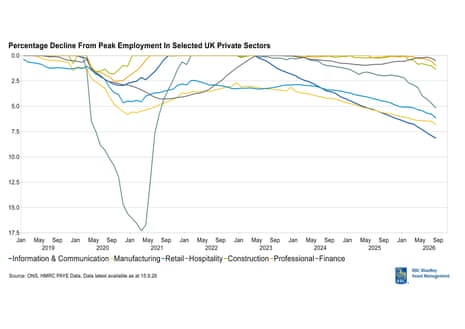
Bell adds:
Also of concern is that employment in professional services and construction is now starting to decline along with the longstanding weakness in sectors like retail, hospitality, manufacturing and tech. The decline in employment is broad based across regions too.
The government’s policy that pensioners whose only income is the state pension won’t pay tax creates “an unusual divide”, says Ian Futcher, financial planner at Quilter:
With the state pension set to rise over the tax-free personal allowance next year, Futcher says:
Someone relying solely on the State Pension will be protected from paying tax, while a pensioner who has built up even a relatively modest private pension could still find themselves facing a tax bill.
After spending decades encouraging people to save for retirement, the system risks creating a cliff edge where those who have made additional provision can be treated less favourably than those relying entirely on the State Pension.
School uniform spending drops in cost of living squeeze

Julia Kollewe
Parents and carers in Great Britain spent 12.5% less on school uniform in the run-up to the start of this academic year, turning to promotions and second-hand items to keep expenses down as families struggled with the cost of living crisis.
The average spend on school uniform was £54.53 in the four weeks to 6 September, down an eighth from £62.29 in the same period last year, according to the market research company Worldpanel by Numerator. Overall grocery inflation picked up to 2.3% from 2.1%.
The monthly report also showed that branded goods outpaced supermarkets’ cheaper own-label items for only the second time in the past year, with sales up 3.7% compared to 2.9% growth for own label – a reversal of a pattern that has defined much of this year. Despite this shift, shoppers have kept a strong appetite for promotions. Spending on grocery deals rose by £243m, or 7% year on year, significantly outstripping full-price sales growth of just 1.4%.
Grocery-only sales at Marks & Spencer jumped 14.8% year on year, measured by till spend, i.e. the value of sales (so also reflecting price rises).
Sales at Asda rose by 0.1% over the 12 weeks to 6 September, as the grocer returned to growth for the first time since March 2024. However, the Leeds-based retailer’s market share dipped to 11.5%, with a higher share of 16% in the north of England. It outperformed the market in areas such as hot drinks, ice cream and chilled poultry.
The online grocersupermarket Ocado, with sales up by 13.3%, remained the fastest -growing grocer overall, used by 4.4% of households, with a slightly higher market share of 2.2%. Lidl moved up to 8.7% of the market, from 8.3% a year ago. Sales rose by 8%, lifted by strong performance across confectionery, soft drinks and fresh produce.
Sales at Sainsbury’s were 2.9% higher than last year. The UK’s second largest grocer was just ahead of and Morrisons, where till spend rose by 2.8%, and the two supermarket chains maintained their previous market share of 15.2% and 8.4%, respectively.
At Tesco, the UK’s largest supermarket, sales rose by 1.7%, but its market share dipped to 27.8% from 28.1%. The German discounter Aldi’s sales edged 0.7% higher, giving it a slightly lower market of 10.6% share.
Sales at the Co-op were up by 2.9%, with market share flat at 5.5%. Waitrose sales grew by 2.8%, with its market share also stable, at 4.5%.
European markets in the red as US Treasury 10-year yield rises over 5%
European stock markets are in the red this morning, as investors fret about the ongoing sell-off in the bond market and the rising oil price (the two are linked!).
Britain’s FTSE 100 share index has lost 90 points, or 0.85%, to 10,606 points this morning.
Germany’s DAX and France’s CAC 40 are both down around 0.7%.
Neil Wilson, investor strategist at Saxo UK, says “Financials and miners are bearing the brunt in Europe, while AI stocks are down across Asia and the US.”
Investors seem rattled that the US 10-year Treasury yield has risen over 5% this week.
Wilson adds:
The US Treasury 10-year yield broke 5% for the first time since 2023 on Monday and advanced to a 19-year high as it touched 5.03% this morning...is this the point at which markets break?
5.25% is really when it gets dicey. Markets are pricing in a 93% chance the Fed hikes rates this week. While there are lots of reasons behind the bond rout, BMO says Treasury yields and oil prices haven’t been this closely correlated for seven years.
Today’s jobs report also shows that the retail and hospitality sector continued to lose jobs over the summer.
The British Retail Consortium has calculated that there are 122,000 fewer jobs in retail than two years ago, which will limit job opportunities for young people.
Stephen Evans, chief executive at Learning and Work Institute (L&W), explains:
“Headline stability in the job stats masks two underlying and related challenges. The first is that one million young people are not in education, employment or training, risking long-term harm to their career prospects. Ramping up efforts to change that can’t wait.
The second is the stalling of job growth in parts of the private sectors like retail and hospitality, down 150,000 payroll jobs since last year. This limits first job opportunities for young people and reflects underlying economic weakness that ongoing international uncertainty won’t help.
The employment rate is relatively high by international standards, but risks trending in the wrong direction with 3.9 million people not in work but saying they want a job.”
The drop in company vacancies over the last few months suggests demand for workers is weakening, warns Suren Thiru, chief economist at the Institute of Chartered Accountants in England and Wales:
“The ongoing drop in vacancies should set alarm bells ringing for the jobs market, as it suggests that demand for workers is wilting under the weight of soaring staffing costs, onerous regulation and increased automation.
“The UK labour market could be heading for a rockier autumn, as rising energy bills and pre-Budget tax uncertainty increasingly curb hiring intentions, resulting in moderately higher unemployment and lower pay growth.
The debate over the triple lock is set to be reignited by today’s news that the state pensions could rises by 3.9% next year.
So predicts Susannah Streeter, chief investment strategist at Wealth Club:
Pay growth is cooling, with regular earnings growth (including bonuses) easing to 3.9%, but that is hardly enough to make the inflation problem disappear. This snapshot points to a 3.9% rise in the state pension next April under the triple lock, with average earnings growth, the measure used for the calculation, being pushed higher by particularly strong public sector pay growth. Public sector pay is running at 6.3%, more than twice the 2.9% pace in the private sector, which reflects the impact of pay awards and the timing of them.
That’s likely to reignite the debate around the triple lock, particularly when government debt is already so high, and the cost of servicing it is painfully expensive. It may be even more controversial given that a pay measure which has been boosted by public sector wage awards is helping drive up the state pension bill at the same time as the government is already under pressure to contain spending and borrowing.
US government borrowing costs hit 19-year high
The bond market sell-off is continuing this morning, although the UK is avoiding the worst of it.
US government bonds, or Treasuries, are weakening, which is driving up the yield (or interest rate) on 10-year bonds back over 5% to the highest level since 2007.
UK bond yields are only slightly higher. They might be being suppressed by reports that the Bank of England will halt its sale of long-dated government bonds later this week.
That “quantitative tightening” programme has been blamed for boosting supplies of bonds in the market, pushing up yields.